
Can You Build a Garden Room with No Side Access? Here’s How We Recently Did It in Surrey
Think your garden is impossible to access? Discover how our latest Surrey garden room project demonstrates that limited access doesn’t always mean limited possibilities.
One of the first things many homeowners say when they contact us isn’t about the size of the cabin or how much it costs.
Instead, it’s usually something like:
“I don’t think you’ll be able to get it into the garden.”
Perhaps there’s no side gate.
Maybe your property is terraced.
Perhaps the access is narrow, or neighbouring fences leave very little room to manoeuvre.
Many people assume that because a garden room is a substantial structure, it must arrive in one huge piece.
Fortunately, that’s rarely the case.
A recently completed project in Surrey perfectly demonstrates why limited access is often far less of an obstacle than homeowners imagine.
Quick Answer
Can a garden room be built if there’s no side access?
In many cases, yes.
Unlike some pre-manufactured buildings that rely on large factory-built sections being craned into position, our garden rooms are constructed on site using Structural Insulated Panels (SIPs).
This means materials can often be carried through side passages, through the house or, where appropriate, by temporarily removing fence panels.
Every property is different, but restricted access is rarely the deal-breaker many people assume it will be.
Why Access Worries So Many Homeowners
It’s completely understandable.
When people picture a garden room being installed, they often imagine:
Huge wall sections arriving on articulated lorries.
Large cranes lifting buildings over houses.
Extensive disruption to neighbouring properties.
Major landscaping work before construction can even begin.
In reality, many bespoke garden rooms are built very differently.
The construction method plays a huge role in determining how easily materials can be transported to the garden.
How We Build Our Garden Rooms
At Backyard Cabins, our buildings are constructed on site using high-performance 97mm Structural Insulated Panels (SIPs), featuring a continuous 75mm polyurethane insulation core.
Rather than transporting one enormous building to your property, individual structural components are carefully brought to site before being assembled into the finished cabin.
This approach offers several advantages.
It makes transportation significantly more manageable.
It allows us to work in gardens with restricted access.
It also enables us to maintain an exceptionally high standard of finish throughout the build.
Every project is carefully planned around the individual property rather than expecting every garden to suit a standard construction process.
A Real Project in Surrey
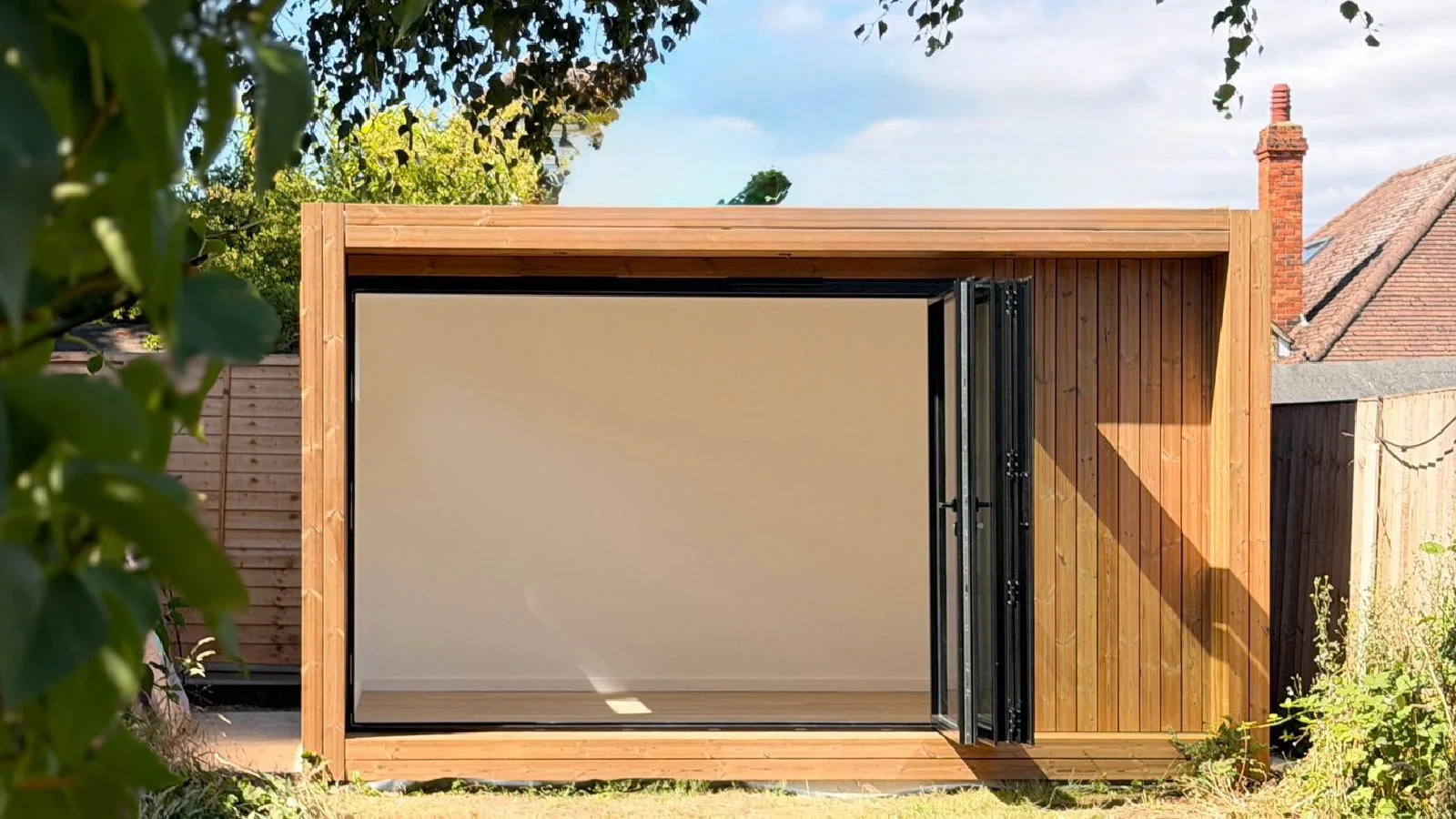
Our latest FORZA garden room project in Surrey is a perfect example.
The client wanted a dedicated home office that could also become a quiet study space for their daughter as she prepares for her GCSE examinations.
The garden already contained an existing concrete base, making it an ideal starting point for the project.
Access was available via the neighbouring property, allowing materials to be transported efficiently.
However, even without that access, alternative solutions were available.
Depending on the property, materials can often be taken through the house or by temporarily removing fence panels where appropriate.
It’s exactly why we always recommend discussing your property before assuming a garden room isn’t possible.
Every Garden Is Different
No two gardens are the same.
Some have:
Narrow side passages.
Terraced layouts.
Existing patios.
Mature landscaping.
Sloping ground.
Limited working space.
These aren’t unusual situations.
In fact, they’re something we encounter regularly.
Rather than looking for reasons why a project can’t be completed, we focus on finding the most practical way to make it work.
Sometimes that means adjusting the installation sequence.
Sometimes it means changing how materials are transported.
Sometimes it simply means careful planning before work begins.
Building During a Summer Heatwave
This particular project was completed during one of the hottest spells of the year, with temperatures reaching around 35°C.
Working in those conditions requires flexibility.
Rather than exposing materials unnecessarily to direct sunlight throughout the day, sections of the external cladding were prepared under cover before being installed onto the cabin.
This approach offered several advantages.
It improved efficiency.
It allowed greater accuracy during assembly.
It reduced unnecessary exposure to the hottest conditions.
Most importantly, it helped us maintain the quality standards we expect on every build.
Why Preparation Makes Such a Difference
People often think building a garden room is simply a case of arriving on site and fixing everything together.
The reality is very different.
Good preparation speeds up installation while also improving quality.
By carefully preparing components before installation, we can spend more time focusing on precision, alignment and finishing details once they reach the building itself.
Many of the small details homeowners notice in the finished cabin are the result of careful planning long before the final boards are fixed into place.
Designed for More Than Just Work
Although this cabin has been built primarily as a home office, it has also been designed with flexibility in mind.
During the working week it provides a quiet, professional workspace away from the distractions of the main house.
Outside working hours it becomes a comfortable study room, giving the family’s daughter a peaceful environment for GCSE revision.
As life changes, the space can continue to evolve.
A home office today might become a hobby room, creative studio, treatment room, home gym or simply somewhere to relax tomorrow.
That’s one of the biggest advantages of investing in a properly insulated garden room.
What’s Left Once We Finish?
Another common misconception is that homeowners need to coordinate numerous trades after the cabin has been built.
In reality, almost everything is completed before handover.
The cabin includes:
First-fix electrics.
Internal consumer unit.
Integrated lighting.
Double sockets.
Finished plastered and painted interior.
Luxury LVT flooring.
The only remaining step is for the client’s qualified electrician to connect the cabin to the property’s electrical supply.
Once that’s complete, the garden room is ready to enjoy.
Don’t Rule Your Garden Out Too Quickly
Over the years we’ve visited many properties where the homeowner’s first words were:
“I don’t think it’ll fit.”
More often than not, it does.
Limited access doesn’t automatically prevent you from building a beautiful, fully insulated garden office.
Every property presents its own challenges, but with careful planning, flexible construction methods and the right design approach, many gardens are far more suitable than people initially believe.
The best way to find out is simply to ask.
You might be surprised by what’s possible.