
Can You Put a Toilet or Shower Room in a Garden Room? A Practical UK Guide
A toilet or shower can be incorporated into a custom garden room, but it needs careful planning. Discover what is possible and who is responsible for the plumbing, drainage and approvals.
Yes, it is possible to incorporate a toilet, shower room or bathroom into a garden room.
However, it needs to be planned properly from the beginning. Water supply, hot water, drainage, ventilation, waterproofing and Building Regulations may all need to be considered before construction starts.
At Backyard Cabins, we can design and build a custom garden room with space for a toilet or shower room. Depending on the agreed specification, we may also be able to complete elements such as internal partitions, tiling and the fitting of selected bathroom items.
We do not carry out the plumbing, water connection or external drainage work. These parts of the project must be completed by suitably qualified contractors appointed separately by the customer.
If you are considering a garden office with a toilet, a garden gym with a shower or a flexible room for guests, this guide explains what you need to know.
Quick answer: can a garden room have a toilet or shower?
A garden room can have a toilet, sink, shower or complete shower room, provided the necessary services can be installed safely and legally.
The project will normally require:
A suitable water supply
A foul-water drainage solution
Hot water if a shower or hot tap is required
Appropriate ventilation
Waterproof finishes in wet areas
Safe electrical installations
Consideration of Building Regulations
Confirmation that the intended use complies with planning requirements
The earlier these requirements are discussed, the easier it is to design the room around them.
If you already know that you want bathroom facilities, tell your garden room designer before the layout and foundations are finalised. Retrofitting plumbing and drainage after the room has been built can be more disruptive and expensive.
Why add a toilet or shower to a garden room?
A toilet or shower can make a garden room considerably more practical, particularly when it is positioned some distance from the main house.
A garden office with a toilet reduces interruptions during the working day. A shower can make a garden gym more convenient, while bathroom facilities can also support a treatment room, creative studio or flexible guest space.
Customers commonly consider bathroom facilities for:
Garden offices used throughout the working day
Home gyms and yoga studios
Treatment and therapy rooms
Hair, beauty or wellness spaces
Music and creative studios
Entertainment rooms
Poolside rooms
Occasional guest accommodation
Larger multifunctional garden rooms
The right arrangement depends on how the room will be used. A compact cloakroom may be sufficient for an office, while a gym or wellness room may benefit from a properly designed shower area.
Toilet, shower room or full bathroom: what do you actually need?
Before designing the room, it helps to decide which facilities are genuinely necessary.
A compact toilet and sink
A small cloakroom containing a toilet and hand basin usually requires the least internal space. It can be a sensible choice for a garden office, studio or treatment room.
Even a small cloakroom still requires water, waste drainage, ventilation and appropriate electrical planning.
A shower room
A shower room normally includes a shower, toilet and hand basin. This is particularly useful in a garden gym, wellness studio or poolside building.
It requires more careful planning because the room needs waterproof surfaces, effective ventilation, hot water and suitable drainage for both the toilet and shower.
A full bathroom
A full bathroom may include a bath as well as a toilet, basin and shower. It requires more floor space and potentially a greater hot-water capacity.
For most garden rooms, a compact shower room is more practical than a traditional bathroom. However, because many of our cabins are custom designed, the layout can be developed around your priorities and available garden space.
Explore our garden room models, sizes and prices to see the starting point for your project. Existing models can be adapted, or we can design a completely custom room.
How does plumbing work in a garden room?
A garden room with a toilet or shower normally needs a water supply from the main property and a suitable way to carry wastewater away.
The feasibility and cost will depend on factors including:
The distance between the house and the garden room
The location of the property’s existing water supply
The position and depth of the existing foul drain
The level of the garden
Access for excavation
Whether wastewater can flow using gravity
Whether a pumping system may be required
The route pipes need to take around existing buildings or landscaping
The simplest solution is often a conventional connection to the property’s existing foul drainage system. Whether this is possible must be assessed by an appropriate drainage specialist or plumber.
If the garden room is far from the main house or sits below the level of the existing drains, an alternative solution may need to be considered. A qualified contractor should recommend the right approach for the individual property.
Approved Document H provides the official guidance covering foul-water drainage and waste disposal in England. Any flushing toilet must discharge into an adequate drainage system. You can read the current government guidance on drainage and waste disposal.
Who completes the plumbing and drainage?
Backyard Cabins designs and constructs the garden room itself.
We can incorporate the necessary internal space, partitions and agreed finishing details into the cabin design. Depending on the individual project, we may also be able to undertake tiling and fit selected bathroom items.
We do not complete plumbing, water connections or external drainage work. The customer will need to appoint suitably qualified contractors for these services.
This division of work should be discussed before construction begins so that everyone understands:
Where water and waste pipes will enter the building
What preparation is required beneath the floor
When the plumber or drainage contractor needs access
Who will supply the toilet, shower, basin and fittings
What work will be completed by each contractor
When inspections or approvals may be required
We have completed several garden rooms that incorporate toilets or bathrooms, with the plumbing and drainage completed separately by the customer’s appointed specialists.
Should the toilet or shower be planned before the cabin is built?
Yes. This is one of the most important pieces of advice in this guide.
If bathroom facilities are part of your plan, they should be included in the initial design rather than treated as a future addition.
Early planning allows us to consider:
The best location for the bathroom
Internal wall positions
Door access and privacy
Pipe entry points
Floor construction
Ventilation
Lighting and electrical positions
Waterproof finishes
The effect on the remaining usable space
Access for the plumber and drainage contractor
Good planning also prevents pipes or fittings from being positioned where they conflict with structural elements, doors, windows or furniture.
If you would like to understand how the main room will be constructed, read our guide to what is included with every Backyard Cabin.
Does a garden room with a toilet need Building Regulations approval?
Bathroom facilities can introduce Building Regulations considerations even where the garden room itself might otherwise qualify for an exemption.
Building Regulations and planning permission are separate matters. A project may not require planning permission but could still need Building Regulations approval for specific parts of the work.
Relevant areas can include:
Sanitation and hot-water safety
Foul-water drainage
Ventilation
Electrical safety
Moisture resistance
Structural work
Energy efficiency
Government Approved Document G covers sanitation, washing facilities, hot-water safety and water efficiency. Approved Document H covers sanitary pipework and foul-water drainage.
Small detached outbuildings without sleeping accommodation may sometimes be exempt from Building Regulations, depending on their size, construction and position. However, you should not assume that the same exemption automatically covers new plumbing and drainage work.
The safest approach is to speak to your local authority’s building control team or an approved building control provider before work begins. Your plumber and drainage contractor should also be able to explain which parts of their work require notification, inspection or approval.
This article provides general information for properties in England. It is not a substitute for advice about your individual property.
Do you need planning permission for a garden room with a toilet?
Adding a toilet does not automatically mean that planning permission will be required. The deciding factors include the building’s size, height, position and intended use.
Many garden rooms used for purposes incidental to the enjoyment of the main house can be built under permitted development rights, provided all the relevant conditions are met.
However, permitted development rights do not cover a garden room used as separate, self-contained living accommodation.
This distinction is important. A garden office with a convenient toilet is not necessarily the same as an independent dwelling containing facilities for sleeping, washing and preparing food.
Planning permission may be more likely to be required if:
The room will be used as separate living accommodation
It includes sleeping facilities as part of an independent unit
Its use is no longer incidental to the main house
It will be used for a business that creates additional visitors, traffic or disturbance
The building exceeds permitted development limits
The property is listed
The garden is within a conservation area or other designated land
Previous planning conditions restrict development
Permitted development rights have been removed
The Planning Portal confirms that outbuilding permitted development rights do not cover separate, self-contained living accommodation. Check the current Planning Portal guidance for outbuildings and speak to your local planning authority if you are uncertain.
You can also read our detailed guide to garden room planning permission in England.
Can a garden room with a bathroom be used as a bedroom?
This is where the purpose of the building becomes particularly important.
A garden room used as an office, gym or family space, with a toilet for convenience, is different from a self-contained residential annexe.
Adding a bathroom, sleeping area and kitchen facilities may indicate that the building is intended to operate as a separate home. That can materially change the planning and Building Regulations position.
If you are considering regular sleeping accommodation or a self-contained annexe, seek advice from your local planning authority and building control before agreeing the design.
Be clear about the intended use from the outset. Trying to describe a self-contained annexe as an ordinary garden room could result in planning, compliance and property-sale problems later.
What needs to be considered when adding a shower?
A shower creates more moisture than a toilet and hand basin, so the room needs to be designed as a genuine wet area.
Important considerations include:
Waterproof wall and floor finishes
Sealing around the shower tray or wet-room area
Mechanical extraction
Moisture-resistant materials
Adequate hot-water provision
Safe placement of sockets, switches and lighting
Suitable drainage capacity
Access for future maintenance
Heating and frost protection
Ventilation is particularly important. Without effective extraction, persistent moisture can lead to condensation, mould and damage to finishes.
Electrical work in or near a shower room must also be designed and completed correctly. Bathroom electrical installations are subject to specific safety zones and requirements, so this work should be undertaken by a suitably qualified electrician.
How is hot water supplied to a garden room?
If you only need a toilet and cold-water hand basin, the system may be relatively straightforward. If you want hot water for a basin or shower, you will need an appropriate hot-water solution.
Possible options may include:
A supply from the main house
A compact electric water heater
An instantaneous water heater
Another system recommended by the appointed plumber
The right choice depends on the distance from the house, available electrical capacity, expected water use and number of fittings.
A shower normally needs a more capable supply than a small hand basin. Ask your plumber to assess the required water pressure, flow rate and hot-water capacity before purchasing fittings.
How much does it cost to add a toilet or shower to a garden room?
There is no reliable one-price answer because every garden and drainage arrangement is different.
The total cost can be affected by:
The size of the bathroom area
The number and quality of fittings
Tiling and waterproofing requirements
The distance from the main house
Ground conditions
Drain depth and location
Excavation and reinstatement
Whether a gravity-fed drain is possible
Whether a pumping system is required
Hot-water equipment
Ventilation
Electrical work
Building control fees
The amount of customisation required within the cabin
A small cloakroom positioned close to accessible services is likely to be less complex than a shower room at the far end of a large garden.
For this reason, bathroom and service costs should be assessed separately from the price of the garden room. Backyard Cabins can provide a quotation for the cabin and the work included within our agreed scope. Your plumber and drainage contractor should quote separately for their parts of the project.
Our complete garden rooms currently start from £18,540 including VAT. See our garden room range and VAT-inclusive prices for standard sizes, specifications and bespoke options.
Is it better to choose a custom garden room?
A custom design is often the best solution when a toilet or shower room is required.
A bathroom occupies valuable internal floor space. Simply placing it inside a standard rectangular room can leave awkward corners or reduce the usability of the main area.
With a custom design, we can consider:
The proportions of the bathroom and main room
The best route for services
Privacy and door placement
Natural light
Furniture positions
Separate zones for work, exercise or relaxation
Additional windows
Internal storage
The relationship between the cabin and the garden
How the exterior will look from the house
Many Backyard Cabins projects are custom built. We can adjust one of our existing models or develop a cabin around your particular garden, intended use and preferred layout.
You can view examples of our workmanship in our completed garden room gallery.
What is included with the garden room?
Every Backyard Cabin is designed as a complete, fully finished room for year-round use.
Our standard specification includes:
A fully insulated SIPs structure
Insulated walls, floor and roof
Premium external cladding
Aluminium double-glazed doors and windows
A durable EPDM roof
Luxury vinyl flooring
A plastered and white-painted interior
Skirting boards
Internal and external lighting
Electrical sockets and a dedicated consumer unit
A WiFi-controlled electric radiator
Professional installation
Removal of installation waste
A 10-year structural warranty
Bathroom facilities, plumbing, water connections and drainage are not included as standard.
Where a toilet or shower room is requested, we will discuss what can be incorporated into our part of the project. The responsibilities of Backyard Cabins and the customer’s appointed contractors will be clearly agreed before work begins.
Our recommended order for planning the project
If you are considering a garden room with a toilet or shower, the following order can help avoid unnecessary changes and delays.
1. Decide how the room will be used
Be clear about whether you want an office, gym, treatment room, guest space or multifunctional room. Tell us if anyone will sleep in the building or if it could become self-contained accommodation.
2. Arrange an initial garden room consultation
We can discuss the space, preferred size, cabin design and how a toilet or shower room might fit within the layout.
3. Speak to a plumber and drainage specialist
Ask suitably qualified contractors to assess the water supply, foul drainage, hot-water requirements and proposed service routes.
4. Check planning and Building Regulations requirements
Confirm the position with the local planning authority and building control where necessary. This should happen before construction, not after the bathroom has been installed.
5. Finalise the cabin and bathroom layout
Once the service requirements are understood, we can agree the room dimensions, partitions, doors, windows and relevant finishes.
6. Agree who is responsible for every part of the work
The quotation and project plan should state who will complete the cabin, plumbing, drainage, electrical connection, tiling and installation of individual bathroom fittings.
Talk to us about a custom garden room
A toilet or shower can turn a garden room into a much more convenient and versatile space, but successful projects depend on good planning.
Backyard Cabins can design and build a high-quality, fully insulated garden room around the way you want to use it. We can create the room and incorporate space for bathroom facilities, while your separately appointed specialists complete the plumbing, water and drainage connections.
Based in Wokingham, we build garden rooms across Berkshire, London, Oxfordshire, Surrey and Wiltshire.
Explore our garden room models and prices, or contact Backyard Cabins to discuss a custom design.
Frequently asked questions
Can you put a normal flushing toilet in a garden room?
Yes, provided it is connected to a suitable water supply and an adequate foul-water drainage system. The proposed connection should be assessed and installed by suitably qualified contractors.
Can a garden office have a toilet?
Yes. A compact toilet and hand basin can make a garden office much more convenient. It should be included in the initial design so that the internal layout, services, ventilation and approvals can be considered properly.
Can you put a shower in a garden room?
Yes. A shower requires hot and cold water, drainage, waterproofing, ventilation and appropriately installed electrics. A garden gym or wellness room can be designed with a separate shower area.
Does Backyard Cabins complete the plumbing?
No. Backyard Cabins builds the room and can incorporate the required internal space and agreed finishes. Customers must appoint suitable contractors to complete the plumbing, water connection and drainage work.
Can Backyard Cabins tile the bathroom?
Tiling may be included as part of an individually agreed custom project. This should be discussed during the design and quotation process.
Does a garden room with a toilet need planning permission?
Not automatically. It depends on the building’s dimensions, position, intended use and the property itself. A toilet provided for convenience is different from creating separate, self-contained living accommodation. Always check your individual circumstances.
Does the plumbing need Building Regulations approval?
New or altered drainage, sanitation, hot-water and electrical work may be subject to Building Regulations. Speak to building control and use suitably qualified contractors before starting work.
Can a garden room bathroom be added later?
It may be possible, but planning it before construction is usually easier and more cost-effective. Retrofitting can involve lifting floors, altering walls and excavating completed landscaping.
How much space does a garden room toilet need?
The space required depends on the fittings, door position, access and intended use. A compact cloakroom requires less room than a shower room. A custom layout can help use the available floor area efficiently.
Can a garden room with a bathroom be used as an annexe?
Potentially, but using the building as separate living accommodation changes the planning and compliance considerations. Obtain advice from the local planning authority and building control before designing or using it as an annexe.
Important information
This article provides general information for garden room projects in England and was last reviewed in July 2026.
Planning requirements, Building Regulations and individual site conditions vary. The information here does not constitute legal, planning, drainage or Building Regulations advice.
Before starting work, confirm the requirements for your property with your local planning authority, building control and appropriately qualified contractors.
Do You Need Planning Permission for a Garden Room? The Complete 2026 Guide (England)
Planning permission is one of the biggest concerns for anyone considering a garden room. This comprehensive guide explains Permitted Development rights, Building Regulations, conservation areas, Article 4 Directions, listed buildings, business use and other common questions to help you understand the rules before starting your project.
Last reviewed: July 2026
Important
This guide is intended as general information only and reflects our understanding of the planning system at the time of writing.
Planning legislation, permitted development rights and Building Regulations can change, and individual properties may be subject to additional restrictions, including Article 4 Directions, conservation areas, Tree Preservation Orders (TPOs), restrictive covenants and listed building status.
This article does not constitute legal, planning or Building Regulations advice. Before starting your project, we strongly recommend checking the latest guidance on the Planning Portal and GOV.UK, and confirming your individual circumstances with your local planning authority or a suitably qualified planning professional.
This guide relates to houses in England only. Planning rules differ in Wales, Scotland and Northern Ireland.
Quick Answer
One of the first questions almost every homeowner asks us is:
“Do I need planning permission for a garden room?”
For many people, the answer is no.
Most garden rooms can be built under Permitted Development Rights, meaning you won’t usually need to submit a full planning application.
However, that doesn’t mean every garden room is automatically exempt.
Whether planning permission is required depends on factors such as:
where the building sits within your garden
its height
how much of your garden has already been developed
whether your property is listed
whether you live in a conservation area or another designated location
how you intend to use the building.
That’s why you’ll often hear conflicting advice online.
One website says planning permission is never needed.
Another says you should always apply.
The truth sits somewhere in the middle.
Most projects are straightforward, but there are enough exceptions that it’s worth understanding the rules before investing thousands of pounds into a garden room.
This guide explains the key points in plain English, helping you understand when planning permission is likely to be required and when it probably isn’t.
What Is Permitted Development?
Permitted Development Rights are national planning rules that allow certain types of building work to take place without making a full planning application.
They were introduced to simplify smaller household projects and avoid unnecessary paperwork for straightforward developments.
Garden rooms often fall within these rights, provided they meet the relevant criteria.
That doesn’t mean there are no rules.
Instead, it means the Government has already decided that certain types of development are acceptable without requiring formal planning permission.
As long as your proposed garden room stays within those limits, a planning application is not normally required.
When Can I Build a Garden Room Without Planning Permission?
For many homeowners in England, a garden room can be built without planning permission if it complies with the Permitted Development rules.
Some of the key requirements include:
The building must be incidental to the enjoyment of the house (for example, a home office, gym, studio or hobby room).
It must not be positioned in front of the principal elevation (the front) of the original house.
If any part of the building is within 2 metres of a boundary, the overall height must not exceed 2.5 metres.
If the building is more than 2 metres from every boundary, the maximum overall height is generally 4 metres with a dual-pitched roof or 3 metres with any other roof type.
Outbuildings and extensions must not cover more than 50% of the land surrounding the original house.
Those are the national rules that apply to many properties in England.
However, they aren’t the whole story.
Some homes have additional restrictions that remove or limit Permitted Development Rights altogether, which we’ll come onto shortly.
Why So Many Garden Room Companies Oversimplify Planning Permission
One of the biggest myths in the garden room industry is that planning permission is simply about keeping a building below 2.5 metres.
Unfortunately, it isn’t that simple.
Height is only one part of the picture.
The location of the building, whether your property is listed, whether you’re in a conservation area, whether Article 4 Directions apply, how much of your garden has already been developed and even how you intend to use the building can all affect whether planning permission is required.
That’s why we never assume.
Every project starts by understanding your property and your plans before recommending the most suitable approach.
Sometimes the answer is straightforward.
Occasionally it isn’t.
A short conversation at the beginning of a project can often avoid far bigger problems later.
Does a Garden Room Count as an Extension?
No.
Although both add extra usable space, a garden room is generally considered an outbuilding, not an extension.
An extension forms part of the main house.
A garden room is a separate structure within the garden.
This distinction is important because different planning rules usually apply to each.
It’s one reason why many homeowners choose a garden room instead of extending their house.
When designed well, it can provide a dedicated home office, studio, gym or multi-purpose room with significantly less disruption than a traditional extension.
Garden Room or Garden Office, Is There a Difference?
Not really.
A garden office is simply one possible use for a garden room.
The planning system is generally more interested in how the building will be used than what it’s called.
For example, all of the following are commonly considered incidental uses:
Home office
Gym
Art or music studio
Treatment room
Hobby room
Garden lounge
Games room
Because many people now work remotely, “garden office” has become the phrase most homeowners search for.
In planning terms, however, it’s usually the building’s use—not its marketing name—that matters.
Does It Matter Where the Garden Room Sits in My Garden?
Yes.
Positioning can make a significant difference.
For example, Permitted Development generally doesn’t allow an outbuilding to be built forward of the principal elevation of the original house.
Similarly, height limits change depending on how close the building is to your property’s boundaries.
It’s one of the reasons we don’t believe in trying to squeeze a standard-sized cabin into every garden.
Sometimes moving a building slightly, adjusting its dimensions or designing something bespoke creates a much better outcome while also making it easier to comply with planning guidance.
At Backyard Cabins, that’s one of the first conversations we have with every client.
Standard Cabin or Bespoke Design?
Many people assume choosing a standard model makes planning simpler.
In reality, planning permission doesn’t depend on whether a garden room is standard or bespoke.
It depends on how that particular building sits within your garden.
Our standard cabin range is designed to provide inspiration and proven layouts, but many of the projects we build are completely bespoke.
Why?
Because every garden is different.
Rather than asking you to compromise by choosing the closest available size, we can design a garden room that works around your space, your lifestyle and your long-term plans.
Sometimes reducing the width by just a few centimetres or repositioning a window creates a far better solution than forcing a standard building into an awkward plot.
That’s one of the biggest advantages of building every cabin individually rather than mass-producing fixed designs.
Can You Sleep in a Garden Room?
This is probably one of the biggest areas of confusion.
Many people assume that because a garden room is insulated, heated and comfortable enough to spend long periods in, it can automatically be used as a bedroom.
Planning doesn’t quite work like that.
Garden rooms built under Permitted Development are generally intended to be incidental to the enjoyment of the house. In other words, they support the main home rather than becoming a separate home in their own right.
That means they’re commonly used as:
Home offices
Home gyms
Studios
Games rooms
Hobby rooms
Garden lounges
Occasionally having a guest stay overnight is very different from creating a self-contained living space.
If your intention is for somebody to live in the building permanently, or for it to function as an independent dwelling with sleeping, cooking and washing facilities, different planning rules are likely to apply.
If that’s your goal, it’s always worth discussing the proposal with your local planning authority before work begins.
Can I Run a Business From a Garden Room?
For many of our clients, this is exactly why they’re investing in one.
A garden room can make an excellent:
Home office
Architect’s studio
Design practice
Beauty or therapy room
Photography studio
Consultancy space
Online business headquarters
Simply working from a garden room doesn’t automatically mean planning permission is required.
In fact, millions of people now work from home, and using a garden room as a quiet office is often considered an incidental use of the property.
However, circumstances can change if your business begins to affect neighbouring properties.
For example, planning considerations may become more relevant if your business generates:
Frequent customer visits.
Regular deliveries by larger vehicles.
Additional staff working from the building.
Increased parking or traffic.
Noise or disturbance for neighbours.
Every situation is different, so if your business involves visitors rather than simply working quietly from home, it’s sensible to seek advice before proceeding.
Could I Have to Pay Business Rates?
This is something very few garden room companies talk about, yet it’s an important consideration for anyone planning to work from home.
In some circumstances, a garden room that is used exclusively for business purposes may be assessed for business rates.
Whether this happens depends on several factors, including how the building is used and whether it remains connected with normal domestic living.
Many home offices never encounter this issue.
However, if the building is dedicated solely to commercial activity, it’s worth discussing the position with both your accountant and your local authority before making any decisions.
It’s a good example of why planning, tax and business use should always be considered separately, they’re three different subjects with different rules.
Do Garden Rooms Need Building Regulations Approval?
One of the biggest misconceptions is that Planning Permission and Building Regulations are the same thing.
They’re not.
Planning Permission considers whether you’re allowed to build.
Building Regulations consider how the building is constructed.
Even if your garden room doesn’t require planning permission, Building Regulations may still be relevant depending on factors such as its size, construction and intended use.
In England, detached single-storey buildings are often exempt from Building Regulations where:
the internal floor area does not exceed 15m² and there is no sleeping accommodation; or
the internal floor area is between 15m² and 30m², there is no sleeping accommodation, and either the building is at least 1 metre from any boundary or it is constructed substantially from non-combustible materials.
Electrical work must still comply with the relevant electrical safety requirements.
If you’re unsure whether Building Regulations apply to your project, it’s always worth discussing the details with Building Control before construction begins.
Planning Permission and Building Regulations – What’s the Difference?
Although they’re often mentioned together, they’re completely separate systems.
Planning Permission considers things such as:
The building’s size.
Its position within the garden.
Its impact on neighbouring properties.
Its appearance.
Whether the development is acceptable.
Building Regulations focus on issues including:
Structural safety.
Fire safety.
Energy efficiency.
Electrical safety.
Ventilation.
Drainage where relevant.
A project may not require planning permission while still needing to comply with certain Building Regulations requirements.
Understanding the distinction can save a great deal of confusion later.
What If My Home Is Listed?
Listed buildings are treated very differently from most other homes.
If your property is listed, the normal Permitted Development rules generally do not apply in the same way.
Within the curtilage of a listed building, constructing a garden room will normally require planning permission, and additional listed building considerations may also apply depending on the circumstances.
If you own a listed property, we strongly recommend discussing your plans with your local planning authority before progressing any further.
What If I Live in a Conservation Area?
Living in a conservation area doesn’t automatically prevent you from building a garden room.
Many homeowners successfully install them.
However, conservation areas are subject to additional planning controls intended to protect the character and appearance of the area.
As a result, developments that would normally fall under Permitted Development elsewhere may require additional consideration.
If your property is located within a conservation area, it’s always worth checking the position with your local authority before making assumptions.
What Is an Article 4 Direction?
An Article 4 Direction allows a local authority to remove certain Permitted Development rights within a defined area.
They’re commonly introduced where councils want greater control over development, such as conservation areas or locations with particular architectural or historic significance.
If your property is affected by an Article 4 Direction, planning permission may be required for work that would normally be permitted elsewhere.
Many homeowners have never heard of Article 4 Directions until they begin researching a project.
Fortunately, your local authority can confirm whether your property is affected.
What About Tree Preservation Orders (TPOs)?
Mature trees can completely transform a garden, but they can also influence where a garden room can be built.
If your property contains trees protected by a Tree Preservation Order (TPO), or trees within a conservation area, additional permissions may be required before carrying out work that could affect them.
This doesn’t necessarily prevent a garden room from being built.
It simply means the design and foundations may need more careful consideration.
At Backyard Cabins, we always look at the whole garden before recommending a layout, helping ensure the building works with the landscape rather than against it.
What If My Property Is in a Flood Zone?
Being in a flood zone doesn’t automatically rule out a garden room.
However, it can introduce additional planning considerations depending on the flood risk classification and the nature of the proposed development.
If your property is known to be within a flood zone, it’s sensible to raise this at an early stage so any additional requirements can be understood before work begins.
What About New-Build Estates and Restrictive Covenants?
One area that’s often overlooked is restrictive covenants.
Many newer housing developments include legal restrictions placed on properties by the original developer.
These can sometimes limit or control what homeowners are allowed to build, even where planning permission isn’t required.
Restrictive covenants are separate from planning law.
It’s therefore possible for a garden room to satisfy planning rules while still being affected by a covenant contained within your property’s deeds.
If you live on a relatively new development, it’s worth checking your paperwork before committing to any project.
Every Property Is Different
One of the biggest lessons we’ve learnt over the years is that no two gardens are ever quite the same.
Some have awkward boundaries.
Others have mature trees, slopes, narrow access or existing patios.
Some are located within conservation areas, while others sit on modern housing developments with restrictive covenants.
This is exactly why we don’t believe in a one-size-fits-all approach.
Before recommending a design, we always take the time to understand both the property and how you intend to use the space.
Quite often, a small adjustment to the size, position or layout of the cabin creates a better solution than simply trying to make a standard design fit.
How Backyard Cabins Helps You Navigate the Process
Planning can feel daunting if you’ve never built a garden room before.
The good news is that, for many homeowners, the process is far more straightforward than they expect.
Every project begins with a conversation about your property, your garden and how you intend to use the space. Rather than simply recommending a standard cabin, we look at the wider picture to help you make informed decisions from the outset.
We’ll discuss things such as:
The most suitable location within your garden.
Whether a standard model or bespoke design would make better use of the available space.
Site access and construction logistics.
Foundation options.
Any planning considerations you may wish to investigate before moving forward.
While we cannot provide legal or planning advice, we can explain how similar projects are commonly approached and help you understand the questions you may wish to discuss with your local planning authority.
Quite often, a short conversation at the beginning of a project provides homeowners with the confidence to move forward.
The Most Common Planning Mistakes Homeowners Make
After building garden rooms across Berkshire, Surrey, Oxfordshire, Wiltshire, London and the surrounding areas, we’ve noticed the same misconceptions appearing time and time again.
Assuming every garden room needs planning permission
This is probably the biggest myth of all.
Many garden rooms are built under Permitted Development without requiring a formal planning application.
Assuming no garden room needs planning permission
The opposite assumption can be equally costly.
Listed buildings, conservation areas, Article 4 Directions and restrictive covenants can all affect what’s possible.
Choosing a standard size before considering the garden
Many homeowners focus on finding the “right model” rather than asking what size would work best for their particular garden.
In reality, a bespoke design often creates a better result.
Confusing Planning Permission with Building Regulations
These are two separate systems with different purposes.
Understanding the distinction early on can save considerable confusion later.
Designing only for today
A home office might become a hobby room.
A hobby room might become a home gym.
A gym might become a teenage study.
Thinking a few years ahead often leads to much better design decisions.
Frequently Asked Questions
Do I always need planning permission for a garden room?
No. Many garden rooms are built under Permitted Development Rights, although every property should be considered individually.
Does a garden office need planning permission?
Not usually. A garden office is generally treated as an incidental outbuilding, provided it complies with the relevant planning rules and doesn’t become a separate dwelling.
Can I build a garden room right next to my fence?
Possibly. Height restrictions become particularly important when building close to boundaries, so careful planning is essential.
Can I install a garden room in my front garden?
Generally, Permitted Development doesn’t allow outbuildings forward of the principal elevation of the original house. If you’re considering this type of project, planning permission is likely to be required.
Can I build a garden room if I have a small garden?
Very often, yes.
In fact, careful design and bespoke sizing can make a surprisingly small garden feel much larger while still creating a comfortable, usable room.
Does my garden room have to match my house?
Not necessarily.
Many homeowners choose contemporary designs that complement rather than copy the existing property.
Can I add air conditioning to a garden room?
Yes.
Many clients choose to install air conditioning, which also provides highly efficient heating during colder months.
Can I install solar panels on a garden room?
Potentially, yes.
The suitability depends on the roof design, orientation and the wider electrical installation.
Will a garden room add value to my home?
While no increase in property value can ever be guaranteed, many homeowners see a high-quality garden room as an attractive feature that provides flexible additional living space.
Can I build a garden room on an existing concrete base?
Sometimes.
The existing base must be suitable in terms of its size, condition and construction before it can be reused safely.
What if my garden has poor access?
Restricted access is far more common than many people realise—and it’s one of the challenges we regularly overcome.
Unlike many manufacturers, we don’t deliver a completed garden room in large factory-built sections. Every Backyard Cabin is individually constructed on-site using Structural Insulated Panels (SIPs), allowing the materials to be carried into the garden, piece by piece.
That means we can often build in gardens where access is limited, including properties with narrow side passages, terraced houses and, in many cases, even when the only access is through the house itself.
We’ve successfully completed projects where other companies have said it couldn’t be done. Every property is different, but restricted access is very rarely the reason we can’t build a cabin.
If you’re unsure whether your garden is suitable, we’d much rather assess it before you rule the idea out. You may be surprised by what’s possible.
Can a bespoke garden room make planning easier?
Sometimes.
Adjusting the size, roof design or position of a garden room can occasionally create a solution that works better for both the garden and the applicable planning rules.
How long does it usually take to build a garden room?
Most of our standard cabins are completed in approximately 10–15 working days once the foundations are ready, with larger bespoke projects taking a little longer depending on their complexity.
Can I use a garden room all year round?
Yes.
Our cabins are designed for year-round use using high-performance Structural Insulated Panels (SIPs), quality insulation and modern construction methods.
What’s the first step if I’m considering a garden room?
Start by thinking about how you’d like to use the space.
From there, it’s much easier to choose the right size, layout and specification for both your lifestyle and your garden.
Where to Find Official Planning Guidance
While we’ve done our best to explain the planning rules as clearly as possible, planning legislation can change and every property is different.
If you’re unsure whether your proposed garden room falls within Permitted Development, we recommend checking the official guidance before making any decisions.
The following resources are particularly helpful:
Planning Portal – Outbuildings (England):
https://www.planningportal.co.uk/permission/common-projects/outbuildingsPlanning Portal – Interactive House:
https://interactive.planningportal.co.uk/GOV.UK – Building Regulations:
https://www.gov.uk/building-regulations-approval
If you’re still unsure after reading the official guidance, we’re always happy to discuss your project and share our experience of building garden rooms across Berkshire, Oxfordshire, Surrey, Wiltshire and West London. While we can’t provide planning or legal advice, we can often highlight considerations that are worth discussing with your local planning authority before your project begins.
Final Thoughts
Planning permission is one of the first topics homeowners research, yet it’s often one of the most misunderstood.
The reality is that many garden rooms can be built without a full planning application, but there are enough exceptions that it’s worth understanding the rules before committing to a project.
Rather than relying on general assumptions or conflicting advice found online, take the time to consider your own property, your intended use and any restrictions that may apply.
A little research at the beginning of a project can provide valuable peace of mind and help avoid unnecessary delays later.
Ready to Start Planning Your Garden Room?
Whether you’re looking for a compact home office, a spacious family room or a completely bespoke garden room designed around your property, we’re always happy to discuss your ideas.
If you’re still exploring your options, you may also find these guides helpful:
Contact Us to arrange a site visit or discuss your project.
Every garden is different, and every homeowner has different priorities. Whether one of our standard cabins is the perfect fit or a bespoke design would make better use of your space, we’ll help you create a garden room that’s designed around your garden, your lifestyle and the way you’ll actually use it.
How to Make a Garden Room Feel Like a Natural Extension of Your Home
A premium garden room should feel like another room in your home, not an outbuilding. Discover the design choices that create beautiful, timeless spaces you’ll enjoy for years.
Many homeowners dream of adding a garden room, but they don’t want it to feel like an outbuilding at the bottom of the garden.
They want it to feel like another room of the house.
A place that’s warm, welcoming and comfortable enough to use every day of the year.
The good news is that achieving this has very little to do with the size of the building.
Instead, it’s the combination of thoughtful design, quality construction and carefully chosen finishes that transforms a garden room into a genuine extension of your home.
At Backyard Cabins, that’s exactly what we aim to create with every project.
Quick Answer
How do you make a garden room feel like part of your home?
A garden room feels like a natural extension of your home when it’s designed with high-quality construction, a fully plastered interior, premium glazing, carefully planned lighting and materials that complement your house. Rather than feeling like a separate building, it should create a seamless transition between indoor and outdoor living.
Stop Thinking of It as a Cabin
One of the biggest mindset shifts happens before construction even begins.
Many people still imagine a garden room as a modern shed.
We don’t.
We design them as proper rooms that just happen to sit within the garden.
That approach influences every decision we make—from the construction method and insulation to the lighting, flooring and overall proportions.
When everything works together, stepping into the garden room feels remarkably similar to walking into another part of your home.
Quality Construction Creates the Feeling
Beautiful furniture won’t disguise poor construction.
The feeling of quality starts with what’s hidden behind the plaster.
All of our cabins are built using Structural Insulated Panels (SIPs), creating a highly insulated shell that’s designed for comfortable year-round use.
Combined with fully plastered walls, premium flooring and quality glazing, the finished space feels solid, quiet and comfortable in every season.
If you’d like to understand more about how our cabins are built, take a look at our Garden Room Design & Build Information page.
Blur the Line Between Indoors and Outdoors
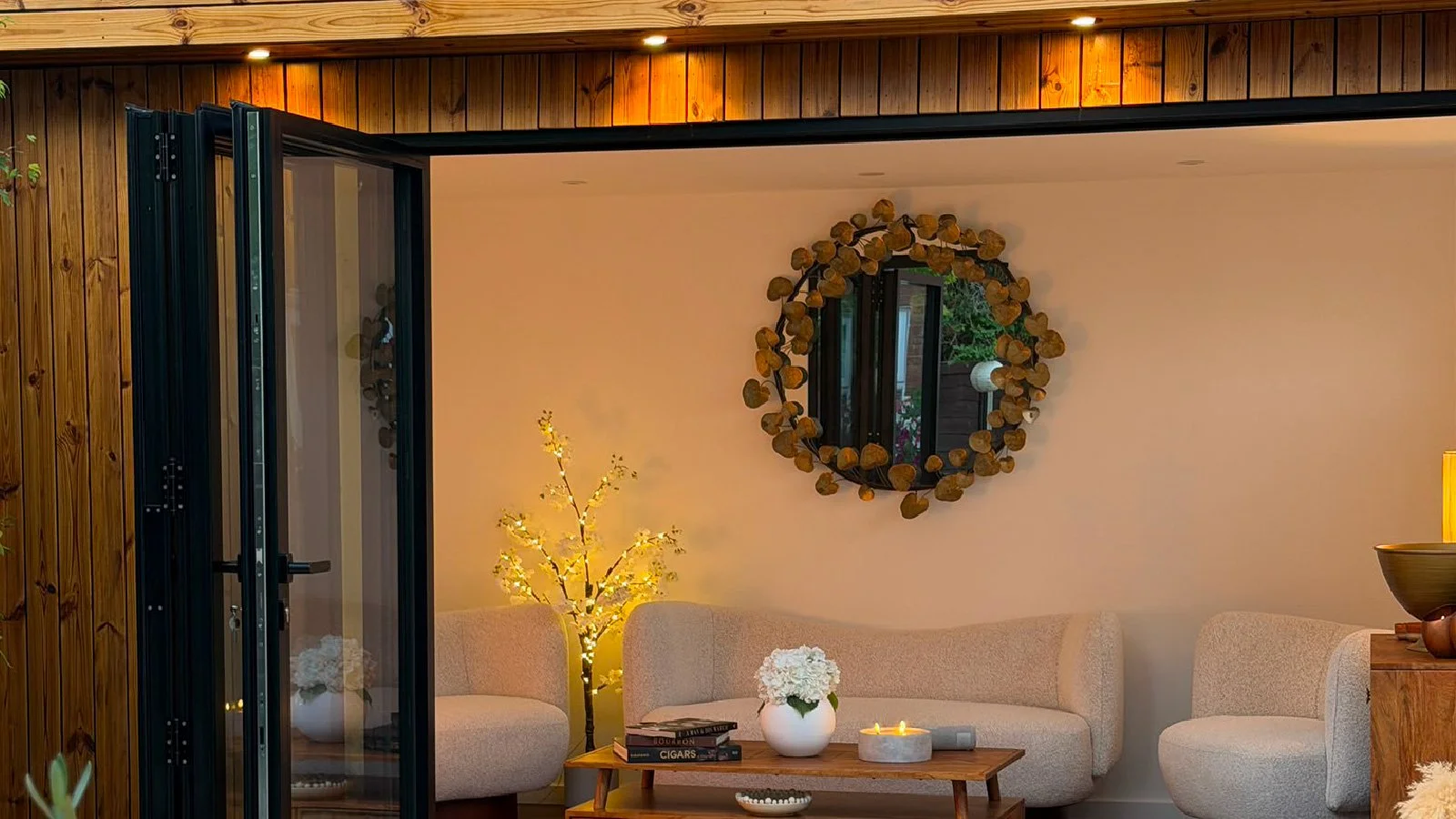
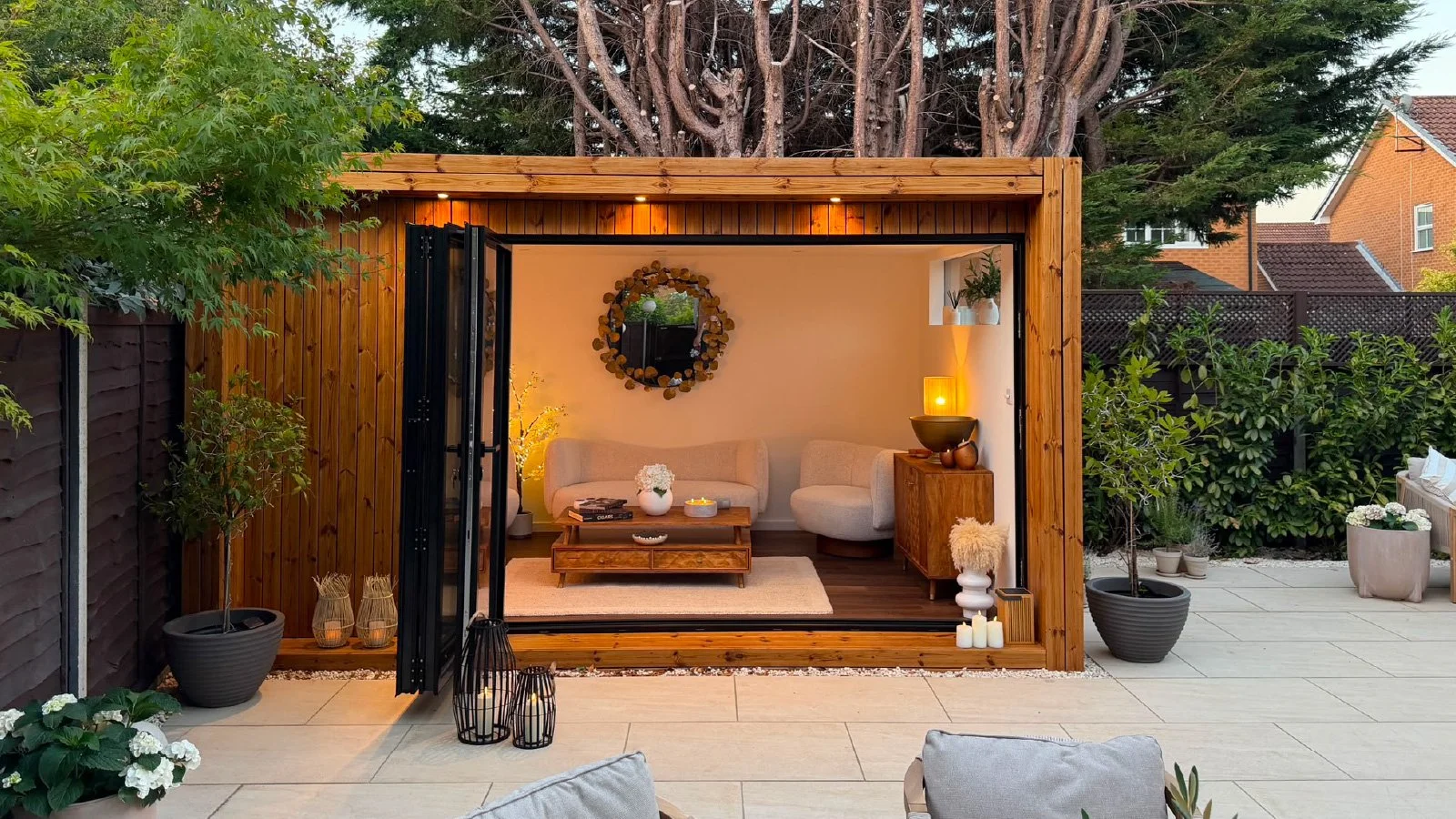
One of the biggest reasons this recent project feels so inviting is the connection between the interior and the garden.
Large aluminium bi-fold doors remove the visual barrier between inside and outside.
When they’re open, the patio almost becomes part of the room.
Even when they’re closed, the uninterrupted glazing allows natural light to flood the interior while maintaining views across the garden.
Rather than looking at the garden, you feel connected to it.
Keep the Interior Calm and Timeless
Choose materials that age gracefully
Interior trends come and go.
Timeless spaces don’t.
Neutral colours.
Natural timber.
Soft textures.
Quality flooring.
Simple plastered walls.
These materials continue to look elegant years later and allow furniture and accessories to evolve with your tastes.
Avoid trying to fill every corner
A common mistake is believing every wall needs furniture.
In reality, carefully chosen pieces with space around them often create a far more luxurious feel.
A comfortable sofa.
A statement coffee table.
Warm lighting.
Natural accessories.
Sometimes less really is more.
Lighting Makes the Biggest Difference After Sunset
Many homeowners focus entirely on daylight.
But some of the most enjoyable moments happen during the evening.
Warm LED downlights.
Feature lamps.
Soft indirect lighting.
Discreet exterior soffit lights.
Together they create a welcoming atmosphere that encourages you to use the space long after the sun goes down.
A beautifully lit garden room quickly becomes somewhere you genuinely want to spend time.
Design for the Next Ten Years, Not Just Today
Today’s home office could become tomorrow’s:
Family room
Reading room
Hobby studio
Home gym
Treatment room
Guest retreat
The best garden rooms are flexible.
Rather than designing around a single purpose, think about how your lifestyle may change over the next decade.
A timeless layout will continue to work whatever life brings.
Small Details Create a Premium Finish
People often notice the overall feeling before they notice individual features.
That’s because lots of smaller details work together.
Things like:
Flush internal finishes.
Carefully positioned windows.
Architectural lighting.
Consistent flooring.
Minimal trims.
Clean lines.
High-quality plastering.
None of these features are particularly dramatic on their own.
Combined, they create a room that feels calm, refined and permanently connected to the home.
Every Garden Deserves Its Own Design
One of the biggest differences between Backyard Cabins and many larger manufacturers is that we don’t simply deliver identical buildings.
Our standard cabins are an excellent starting point, but many clients choose to adapt the dimensions, glazing or layout to suit their garden.
Whether that’s a compact NEO, a versatile FORZA, a spacious LUNA, or a completely bespoke design, every project starts with understanding how you’ll actually use the space.
That’s why no two Backyard Cabins ever feel exactly the same.
Frequently Asked Questions
Can a garden room really feel like another room in the house?
Absolutely. With high-performance SIPs construction, plastered walls, quality glazing and thoughtful interior design, a premium garden room can feel remarkably similar to a traditional extension.
What flooring works best in a garden room?
Luxury Vinyl Tile (LVT) is one of the most popular choices because it’s durable, low maintenance and suitable for year-round use.
Should a garden room match my house?
It doesn’t need to copy your home exactly, but complementary colours, materials and proportions help create a natural transition between the two.
How do you make a small garden room feel bigger?
Large glazing, uncluttered layouts, neutral colours and a strong visual connection to the garden all help maximise the feeling of space.
Final Thoughts
The best garden rooms aren’t remembered because they’re the biggest.
They’re remembered because of how they make you feel.
Warm.
Comfortable.
Bright.
Peaceful.
A place where work feels easier, evenings feel more relaxing and time spent with family feels that little bit more special.
That’s what we aim to create with every Backyard Cabin.
Ready to Create Your Own Garden Room?
Whether you’re looking for a compact home office or a completely bespoke garden room, we’d love to hear about your ideas.
Explore our Garden Cabin Range to compare our standard models, browse our Gallery to see completed projects, or contact us to arrange a site visit and discuss what’s possible for your garden.
What Size Garden Room Should You Build? Why the Best Size Is Rarely Standard
Not sure what size garden room you need? Compare 3m x 3m, 4m x 3m, 5m x 4m, 6m x 4m and bespoke garden rooms, and discover why designing a cabin around your garden often delivers a better result than choosing a standard size.
Choosing the right size garden room is one of the biggest decisions you’ll make during your project.
Many homeowners begin by asking:
Should I choose a 3m x 3m garden office?
Is a 4m x 3m garden room big enough?
Would a 5m x 4m be better?
Should I build something completely bespoke?
The truth is that there isn’t one perfect answer.
The best garden room isn’t necessarily the biggest one, nor is it always one of the standard sizes shown on a website.
At Backyard Cabins, we believe the best garden room is the one that’s designed around your garden, your lifestyle and how you’ll actually use the space.
If you’re new to garden rooms, it’s also worth exploring our Garden Room Design & Build Information page to understand how our cabins are constructed and what makes them suitable for year-round use.
Quick Answer
What size garden room should I choose?
For many people, a 4m x 3m garden room provides an excellent balance of space and practicality. However, every garden is different, and many homeowners benefit from a bespoke size that makes better use of the available space.
Rather than asking which standard model to buy, it’s often better to ask:
“What size works best for my garden?”
Your Garden Isn’t Standard – Why Should Your Garden Room Be?
One of the biggest differences between Backyard Cabins and many larger manufacturers is our approach to design.
Many companies build a limited range of standard sizes in a factory.
You simply choose one that is “close enough” to what you need.
We work differently.
Our standard cabin range provides inspiration and proven layouts, but these models are only a starting point.
If your garden would work better with a cabin measuring 4.3m x 3.2m, or 5.6m x 3.8m, that’s exactly what we’ll design and build.
Every cabin is hand-built on site, allowing us to create a garden room that suits your space rather than forcing your space to suit a factory-produced building.
Small Gardens – Making Every Metre Count
If you have a smaller garden, every centimetre matters.
Many homeowners assume they need to compromise, but careful design can often create a surprisingly spacious room without overwhelming the garden.
Our NEO 3m x 3m is an excellent example of a compact garden office that’s ideal for home working, hobbies or a quiet retreat.
However, some gardens may suit a bespoke size slightly larger or slightly smaller, depending on the available space.
Sometimes adding just a few extra centimetres creates room for additional storage or a more comfortable desk layout.
The UK’s Most Popular Garden Office Size
For many households, a 4m x 3m garden room strikes the perfect balance.
It’s large enough to provide a generous workspace while still fitting comfortably into most gardens.
Discover why the FORZA 4m x 3m Garden Room has become one of our most popular layouts.
It works beautifully as:
A home office.
A treatment room.
A creative studio.
A hobby room.
A home gym.
A flexible family space.
But again, if your garden is slightly wider or slightly narrower, we can adjust the dimensions accordingly.
When a Larger Garden Room Makes Sense
If you’re looking to create a shared workspace, a larger studio or a multi-purpose family room, additional space can make a significant difference.
Our LUNA 5m x 4m provides generous proportions that work well for:
Two-person home offices.
Creative studios.
Wellness spaces.
Family rooms.
Entertaining.
Combined work and relaxation.
Many homeowners are surprised by how much more versatile a larger room becomes.
It allows different activities to take place comfortably within the same space without feeling cramped.
Take a closer look at the LUNA 5m x 4m Garden Room, designed for larger home offices, family spaces and flexible living.
Maximum Space and Complete Flexibility
For clients looking to create something truly special, our META 6m x 4m offers exceptional flexibility.
It can comfortably accommodate:
Multiple workstations.
Large home gyms.
Creative businesses.
Treatment clinics.
Games rooms.
Premium entertaining spaces.
It’s ideal for homeowners who want their garden room to become a genuine extension of their home.
See how the META 6m x 4m Garden Room provides generous space for premium home offices, studios and multi-purpose living.
When a Bespoke Garden Room Is the Better Choice
In reality, many of the cabins we build aren’t one of our standard sizes.
Every garden is different.
Some have mature trees.
Others have awkward boundaries.
Some need to maximise every available metre.
Others are designed around existing patios, landscaping or swimming pools.
Rather than asking you to compromise, we simply design the cabin around your space.
That’s one of the biggest advantages of building each project individually rather than manufacturing identical buildings in a factory.
Why We Don’t Mass Produce Garden Rooms
Backyard Cabins isn’t a production line.
We don’t have rows of identical garden rooms sitting in a warehouse waiting to be delivered.
Every project starts with a conversation.
We learn how you want to use the space.
We assess your garden.
We discuss the layout.
Only then do we begin creating your cabin.
Every structural panel is cut and assembled specifically for your project, with the building constructed on site by our experienced team.
That approach gives us the flexibility to create a garden room that feels as though it was always meant to be part of your garden.
If you’d like to learn more about how our cabins are constructed, the materials we use and why we’ve chosen SIPs construction, visit our Garden Room Design & Build Information page. It explains the build process in more detail and what makes our cabins suitable for comfortable year-round use.
Think About How You’ll Use the Space in Five Years
One of the biggest mistakes homeowners make is designing only for today’s needs.
A home office today might become:
A teenager’s study room.
A creative studio.
A treatment room.
A home gym.
A hobby room.
A guest retreat.
Thinking ahead often leads to better design decisions and a garden room that continues to work for many years.
Frequently Asked Questions
What is the most popular garden room size?
A 4m x 3m garden room is one of the most popular choices because it offers an excellent balance between internal space and garden impact.
Is a bespoke garden room more expensive?
Not necessarily. The cost depends on the overall design, specification and materials rather than simply whether the dimensions are standard or bespoke.
Can you build a garden room to fit an awkward space?
Yes. Many of our projects are designed specifically around unusual garden layouts, existing landscaping or awkward boundaries.
Should I choose a standard model or a bespoke design?
Our standard cabins are an excellent starting point, but many clients ultimately choose a bespoke size to make the best possible use of their garden.
Final Thoughts
Choosing the right garden room isn’t about finding the closest standard size.
It’s about creating a space that fits your garden, complements your home and supports the way you want to live.
Whether that’s a compact home office, a spacious family room or something completely bespoke, the right design should work around you—not the other way around.
At Backyard Cabins, that’s exactly how we approach every project.
Ready to Find the Right Garden Room?
Whether one of our standard designs is the perfect fit or you need a completely bespoke cabin, we’re always happy to discuss your ideas and help you create a garden room that’s designed around your garden, your lifestyle and the way you’ll use the space.
Explore Our Cabin Range to compare our standard models, browse our Gallery to see completed projects, or arrange a site visit and we’ll help you decide on the right size, layout and specification for your project.
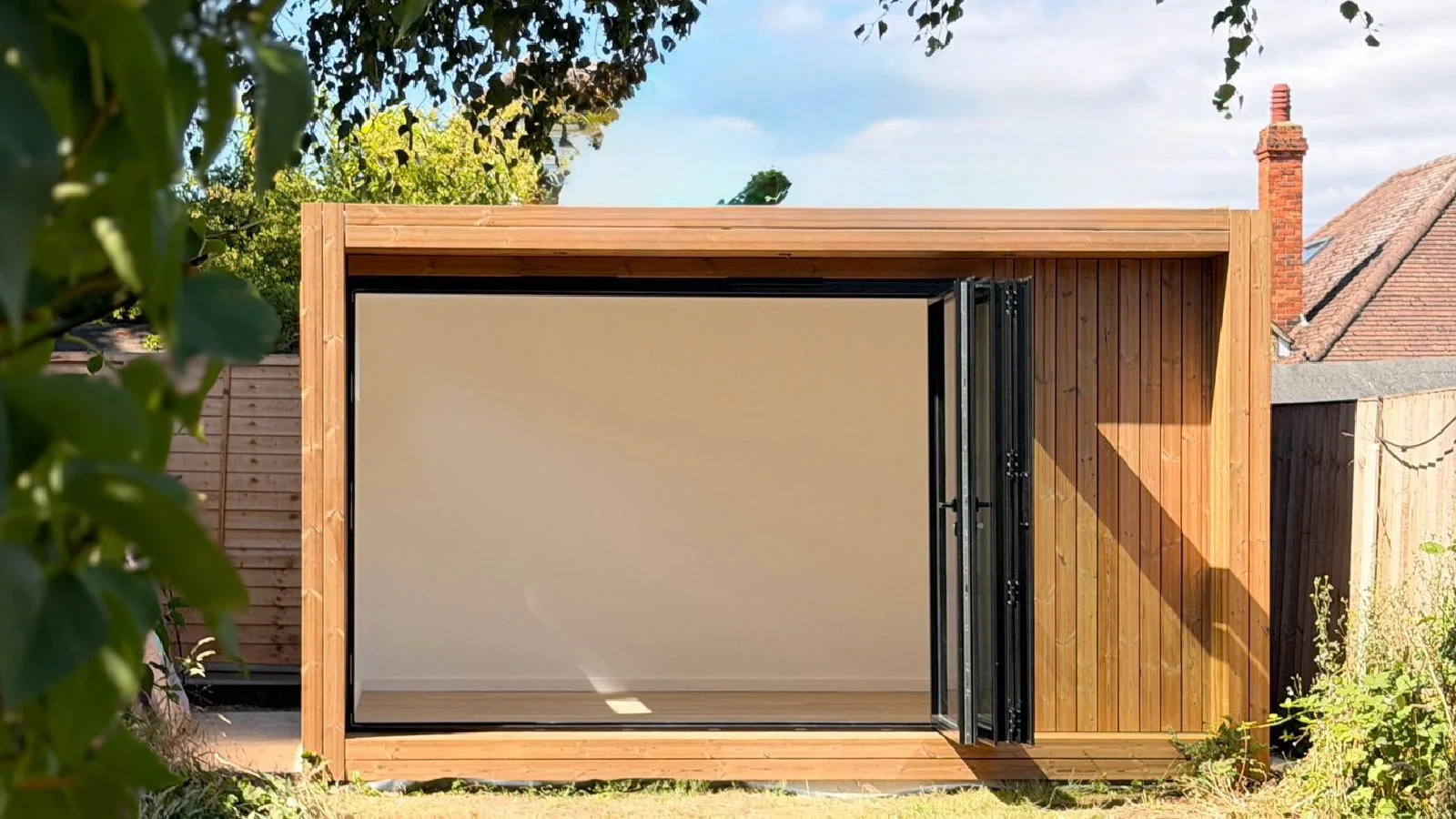
Can You Build a Garden Room with No Side Access? Here’s How We Recently Did It in Surrey
Think your garden is impossible to access? Discover how our latest Surrey garden room project demonstrates that limited access doesn’t always mean limited possibilities.
One of the first things many homeowners say when they contact us isn’t about the size of the cabin or how much it costs.
Instead, it’s usually something like:
“I don’t think you’ll be able to get it into the garden.”
Perhaps there’s no side gate.
Maybe your property is terraced.
Perhaps the access is narrow, or neighbouring fences leave very little room to manoeuvre.
Many people assume that because a garden room is a substantial structure, it must arrive in one huge piece.
Fortunately, that’s rarely the case.
A recently completed project in Surrey perfectly demonstrates why limited access is often far less of an obstacle than homeowners imagine.
Quick Answer
Can a garden room be built if there’s no side access?
In many cases, yes.
Unlike some pre-manufactured buildings that rely on large factory-built sections being craned into position, our garden rooms are constructed on site using Structural Insulated Panels (SIPs).
This means materials can often be carried through side passages, through the house or, where appropriate, by temporarily removing fence panels.
Every property is different, but restricted access is rarely the deal-breaker many people assume it will be.
Why Access Worries So Many Homeowners
It’s completely understandable.
When people picture a garden room being installed, they often imagine:
Huge wall sections arriving on articulated lorries.
Large cranes lifting buildings over houses.
Extensive disruption to neighbouring properties.
Major landscaping work before construction can even begin.
In reality, many bespoke garden rooms are built very differently.
The construction method plays a huge role in determining how easily materials can be transported to the garden.
How We Build Our Garden Rooms
At Backyard Cabins, our buildings are constructed on site using high-performance 97mm Structural Insulated Panels (SIPs), featuring a continuous 75mm polyurethane insulation core.
Rather than transporting one enormous building to your property, individual structural components are carefully brought to site before being assembled into the finished cabin.
This approach offers several advantages.
It makes transportation significantly more manageable.
It allows us to work in gardens with restricted access.
It also enables us to maintain an exceptionally high standard of finish throughout the build.
Every project is carefully planned around the individual property rather than expecting every garden to suit a standard construction process.
A Real Project in Surrey
Our latest FORZA garden room project in Surrey is a perfect example.
The client wanted a dedicated home office that could also become a quiet study space for their daughter as she prepares for her GCSE examinations.
The garden already contained an existing concrete base, making it an ideal starting point for the project.
Access was available via the neighbouring property, allowing materials to be transported efficiently.
However, even without that access, alternative solutions were available.
Depending on the property, materials can often be taken through the house or by temporarily removing fence panels where appropriate.
It’s exactly why we always recommend discussing your property before assuming a garden room isn’t possible.
Every Garden Is Different
No two gardens are the same.
Some have:
Narrow side passages.
Terraced layouts.
Existing patios.
Mature landscaping.
Sloping ground.
Limited working space.
These aren’t unusual situations.
In fact, they’re something we encounter regularly.
Rather than looking for reasons why a project can’t be completed, we focus on finding the most practical way to make it work.
Sometimes that means adjusting the installation sequence.
Sometimes it means changing how materials are transported.
Sometimes it simply means careful planning before work begins.
Building During a Summer Heatwave
This particular project was completed during one of the hottest spells of the year, with temperatures reaching around 35°C.
Working in those conditions requires flexibility.
Rather than exposing materials unnecessarily to direct sunlight throughout the day, sections of the external cladding were prepared under cover before being installed onto the cabin.
This approach offered several advantages.
It improved efficiency.
It allowed greater accuracy during assembly.
It reduced unnecessary exposure to the hottest conditions.
Most importantly, it helped us maintain the quality standards we expect on every build.
Why Preparation Makes Such a Difference
People often think building a garden room is simply a case of arriving on site and fixing everything together.
The reality is very different.
Good preparation speeds up installation while also improving quality.
By carefully preparing components before installation, we can spend more time focusing on precision, alignment and finishing details once they reach the building itself.
Many of the small details homeowners notice in the finished cabin are the result of careful planning long before the final boards are fixed into place.
Designed for More Than Just Work
Although this cabin has been built primarily as a home office, it has also been designed with flexibility in mind.
During the working week it provides a quiet, professional workspace away from the distractions of the main house.
Outside working hours it becomes a comfortable study room, giving the family’s daughter a peaceful environment for GCSE revision.
As life changes, the space can continue to evolve.
A home office today might become a hobby room, creative studio, treatment room, home gym or simply somewhere to relax tomorrow.
That’s one of the biggest advantages of investing in a properly insulated garden room.
What’s Left Once We Finish?
Another common misconception is that homeowners need to coordinate numerous trades after the cabin has been built.
In reality, almost everything is completed before handover.
The cabin includes:
First-fix electrics.
Internal consumer unit.
Integrated lighting.
Double sockets.
Finished plastered and painted interior.
Luxury LVT flooring.
The only remaining step is for the client’s qualified electrician to connect the cabin to the property’s electrical supply.
Once that’s complete, the garden room is ready to enjoy.
Don’t Rule Your Garden Out Too Quickly
Over the years we’ve visited many properties where the homeowner’s first words were:
“I don’t think it’ll fit.”
More often than not, it does.
Limited access doesn’t automatically prevent you from building a beautiful, fully insulated garden office.
Every property presents its own challenges, but with careful planning, flexible construction methods and the right design approach, many gardens are far more suitable than people initially believe.
The best way to find out is simply to ask.
You might be surprised by what’s possible.
Can a Garden Office Stay Cool During a UK Heatwave? What Homeowners Need to Know
Worried your garden office will overheat? Learn how modern insulation, SIPs construction and optional air conditioning can help keep your workspace comfortable during even the hottest UK summers.
With temperatures reaching well above 30°C across parts of the UK, many homeowners are asking the same question:
“Will a garden office become unbearably hot in summer?”
It’s a sensible concern. If you’re planning to spend hours working from home, the last thing you want is a space that feels more like a greenhouse than a professional office.
The good news is that a well-designed, properly insulated garden room can remain comfortable even during periods of unusually hot weather.
In fact, many of the same features that keep a building warm in winter also help keep it cooler in summer.
Whether you’re working from a garden in Wokingham, Walton-on-Thames, Salisbury or anywhere else across the South East, thoughtful design can make all the difference.
Quick Answer
Do garden offices get too hot during a heatwave?
Not necessarily.
A high-quality garden room built with modern insulation, quality glazing and good ventilation will generally perform far better than a basic timber shed or summerhouse. Optional air conditioning can provide additional comfort during prolonged periods of extreme heat.
The key is choosing a building that’s designed for year-round use rather than occasional seasonal use.
Insulation Doesn’t Just Keep Heat In, It Helps Keep Heat Out
Many people assume insulation only matters in winter.
In reality, insulation slows the transfer of heat in both directions. During colder months it helps retain warmth inside the building, while during summer it reduces the amount of external heat entering the structure.
This is one reason why a well-insulated home often feels cooler than a poorly insulated one during a heatwave.
At Backyard Cabins, our buildings utilise high-performance 97mm Structural Insulated Panels (SIPs) incorporating a continuous 75mm polyurethane insulation core, creating an efficient thermal envelope designed for comfortable year-round use.
A Garden Office Is Very Different from a Garden Shed
It’s easy to assume all timber buildings behave the same way in hot weather.
They don’t.
A typical garden shed is designed for storing tools and equipment. It often has little or no insulation and minimal consideration for year-round occupancy.
A professionally designed garden office is built with comfort in mind.
Features such as insulated wall systems, quality glazing, interior finishes and heating options all contribute to creating a space that’s suitable for everyday work rather than occasional storage.
Natural Light Is Important, So Is Thoughtful Design
Large glazed doors and windows can transform the feel of a garden office, filling it with daylight and creating a strong connection to the garden.
Equally important is how those openings are incorporated into the overall design.
Window placement, ventilation and sensible use of shading can all contribute to maintaining a pleasant internal environment during warmer weather.
Every project is different, which is why bespoke planning often delivers the best long-term results.
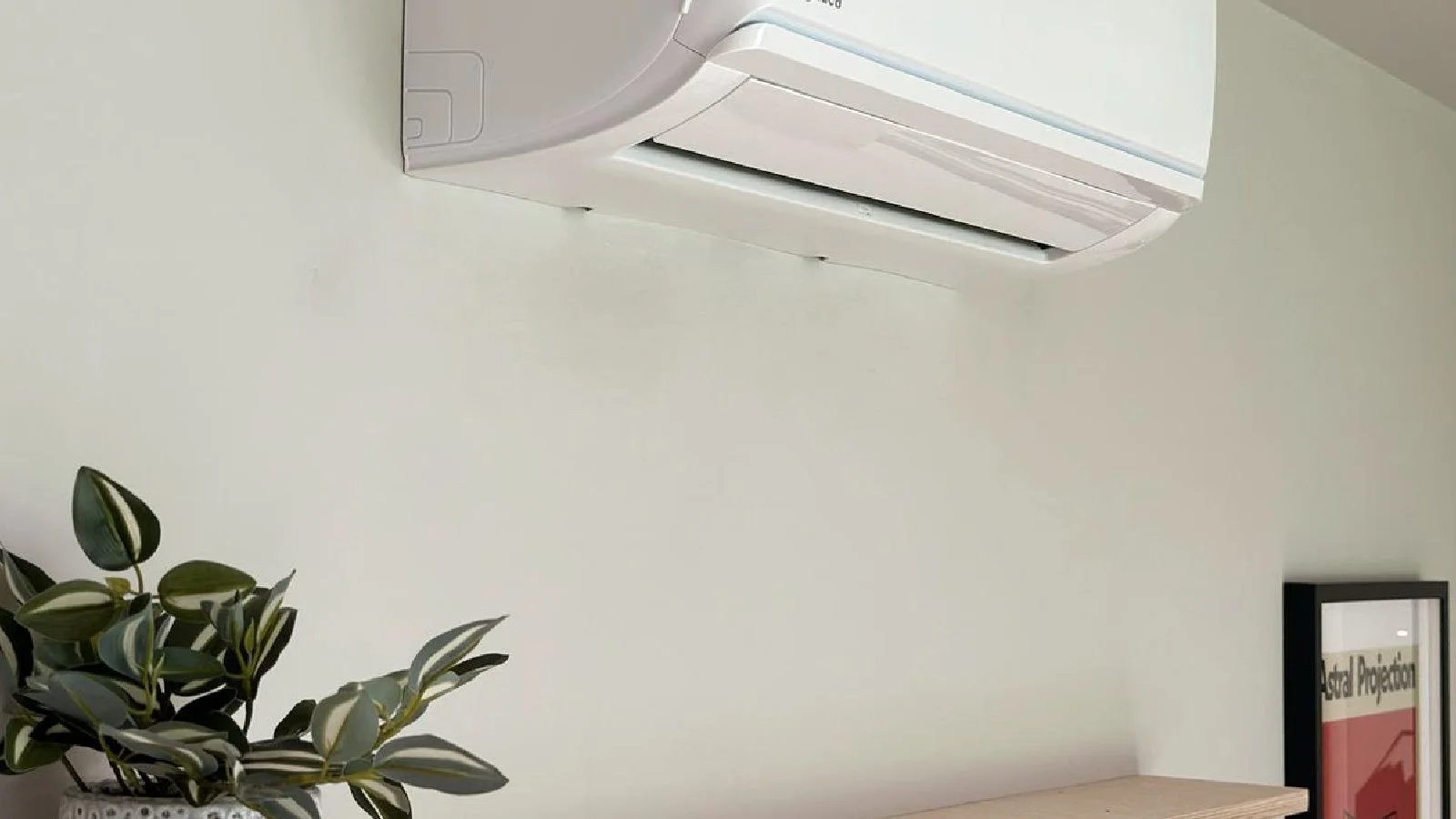
Air Conditioning Can Make Summer Working Even More Comfortable
For clients who spend long days working from their garden office, air conditioning can be an excellent optional upgrade.
Modern systems don’t just cool the room in summer – many also provide highly efficient heating during colder months.
Because every Backyard Cabin includes first-fix electrics and an internal consumer unit, incorporating air conditioning into the overall electrical installation is straightforward for a qualified electrician.
Combined with a well-insulated structure, this creates a workspace that remains comfortable whatever the season.
It’s the Whole Design That Makes the Difference
Keeping a garden office comfortable isn’t about relying on a single feature.
It’s the combination of quality construction and intelligent design that delivers the best results.
Important considerations include:
High-performance SIPs construction.
Quality double glazing.
Effective insulation.
Durable roofing systems.
Sensible window positioning.
Good ventilation.
Optional climate control where desired.
Together, these elements help create a space that feels like a genuine extension of your home rather than an outdoor outbuilding.
Comfort Has a Direct Impact on Productivity
Anyone who works from home knows how much the environment affects concentration.
A room that’s too hot can quickly become uncomfortable and distracting.
A properly designed garden office provides a dedicated space where you can focus on your work, enjoy natural light and maintain a comfortable environment throughout the changing seasons.
For many homeowners, that translates into improved productivity and a far more enjoyable working day.
Frequently Asked Questions
Do SIPs garden rooms stay cooler in summer?
High-performance SIPs construction helps reduce heat transfer through the walls, floor and roof, contributing to a more stable internal temperature than poorly insulated structures.
Does insulation help during hot weather?
Yes. Insulation slows heat transfer, helping reduce the amount of external heat entering the building as well as retaining warmth during winter.
Is air conditioning worth adding to a garden office?
For homeowners who expect to use their garden office throughout the hottest months of the year, air conditioning can be an excellent investment and also provides efficient heating in winter.
Will my garden office feel like a greenhouse?
A purpose-built garden office with quality insulation and thoughtful design performs very differently from a basic summerhouse or storage shed and is intended for comfortable year-round use.
H2: Final Thoughts
The recent UK heatwave has highlighted just how important good design can be.
A premium garden office should provide a comfortable place to work not only during spring and autumn but throughout the hottest days of summer and the coldest weeks of winter.
By combining high-performance SIPs construction, quality materials and carefully considered design, a modern garden room can become a practical, productive and enjoyable space all year round.
If you’re considering investing in a garden office, don’t just think about how it will look – think about how it will perform when temperatures reach their extremes.
A building designed for genuine year-round use will reward you every single day you use it.
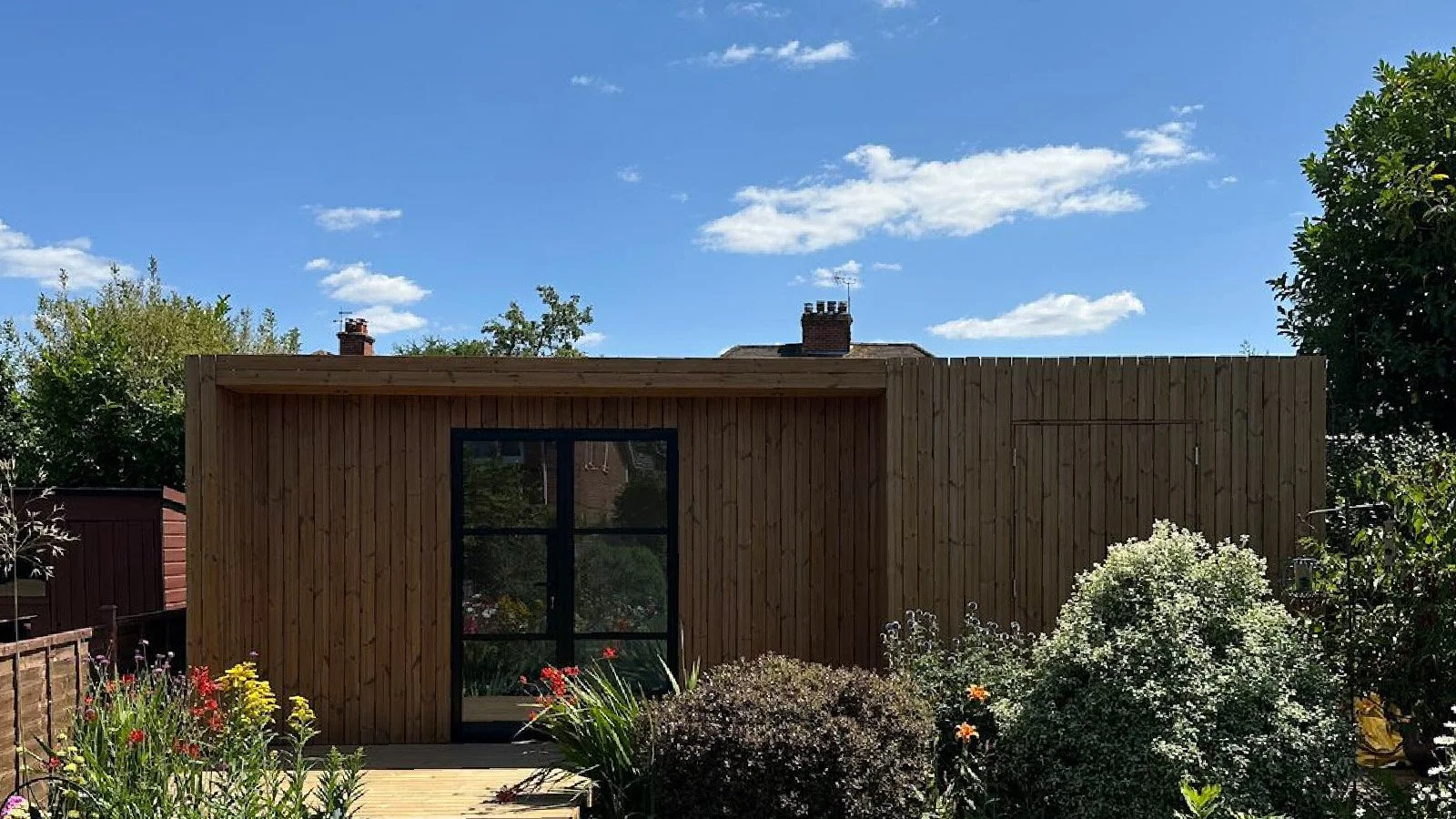
Garden Office and Shed Combined: Design Ideas, Sizes and Custom Options
Need a garden office without losing valuable storage? Explore integrated office and shed designs, separate layouts and bespoke options created around your garden.
Creating a garden office should not mean losing the practical storage your garden still needs.
Bikes, tools, lawnmowers, outdoor furniture and gardening equipment all need somewhere secure and accessible. At the same time, working beside that equipment in a traditional shed is unlikely to provide the quiet, comfortable environment you want from a professional home office.
Fortunately, you do not always have to choose between the two.
A garden office and shed can be combined within one carefully designed building, with a partition separating the insulated office from a dedicated storage area. Alternatively, the office and shed can remain separate while being planned together as part of one attractive garden layout.
The right approach depends on your available space, storage requirements, budget and how you want the garden to feel.
At Backyard Cabins, most of the garden rooms we build involve some level of customisation. We can adjust dimensions, change door and window positions, create internal partitions and design a layout around the way you actually use your garden.
Speak to us about a custom garden office and storage design
Can you combine a garden office and shed?
Yes. A fully insulated garden office and secure storage shed can be created within the same building.
The interior is divided into separate areas, normally with independent external access. The office side is finished as a comfortable room, while the storage side is designed for bikes, tools, garden equipment or other practical items.
Another option is to create two separate structures or retain an existing shed alongside the new garden office. This can work particularly well where the garden has enough space or where keeping noisy, damp or bulky equipment completely separate from the workspace is important.
Neither approach is automatically better. The best design is the one that makes sensible use of your garden and suits your priorities.
What is a combined garden office and shed?
A combined garden office and shed is one building with two distinct functions.
One section is designed as a complete garden office. It is insulated, heated, plastered, painted and fitted with flooring and electrics.
The other section provides practical storage. It may be used for:
Bicycles
Lawnmowers
Garden tools
Outdoor furniture
Barbecues
Sports equipment
Children’s outdoor toys
Decorating supplies
General household storage
A solid internal partition separates the two spaces. Each area can have its own external door, allowing you to enter the office without walking through the storage section.
From outside, the building can appear as one carefully designed garden room. The storage entrance can be positioned discreetly at the side, helping the main office elevation remain clean and attractive.
What are the advantages of an integrated design?
Combining an office and storage area within one structure can be an excellent way to use a smaller garden efficiently.
The main benefits include:
One coordinated building rather than two unrelated structures
A smaller overall footprint
A consistent exterior design
Secure storage immediately beside the office
Greater flexibility over the internal layout
Fewer separate structures competing for space
A cleaner and more organised garden
The ability to conceal the storage entrance from the main view
An integrated layout can also make an awkward corner or unusually shaped part of the garden much more useful.
For example, a narrow section at one end of the building might not add much value to the office, but it could provide excellent bike or tool storage. Custom design allows that space to serve a practical purpose.
When might separate buildings work better?
An integrated office and shed is not the only solution.
In some gardens, keeping the office and storage building separate creates a better result. This may be appropriate when:
You already have a shed that remains in good condition
Your garden has enough space for two buildings
The storage area contains damp, dirty or noisy equipment
You want maximum sound separation
You may remove or replace the shed in the future
An existing concrete base or hardstanding can be reused
The shape of the garden naturally creates two different zones
A separate office remains completely free from gardening equipment, fuel, paint, tools and other stored items. It may also be easier to heat efficiently because every part of the insulated building is used as a finished room.
The decision should be based on the garden as a whole, not simply on what appears easiest from a standard plan.
Integrated or separate: which layout should you choose?
Choose an integrated office and shed when saving space and achieving one coordinated design are the main priorities.
Choose separate buildings when you already have useful storage, have enough available space, or want the cleanest possible separation between work and garden equipment.
It can help to consider the following questions:
How much storage do you genuinely need?
What will you store?
How often will you need to access it?
Do you need to wheel bicycles or machinery through the doorway?
Should the storage entrance be visible from the house?
How many people will use the office?
Could your requirements change in the next few years?
Would storage space be more useful than a larger office?
Are there any awkward boundaries, trees or access restrictions?
Once these questions are answered, it becomes much easier to decide whether one combined building or two separate structures will work best.
How much space should you allow for storage?
The answer depends on what you intend to keep inside.
A compact storage section may be enough for hand tools, folding furniture and garden supplies. Bicycles, lawnmowers and larger equipment need more floor space, a wider doorway and a clear route through the garden.
It is worth measuring the larger items before settling on a design. Storage can quickly become frustrating if a door is too narrow or equipment has to be moved every time you need something from the back.
You should also consider vertical storage. Wall hooks, shelving and tall storage racks can make a relatively compact area far more useful without taking excessive space away from the office.
The office itself must remain large enough for its intended purpose. A single-person workspace may only require a desk, chair and modest storage. An office for two people, client meetings or creative work will need more room.
A custom layout helps balance these requirements instead of dividing the building according to arbitrary standard measurements.
Garden office and shed layout ideas
There are several ways to arrange a combined building.
Office with storage at the side
This is one of the most practical layouts.
The main garden-facing elevation is used for the office, with glazed doors or windows providing natural light. A separate storage door is positioned on the side of the building.
This keeps the storage entrance discreet and allows the office to remain the visual focus.
It works particularly well in gardens with side access or enough clearance beside the cabin.
Office with storage at the rear
A storage section can sometimes be placed behind the office, particularly on a deeper plot.
This creates a clean front elevation, although the design must provide a practical route to the rear entrance. It is important to ensure the storage space does not become awkward to access.
Office and storage divided across the front
Where side access is limited, both doors can be positioned on the front elevation.
Careful design can still make the office feel attractive and welcoming. Different door styles, cladding details and positioning can help the storage entrance appear more discreet.
L-shaped office and storage layout
An L-shaped design can work well in a corner garden or around an existing feature.
One section may contain the main office, while the shorter return provides storage. This can create a sheltered outdoor area while making good use of an awkward boundary.
Office with a narrow bike store
A slim storage section can be included specifically for bicycles.
This is helpful for households that need secure bike storage but do not require a full-sized shed. A wide external door, strong lock and suitable internal fixings should be considered from the beginning.
Two-room garden office
Not every additional room has to be used as a traditional shed.
A partitioned garden room might include:
A main office and stock room
An office and archive
A studio and equipment store
A treatment room and supply cupboard
A gym and changing area
A creative workspace and materials store
An office and small workshop
This is where custom design becomes particularly valuable. The layout can be planned around the intended use rather than a generic definition of an office or shed.
A real garden office and storage project in Surrey
A recent bespoke FORZA project in Surrey demonstrates how important it is to consider the entire garden before choosing a layout.
The property already had an existing concrete base and the owners needed both a comfortable workspace and practical storage.
Rather than automatically covering the whole area with one large structure, the garden was planned as two complementary zones. The bespoke garden office occupies one side of the available space, while the remaining area is retained for a separate storage building.
This approach gives the client:
A quiet and fully finished office
Space for practical garden storage
Clear separation between work and equipment
Flexibility to change the storage building in the future
Better use of the existing footprint
A garden that remains organised without feeling overcrowded
For another customer, an integrated storage room might be the better solution. The value of bespoke design is that the building and layout can respond to the actual garden.
Learn more about our garden rooms in Surrey
Why custom design matters
Most of the cabins we build are customised in some way.
Standard models are useful starting points because they help customers understand likely sizes, proportions and prices. However, real gardens rarely follow standard measurements.
A custom garden office and shed can be designed around:
The exact width and depth of the available space
Boundaries and neighbouring properties
Existing patios or concrete bases
Trees and established planting
The direction of natural light
Side access
The position of the house
The view from inside the office
The amount and type of storage required
Future changes in how the room may be used
Customisation might involve changing a window position, adding a partition, moving a door or adjusting the external dimensions.
In other cases, a completely bespoke design may provide a much better solution than modifying a standard model.
The aim is not to make the building complicated. It is to make every part of it useful.
View our cabin models and starting prices
What is included in the office section?
The office part of a combined building should feel like a proper room, not a section of a garden shed.
A complete Backyard Cabin includes:
A fully insulated SIPs structure
Insulation in the walls, floor and roof
Premium exterior cladding
Durable EPDM roofing
Aluminium double-glazed doors
Flooring
Skirting boards
A plastered interior
Walls painted white
Internal and external lighting
Electrical sockets and a dedicated consumer unit
A radiator for colder weather
Professional installation
Removal of building waste
A 10-year structural warranty
This creates a comfortable space that is ready to furnish and use.
The precise specification of the storage section will depend on its purpose. It may not require the same internal finish as the office, but security, ventilation and durability should all be considered.
See what is included with a Backyard Cabin
Should the shed section be insulated?
A storage area does not always need the same insulation and internal finish as the office.
If it will only hold garden tools, bicycles or outdoor furniture, a simpler finish may be appropriate. However, the construction still needs to protect stored belongings from the weather and provide suitable ventilation.
If the second section will store sensitive equipment, paperwork, stock, musical instruments or materials affected by temperature and humidity, insulation may be more important.
The intended use should be agreed before the building is designed. It is much easier to include insulation, electrics and suitable ventilation at the planning stage than to add them later.
How do you keep the office quiet and comfortable?
A proper partition is essential.
The storage area should not simply be separated by lightweight shelving or furniture. A well-designed internal wall provides better sound separation, security and temperature control.
The layout should also keep noisy or frequently used equipment away from the main desk position where possible.
Other useful considerations include:
Separate external entrances
Suitable seals around doors
Insulation around the office
Thoughtful socket and desk placement
Storage fixings that prevent tools or bicycles falling
Adequate ventilation in the storage section
A radiator correctly positioned within the office
Windows arranged to provide useful natural light without screen glare
These details may appear small, but they make a significant difference to everyday use.
How secure is a combined office and shed?
Security should be considered for both sections.
The storage area may contain valuable bicycles, tools and equipment, while the office could contain computers and other electronics.
A custom design allows doors and windows to be positioned away from exposed boundaries where appropriate. External lighting can also help make entrances more visible.
Good security starts with a robust structure, suitable doors and appropriate locks. Depending on what you intend to store, you may also wish to consider an alarm, camera or secure internal anchor points.
Avoid treating the storage section as an afterthought. It should be included in the security plan from the beginning.
Can an existing concrete base be reused?
Possibly, but it must be assessed first.
An existing concrete slab may look suitable while being the wrong size, uneven, damaged or inadequate for the proposed structure. Drainage and the relationship between the base and surrounding ground also need consideration.
Reusing an appropriate base can reduce unnecessary disruption, but it should not be assumed that every existing slab is suitable.
We review the site and proposed building before confirming the foundation approach.
Does a combined garden office and shed need planning permission?
Many garden offices and storage buildings can be constructed under permitted development rights, provided they meet the relevant rules.
Combining two uses within one structure does not automatically mean planning permission is required. The building’s height, position, total area and intended use are among the factors that need to be considered.
Additional restrictions may apply if:
The building will be positioned near a boundary
The property is listed
The garden is within a conservation area
An Article 4 Direction applies
Permitted development rights have been removed
The proposed building covers a substantial part of the garden
The use goes beyond normal domestic purposes
Planning rules vary according to the property and circumstances. This article is general information and should not be treated as planning advice.
For a fuller explanation, read our garden room planning permission guide and confirm your circumstances with the relevant local authority or planning professional.
How much does a combined garden office and shed cost?
The cost depends on the overall size, the amount of finished office space, the storage specification, the site and the level of customisation.
Our standard cabin models provide useful starting points for understanding garden room prices. A combined office and storage building normally requires a personalised quotation because the internal proportions and features are designed around the customer.
The quotation may be affected by:
Overall dimensions
Size of the storage section
Number and type of external doors
Internal partitions
Windows and glazing
Insulation requirements
Electrical requirements
Heating
Ground conditions
Site access
Custom finishes
We will discuss these points before confirming a design and price.
View our garden room models and prices
Is a combined office and shed right for a small garden?
It can be.
A combined structure may use less space than two separate buildings because it shares one overall footprint and roofline.
The key is to be realistic about how much office and storage space you need. Trying to fit a large office and full storage shed into a very small structure can leave both areas feeling compromised.
Vertical storage, wall-mounted bike racks and carefully planned shelving can make the storage section more efficient.
For some small gardens, retaining a compact separate shed and choosing a smaller office may still be the better option. A site-specific design will help establish which arrangement makes the best use of the available space.
Frequently asked questions
Can a garden office have an integrated shed?
Yes. A garden office can include a separate storage section within the same structure. A solid partition and independent external doors help keep the office comfortable and the storage area practical.
Is an office and shed combination suitable for use throughout the year?
The office section can be designed for comfortable use throughout the year with proper insulation, double glazing, heating and a complete internal finish.
Will tools and bicycles make the office cold?
They should not if the office and storage areas are designed as separate spaces with an appropriate partition, insulation and independent doors. The design should prevent the storage entrance from opening directly into the office.
Can both sections have electricity?
Yes. Electrical requirements can be included during the design process. The final arrangement will depend on how each area will be used and the agreed specification.
Can you add storage to a standard garden room model?
Often, yes. A standard model can provide a starting point, but the overall dimensions and layout may need adjusting to create useful storage without compromising the office.
Can the storage door be hidden from view?
The storage entrance can often be positioned on the side or rear elevation, subject to access and the garden layout. This helps the main office elevation remain clean and attractive.
Can you build an office and shed on an existing base?
Sometimes. The base must be assessed for its dimensions, condition, level and suitability before it can be reused.
Is one combined building cheaper than two separate buildings?
Not always. The cost depends on the size, specification, groundwork and level of customisation. A combined building may use the available space more efficiently, but it still requires careful construction and a properly finished office.
Can the second room be used for something other than storage?
Yes. It could become a stock room, changing area, small workshop, archive, equipment room or another space suited to your requirements.
Can Backyard Cabins create a completely bespoke layout?
Yes. Most of our projects include custom elements, and we can create a layout around your garden, storage needs and intended use.
Start planning your garden office and storage space
A garden office and shed can work beautifully together when both functions are considered from the beginning.
For some homes, the best solution is one building with an integrated storage section. For others, a separate shed and garden office will create better access, sound separation and long-term flexibility.
The right answer comes from understanding your garden and how you plan to use it.
Backyard Cabins designs and installs complete, fully insulated garden rooms throughout Berkshire, Surrey, Oxfordshire, London, Wiltshire and surrounding areas. Our standard models provide helpful starting points, but most of our cabins are customised to suit the customer.
If you need a quiet place to work without losing valuable storage, we can help you compare the options and create a design that makes sense for your home.
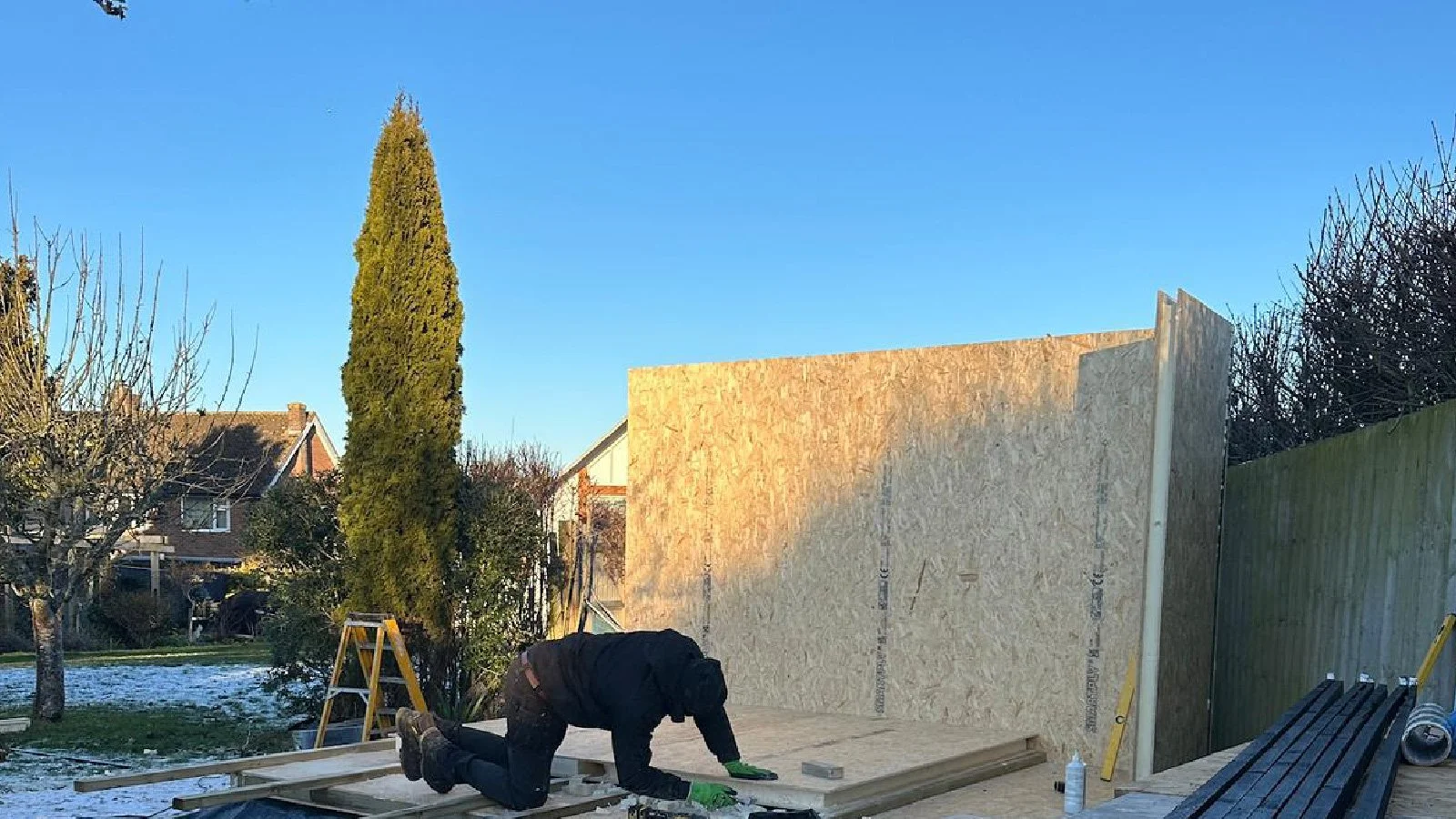
How to Choose the Best Garden Room Company: 10 Questions to Ask Before You Buy
Not all garden room companies are the same. Learn the key questions every homeowner should ask before choosing who to trust with their garden room project.
Investing in a garden room is a significant decision.
Whether you’re creating a home office, gym, studio, treatment room, or additional living space, choosing the right company is just as important as choosing the design itself.
A quick online search reveals hundreds of garden room providers, all claiming to offer the best quality, the best value, and the best service.
So how do you separate a genuinely high-quality garden room company from the rest?
Here are ten questions every homeowner should ask before signing a contract or paying a deposit.
Quick Answer
The best garden room company isn’t necessarily the biggest or the cheapest.
Look for a company that uses high-performance construction materials, offers transparent pricing, can demonstrate genuine completed projects, understands foundations and planning requirements, and provides direct accountability throughout the build.
Companies should be able to explain exactly how their buildings are constructed, what is included within the advertised price, and who will actually be responsible for building your garden room.
1. Who Will Actually Build Your Garden Room?
Many homeowners are surprised to discover that the person they initially speak with disappears once the contract is signed.
Some companies operate large sales teams and outsource installation work to third-party subcontractors.
There’s nothing inherently wrong with this model, but it’s important to understand who will ultimately be responsible for delivering your project.
At Backyard Cabins, Nick oversees the client-facing side of the business and remains closely involved throughout the build process. Meanwhile, Matthew manages the planning, administration, systems and operational side behind the scenes.
This approach allows us to maintain quality control and accountability from initial enquiry through to final handover.
2. What Is the Actual Construction Specification?
Not all garden rooms are built the same way.
Many companies simply describe their buildings as “fully insulated” without explaining what that actually means.
Questions worth asking include:
What type of structure is used?
How thick are the walls?
What insulation system is installed?
What roofing system is included?
What type of glazing is provided?
Our cabins are constructed using 97mm Structural Insulated Panels (SIPs), comprising a 75mm continuous polyurethane insulation core bonded between structural OSB boards.
Combined with premium Thermowood cladding, high-quality double glazing and durable EPDM roofing, this creates a highly insulated structure designed for genuine year-round use.
3. Is the Price Transparent?
One of the biggest frustrations in the garden room industry is discovering additional costs after receiving an initial quote.
A garden room advertised at one price can quickly become far more expensive once flooring, heating, foundations, electrics, installation and VAT are added.
Always ask:
Is VAT included?
Is flooring included?
Is heating included?
Is installation included?
Are there any likely additional costs?
We believe pricing should be clear from the outset. That’s why we display both ex-VAT and VAT-inclusive pricing and clearly explain what is included within every cabin package.
4. Can They Show Real Completed Projects?
A portfolio should contain more than computer-generated renders.
Look for genuine projects, completed installations and real-world examples of previous work.
These provide valuable insight into:
Build quality
Attention to detail
Design capability
Site management
Problem-solving ability
At Backyard Cabins, we regularly document completed projects across Berkshire, Surrey, Oxfordshire, Wiltshire and West London, including bespoke builds and challenging installations where careful planning was required.
5. Can They Explain the Thermal Performance?
Many companies advertise their buildings as “fully insulated”, but few explain the actual thermal performance of the finished structure.
One useful question to ask is:
What is the U-value of the finished wall assembly?
A lower U-value indicates better thermal performance.
As a guide:
Typical shed or log cabin: Often above 1.50 W/m²K
Modern house extension: Around 0.28 W/m²K
High-performance garden room: Around 0.25 W/m²K
Our standard wall build-up achieves a finished wall assembly U-value of approximately 0.25 W/m²K, helping create a comfortable, energy-efficient environment throughout the year.
6. Do They Understand Planning and Permitted Development?
Most garden rooms can be installed under permitted development rights, but every property is different.
A good company should understand:
Common permitted development requirements
Height restrictions
Boundary considerations
Situations where planning permission may be required
Our standard cabin range is designed to remain below 2.5 metres in height, helping many projects fall within permitted development guidelines, subject to the circumstances of the individual property.
7. Can They Handle Challenging Gardens?
Very few gardens are perfectly flat with unrestricted access.
Common challenges include:
Sloping lawns
Narrow side access
Tight corners
Existing landscaping
Restricted boundaries
This is where experience becomes important.
We frequently use ground screw foundations where appropriate. These can often reduce excavation requirements, minimise disruption and provide a practical solution for uneven ground.
We’re also currently completing projects where careful site logistics and SIPs construction methods allow materials to be transported through restricted access routes that would be difficult for larger pre-manufactured structures.
8. What Warranty Is Included?
A garden room is a long-term investment.
Before proceeding, ask:
What warranty is included?
What does it cover?
How long does it last?
Backyard Cabins provides a 10-year structural warranty, reflecting our confidence in both the materials we use and the way our cabins are constructed.
9. How Long Will the Build Take?
Build times vary significantly across the industry.
Ask:
How long will installation take?
What preparation is required beforehand?
What factors could affect the schedule?
Because our cabins utilise SIPs construction and can often be installed on ground screw foundations, many standard models can be completed within approximately 10–15 working days once foundations are prepared.
10. Will the Final Electrical Connection Be Straightforward?
This is a detail many homeowners overlook.
A good garden room company should make the final electrical connection process as simple as possible.
Our cabins are supplied with first-fix electrics already installed, including sockets, lighting circuits and an internal consumer unit.
Once the structure is complete, your electrician simply connects the cabin to the property’s electrical supply, making the final stage straightforward and efficient.
Why Smaller Can Sometimes Be Better
There are many excellent garden room companies operating in the UK, and larger companies often offer impressive showrooms, extensive marketing, and a wide range of standard designs.
However, one advantage of working with a smaller specialist company is simplicity and direct accountability.
With larger organisations, it’s common to deal with multiple departments throughout a project. The person who provides the initial quotation may be different from the project manager, who may be different from the installation team, who may be different from the person handling aftercare.
At Backyard Cabins, things are deliberately simpler.
From your initial enquiry through to completion, you’ll deal directly with the people responsible for delivering your project. Questions are answered quickly, decisions can be made efficiently, and if something needs discussing, you can speak directly to the people who know the project inside out.
This also gives us greater flexibility. We can adapt designs, solve site-specific challenges, and make sensible decisions throughout the build without layers of management or lengthy approval processes.
For many of our clients, that direct relationship and personal service is one of the biggest advantages of working with a small, specialist team.
Final Thoughts
The best garden room company isn’t necessarily the largest, the cheapest or the one with the biggest marketing budget.
It’s the company that combines quality materials, transparent pricing, genuine craftsmanship and a commitment to delivering a great result.
Take your time, ask questions, compare providers and choose a company you trust.
A well-designed garden room should enhance your home and lifestyle for many years to come.
Thinking About a Garden Room?
Whether you’re considering a compact home office or a larger multi-functional garden room, we’re always happy to discuss your project.
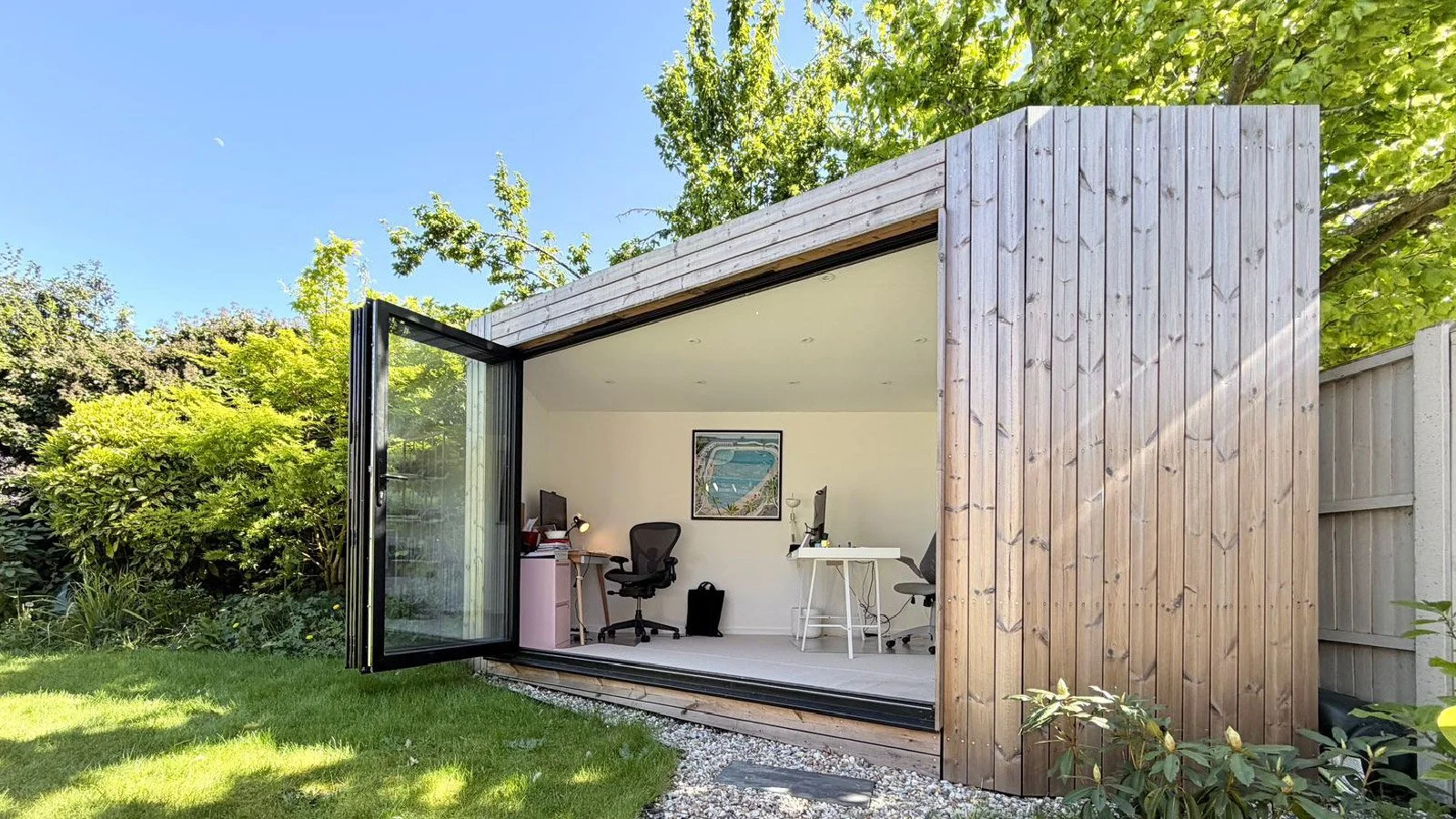
Can You Build a Garden Room in an Awkward Garden? Slopes, Tight Corners & Narrow Access Explained
Think your garden is too small, too steep or too awkward for a garden room? Discover how sloping plots, tight corners and narrow access routes can often be successfully overcome with the right design and construction approach.
Many homeowners assume a garden room isn’t possible because their garden isn’t perfectly flat.
Perhaps the lawn slopes away from the house. Maybe there’s a tight corner you’d like to utilise. Or perhaps access to the garden is restricted by a narrow side passage or terraced property layout.
The good news is that an awkward garden doesn’t automatically mean a garden room is impossible.
In fact, many of the projects we complete across Berkshire, Surrey, Oxfordshire, Wiltshire and West London involve challenges that homeowners initially believed would prevent them from building a garden room altogether.
Quick Answer
Can a garden room be built in an awkward garden?
In many cases, yes.
Sloping ground, restricted access, unusual boundaries and difficult layouts can often be accommodated through careful design, appropriate foundations and a construction method suited to the site.
Every garden is different, but challenging plots are often far more workable than homeowners expect.
The Biggest Misconception About Garden Rooms
One of the most common assumptions we hear is:
“My garden isn’t suitable.”
Most people picture a perfectly level lawn with wide-open access and unlimited space.
The reality is that very few gardens are like that.
Every property presents its own constraints, whether that’s a change in levels, existing landscaping, fences, trees, retaining walls, narrow pathways or unusual boundaries.
The key is designing around those constraints rather than expecting the garden to fit a standard template.
Problem 1: Sloping Gardens
A sloping garden is often the first concern homeowners raise.
Many assume that building on a slope automatically requires extensive excavation, large retaining walls and significant additional costs.
While every site needs assessing individually, modern foundation systems can often provide a much simpler solution.
Ground Screw Foundations
At Backyard Cabins, we frequently use ground screw foundations where appropriate.
These foundations are installed directly into the ground and allow the structure to be levelled without requiring a large concrete slab across the entire site.
Benefits can include:
Reduced ground disturbance
Faster installation
Less excavation
Greater flexibility on uneven terrain
Immediate readiness for construction
In many cases, the cabin build can begin as soon as the foundations are completed.
For homeowners with uneven gardens, this can be a significant advantage compared with traditional concrete-based approaches.
Problem 2: Tight Corners & Boundary Locations
Another common challenge is making the best use of limited garden space.
Many clients want to position their garden room neatly into a corner to maximise the remaining lawn and outdoor living area.
Fortunately, many modern garden rooms are designed specifically with this in mind.
Our standard cabin range is designed to remain below 2.5 metres in height, helping many projects fall within permitted development guidelines, subject to the specific circumstances of the property.
Every property should be assessed individually, but a compact footprint and thoughtful positioning can often transform an otherwise underused section of the garden into a highly functional workspace, studio, treatment room or retreat.
Problem 3: Narrow Access Routes
Restricted access can often be more concerning than the garden itself.
We regularly speak to homeowners who have:
Narrow side passages
Terraced properties
Gates with limited clearance
Existing landscaping they don’t want disturbed
Many people assume a garden room arrives as a giant pre-built structure that must somehow be manoeuvred into place.
That isn’t how we work.
Why SIPs Construction Helps
Our cabins are constructed using Structural Insulated Panels (SIPs).
This approach allows materials to be transported to site efficiently and assembled within the garden itself.
Because the structure is built on site, challenging access arrangements are often much less restrictive than clients initially expect.
We’re currently building a FORZA 4m x 3m garden room in Lower Earley where careful planning and site logistics have been essential to working within the existing residential layout.
Of course, every property is different, but restricted access is rarely something we dismiss without first assessing the site properly.
Why Bespoke Thinking Matters
One advantage of working with a smaller specialist company is flexibility.
Some garden room providers focus primarily on a fixed range of standardised designs and layouts.
There’s nothing wrong with standardisation, but unusual gardens often benefit from a more considered approach.
A few centimetres here or there can completely transform how a garden room sits within a space.
Window positions can be adjusted.
Layouts can be refined.
Access routes can be considered.
Foundations can be selected based on site conditions.
The result is often a garden room that feels like it was always intended to be part of the garden rather than something simply added afterwards.
More Than Just a Product
At Backyard Cabins, every project is approached individually.
Nick leads the client-facing side of the business and oversees the practical delivery of each build, ensuring the finished cabin meets the standards we expect.
Meanwhile, Matthew manages the systems, planning, administration and operational side of the business behind the scenes, helping projects run smoothly from enquiry through to completion.
This combination allows us to remain a small, hands-on company while delivering a professional and highly personalised service.
Unlike larger volume manufacturers, we focus on creating carefully considered garden rooms that are designed around both the property and the people who will use them.
Don’t Rule Out Your Garden Too Quickly
Over the years we’ve visited countless properties where the homeowner’s first comment was:
“I don’t think it’s possible.”
Very often, it is.
A sloping lawn, awkward corner or narrow access route doesn’t automatically prevent you from creating a beautiful garden office, studio, treatment room, home gym or flexible living space.
The best way to find out is to have a conversation and assess the possibilities properly.
Frequently Asked Questions
Can a garden room be built on a slope?
In many cases, yes. Ground screw foundations can often accommodate changes in level without requiring extensive excavation. Every site should be assessed individually.
Can a garden room be built close to a fence?
Many garden rooms can be positioned close to boundaries while remaining within permitted development guidelines. Requirements vary depending on the property and design.
What if my garden has narrow access?
Restricted access does not automatically prevent a garden room being installed. SIPs construction often allows materials to be transported through tighter access routes and assembled on site.
Do I need planning permission for a garden room?
Many garden rooms fall within permitted development rights, although every property should be assessed individually before work begins.
Are SIPs garden rooms suitable for year-round use?
Yes. Our cabins use fully insulated SIPs construction throughout the walls, floor and roof, helping create a comfortable environment designed for year-round use.
Thinking About a Garden Room?
Whether you’re considering a compact home office or a larger multi-functional garden room, we’re always happy to discuss your ideas and assess the suitability of your site.
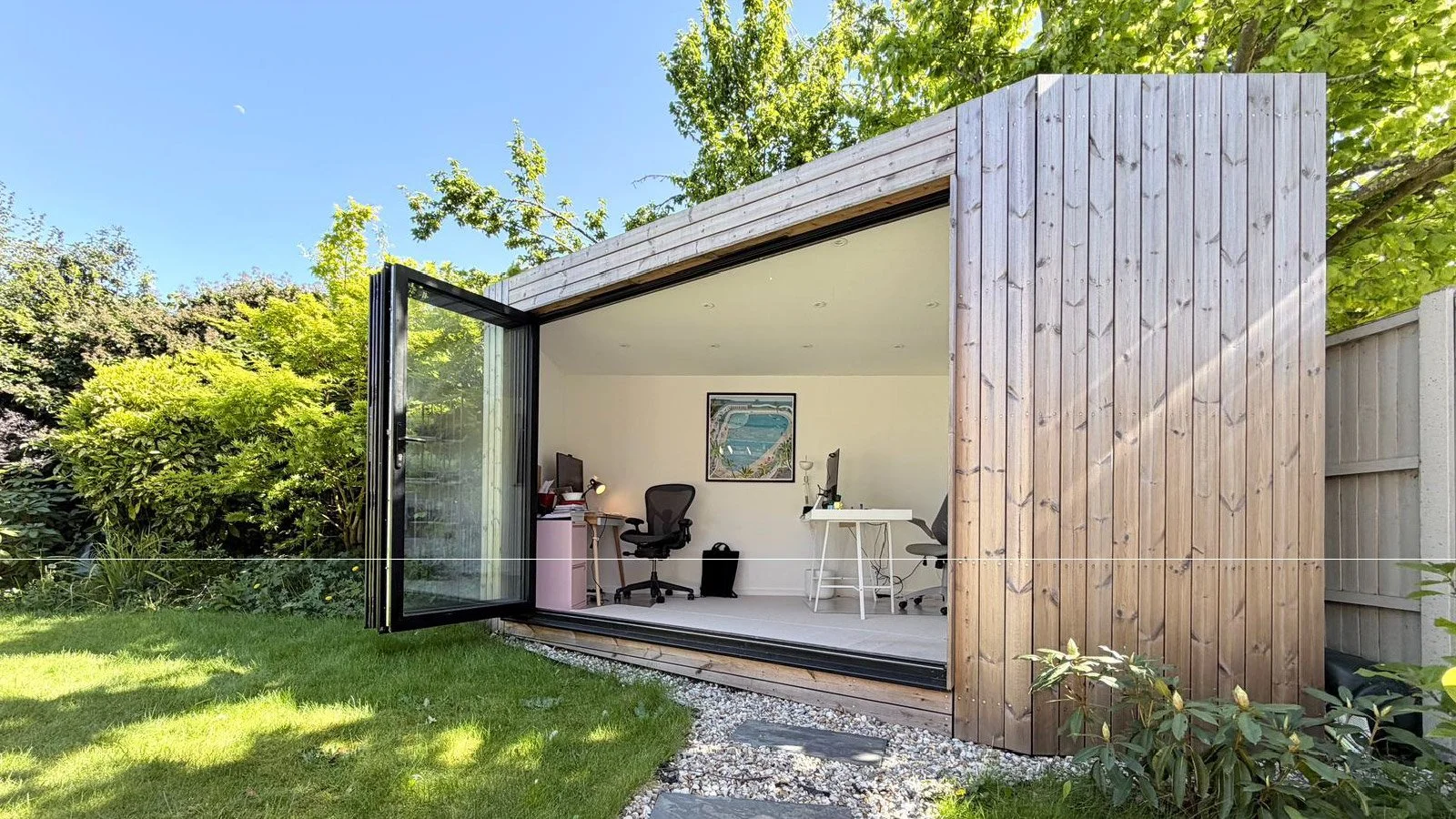
Two Years Later: Revisiting a Berkshire Garden Office Built for Real Everyday Use
What happens to a premium garden office after two years of daily use? We revisit a bespoke SIPs garden office in Berkshire to see how the cladding, insulation, and overall build quality have aged over time.
What actually happens to a garden office after two years of daily use?
That’s one of the biggest questions homeowners ask before investing in a premium garden room — and understandably so. A brand-new cabin always looks impressive on installation day, but long-term performance is what really matters.
Recently, we revisited one of our bespoke garden offices in Wokingham, Berkshire, originally installed for two professionals working from home full-time. Two years later, the cabin is still being used every single day — and the revisit reinforced exactly why build quality, detailing, and proper materials matter so much in the long run.
This wasn’t designed to be a “garden shed with insulation.”
It was designed to feel like a genuine extension of the home.
The Original Brief; A Proper Workspace Separate From the House
The clients already had a large family home, but like many remote professionals, they found that working inside the house blurred the line between work and home life.
Instead of using:
a spare bedroom
the dining table
or a temporary office setup
They wanted a completely separate environment dedicated to work, focus, and routine.
The result was a bespoke 4m x 3m SIPs garden office positioned carefully within the corner of the garden to maximise privacy and usability while maintaining a clean architectural appearance from every angle.
Two years later, the clients still use the cabin daily as their primary workspace.
Why More Homeowners Are Choosing Garden Offices Over Extensions
Across Berkshire, Wokingham, Reading, and the South East, demand for insulated garden offices has increased dramatically in recent years.
For many homeowners, a premium garden room now makes more sense than:
loft conversions
internal renovations
or expensive home extensions
because it creates:
genuine separation from the house
a quieter working environment
faster installation times
lower disruption
and year-round usable space
When designed properly, a garden office becomes more than an outbuilding — it becomes part of how the home functions day-to-day.
The Build Specification
This Berkshire garden office was constructed using the same high-spec methods we use across all of our premium builds.
Key specifications included:
Structural Insulated Panel (SIPs) construction
Double-glazed aluminium bi-fold doors
Fully plastered internal finish
EPDM rubber roofing system
Low-maintenance external detailing
Premium timber cladding
Existing prepared base installation
The focus was not simply on appearance at installation, but on how the cabin would perform after years of real use.
Built for Real Year-Round Performance
This garden office was constructed using high-performance Structural Insulated Panels (SIPs), helping create a workspace that remains comfortable throughout the year.
Unlike many lower-spec garden buildings, SIPs combine structure and insulation into a single high-performance system, improving:
thermal efficiency
airtightness
structural stability
and long-term comfort
Our standard wall build-up delivers thermal performance comparable to many modern house extensions, helping the space stay warm in winter and comfortable in summer with only minimal heating required.
Two years later, the clients still comfortably heat the cabin using a compact electric heater — demonstrating just how effective proper insulation and airtight construction can be in everyday use.
Two Years Later, How Has the Cabin Aged?
One of the most interesting parts of revisiting this project was seeing how naturally the materials had matured over time.
The timber cladding, originally installed in its fresh warm tone, has gradually weathered into a soft silvery-grey finish that now blends beautifully into the surrounding garden.
Importantly, the weathering has occurred evenly across the cabin, creating a far more natural and architectural appearance than many heavily treated timber finishes.
In many ways, the cabin now looks even better than it did when first installed.
Why Exterior Detailing Matters More Than Most People Realise
One thing homeowners often overlook when comparing garden room companies is how the cabin actually looks from around the garden, not just in a front-facing marketing photo.
At Backyard Cabins, we believe a garden room should look premium from every visible angle.
That’s why we continue our cladding around visible side elevations wherever possible rather than focusing only on the front façade.
This creates:
cleaner lines
a more architectural finish
better visual integration into the garden
and a far more premium overall appearance
We also pay close attention to:
trim detailing
material junctions
shadow gaps
and external finishing methods
to avoid the heavily panelled or over-sealed appearance often seen on lower-cost garden buildings.
These details may seem small initially, but they become increasingly noticeable over time.
Why Build Quality Really Matters After the First Winter
One of the biggest differences between premium SIPs garden rooms and lower-cost alternatives only becomes obvious after a few years of ownership.
Many cheaper garden offices can initially look impressive but later develop issues such as:
condensation
poor insulation performance
excessive heating costs
door movement
cold floors
ongoing maintenance problems
For this Berkshire project, long-term usability was prioritised from day one.
Two years later:
the aluminium doors are still operating perfectly
no adjustments have been required
the EPDM roof continues performing flawlessly
the cabin remains warm in winter and comfortable in summer
and the overall structure still feels exceptionally solid
This is exactly why we use Structural Insulated Panels (SIPs) rather than relying solely on traditional timber framing methods.
A garden office should not just survive the first winter — it should continue performing properly for years.
Why Fully Plastered Interiors Make Such a Difference
One of the biggest things clients notice when stepping inside a Backyard Cabin is that the interior feels like a real room rather than a timber outbuilding.
Instead of exposed timber-lined walls, this project was finished with:
fully plastered walls
painted interiors
modern lighting
flooring
and soft furnishings
The result is a space that psychologically feels far closer to a home extension than a typical garden building.
Over time, this becomes incredibly important because the cabin genuinely integrates into daily life rather than feeling like a separate external structure.
Designed for Two People Working From Home
Another key aspect of this project was designing the space to comfortably accommodate two full-time remote workers.
The 4m x 3m footprint allows enough room for:
two desk setups
heating
lighting
storage
and softer home-style furnishings
without feeling cramped or cluttered.
As hybrid and remote working continue growing across Berkshire and the South East, more homeowners are now specifically searching for:
dual home offices
two-person garden offices
and insulated workspaces for couples working remotely together
This project is a strong example of how a compact footprint can still create an extremely functional long-term workspace.
Low Maintenance By Design
No external building is ever truly “zero maintenance,” but modern garden rooms should require as little ongoing upkeep as possible.
This cabin was intentionally designed around:
aluminium glazing
EPDM roofing
natural timber weathering
and durable external detailing
to minimise long-term maintenance requirements.
Even after two years of continuous use, the cabin remains remarkably low maintenance while continuing to look clean, modern, and architecturally sharp.
Why More Berkshire Homeowners Are Choosing Backyard Cabins
Today’s buyers are becoming far more informed about:
insulation quality
construction methods
long-term performance
and architectural detailing
Many homeowners no longer want a “shed-style” garden office.
They want:
a proper insulated room
premium finishes
low maintenance ownership
and something that genuinely adds value to the property
That is exactly the philosophy behind every Backyard Cabins project.
Thinking About Building Your Own Garden Office?
Whether you are planning:
a dedicated home office
a creative studio
a gym
or a multi-use garden room
The materials and construction methods you choose will make a huge difference to how the building performs long term.
A properly built SIPs garden room should still feel warm, solid, and enjoyable to use years after installation — not just on day one.
View Our Garden Room Models & Prices
Explore Images of Our Completed Projects
Request a Personalised Quote
Frequently Asked Questions
How long should a SIPs garden office last?
A professionally installed SIPs garden office built using quality materials should provide excellent long-term performance for many years with minimal maintenance.
Do garden offices get cold in winter?
Properly insulated SIPs garden offices remain comfortable year-round and are designed for daily use throughout winter.
Are garden offices good for two people working from home?
Yes, many modern garden offices are now designed specifically for dual workstations and remote working couples.
Do timber garden rooms require lots of maintenance?
Modern garden rooms using EPDM roofing, aluminium glazing, and quality cladding are generally very low maintenance compared to older timber structures.
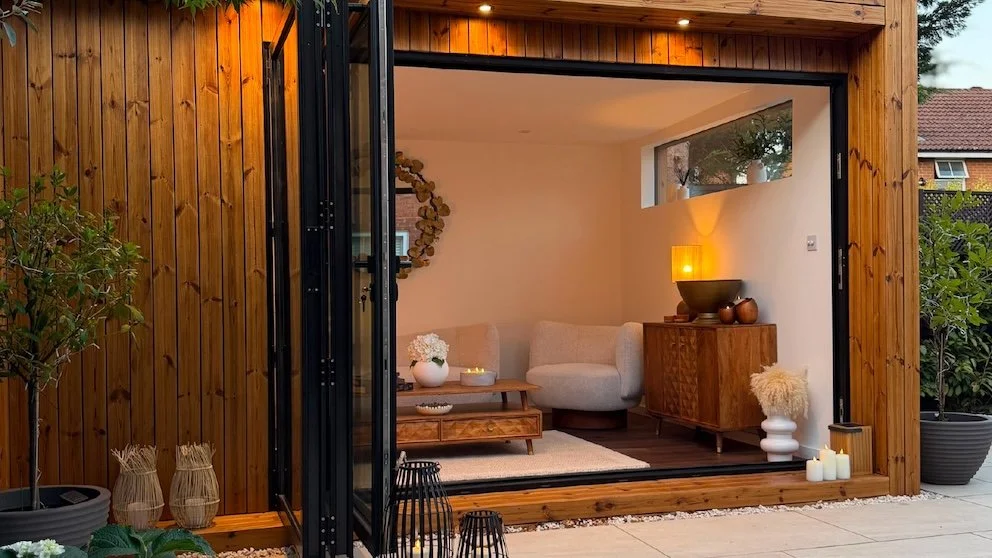
Project Spotlight: A Modern FORZA Garden Office in Lower Earley, Berkshire
A premium FORZA garden office installation in Lower Earley, Berkshire. Explore SIPs construction, glazing, pricing, and modern year-round garden office design.
As remote and hybrid working continue to grow across Berkshire in 2026, more homeowners are investing in dedicated garden offices designed for genuine year-round use.
We are currently on-site in Lower Earley, Berkshire, installing one of our most popular models; the FORZA 4m x 3m garden office.
This project is a strong example of how a professionally designed garden room can create a high-performance workspace without the disruption, cost, or timescale of a traditional extension.
Built using high-spec materials and fully insulated SIPs construction, this FORZA model is designed to function as a proper room, not a seasonal garden building.
Why the FORZA Is One of Our Most Popular Garden Office Models
The FORZA range has become a popular choice for homeowners who want a substantial workspace without overwhelming the garden itself.
At 4m x 3m, it provides enough internal space for:
A dedicated home office
Dual workstation setup
Creative studio
Multi-use workspace
For many homeowners in Lower Earley, Reading, and Wokingham, it offers a far more practical long-term solution than working from a spare bedroom or dining table inside the house.
Designed for Daily Use, Not Just Summer
One of the biggest differences between a premium garden office and a basic garden building is how the space performs during everyday use.
This FORZA build has been designed specifically for:
Year-round comfort
Thermal efficiency
Low maintenance
Long-term durability
Rather than relying on lightweight timber framing, this project uses:
Structural Insulated Panels (SIPs) throughout the walls, floor, and roof.
This creates a space with:
Excellent insulation performance
Improved airtightness
Greater structural stability
More consistent internal temperatures throughout the year
For homeowners looking for a genuine workspace rather than a temporary structure, construction quality makes a significant difference over time.
Architectural Glazing & Natural Light
A major feature of this build is the use of large-format glazing to create a brighter and more open internal environment.
Main Feature:
3000mm Black Aluminium Bi-fold Door
This allows the office to feel visually connected to the garden while maximising natural light throughout the day.
The project also includes:
2000mm x 500mm High-Level Side Window
This detail was specifically chosen to:
Maintain privacy from neighbouring properties
Bring natural light deeper into the workspace
Create a cleaner desk layout internally
This type of glazing layout has become increasingly popular in modern Berkshire developments where gardens are often more compact and privacy is important.
Why SIPs Construction Makes Such a Difference
Not all garden rooms are built to the same standard.
At Backyard Cabins, we use Structural Insulated Panels (SIPs) because they provide significantly better thermal performance, structural strength, and airtightness compared to many traditional timber-framed garden buildings.
This allows us to create garden rooms that feel like genuine extensions of the home, suitable for comfortable daily use throughout the year.
For homeowners investing in a long-term workspace, insulation quality and build performance matter just as much as appearance.
Fast, Clean Installation with Ground Screws
For this Lower Earley installation, we used our:
👉 Ground Screw Foundation System
This modern alternative to concrete foundations offers several advantages:
Faster installation
Minimal excavation
Less disruption to the garden
No waiting for concrete to cure
Adaptable to varying site conditions
Because the system is precise and efficient, we can begin installation immediately and significantly reduce overall project times.
This is one reason why modern SIPs garden rooms can often be installed in a fraction of the time required for traditional building work.
A Realistic Guide to Garden Office Costs in 2026
One of the biggest frustrations for homeowners researching garden rooms is the lack of transparent pricing.
For a professionally installed, fully insulated garden office of this size and specification, projects like this typically sit in the region of:
Around £25,000 including VAT
This level of investment generally reflects:
SIPs construction for year-round insulation
Premium aluminium glazing
Ground screw foundations
High-quality flooring and finishes
Professional installation
The final investment will always vary depending on:
specification
glazing choices
internal finishes
access and site conditions
However, this project gives a realistic example of what a modern, high-spec garden office looks like in practical terms.
Why Garden Offices Are Growing Across Berkshire
In areas like Lower Earley, Reading, Wokingham, and the wider Berkshire area, more homeowners are prioritising dedicated outdoor workspaces.
Common reasons include:
Better separation between work and home life
Increased productivity
Additional usable space without extending the house
Faster installation compared to extensions
A quieter, more professional environment
For many people, a premium insulated garden office has become less of a luxury and more of a practical long-term investment.
Why This FORZA Build Works So Well
This project is a strong example of how thoughtful design can maximise a relatively compact footprint.
Key features include:
Large-format architectural glazing
High-level privacy window
SIPs construction for year-round use
Fast installation with ground screws
Clean, modern architectural styling
Durable low-maintenance materials
The result is a workspace that feels bright, calm, modern, and highly functional for daily use.
Thinking About Your Own Garden Office Project?
If you are considering a garden office in Reading, Lower Earley or the surrounding area, we can help you compare suitable sizes, layouts and prices.
Explore our dedicated guide to garden rooms and garden offices in Reading, browse our cabin range and VAT-inclusive prices, or contact us for a personalised quotation.
View Garden Room Models & Prices
Explore Our Cabin Range
Request a Personalised Quote
Frequently Asked Questions
How much does a garden office cost in 2026?
A professionally installed, fully insulated garden office will vary depending on size and specification. Projects similar to this FORZA installation typically sit around £25,000 including VAT.
Can a garden office be used all year round?
Yes, when built with proper insulation and glazing, a garden office can be used comfortably throughout the year.
What are SIPs panels?
SIPs (Structural Insulated Panels) are high-performance building panels that combine structure and insulation into one system, helping improve thermal performance and energy efficiency.
Do garden offices need concrete foundations?
Not always. Many modern garden rooms now use ground screw foundations, which are faster and less disruptive than traditional concrete bases.
How long does it take to install a garden office?
Most garden offices are installed within 2–3 weeks depending on size, specification, and site conditions.
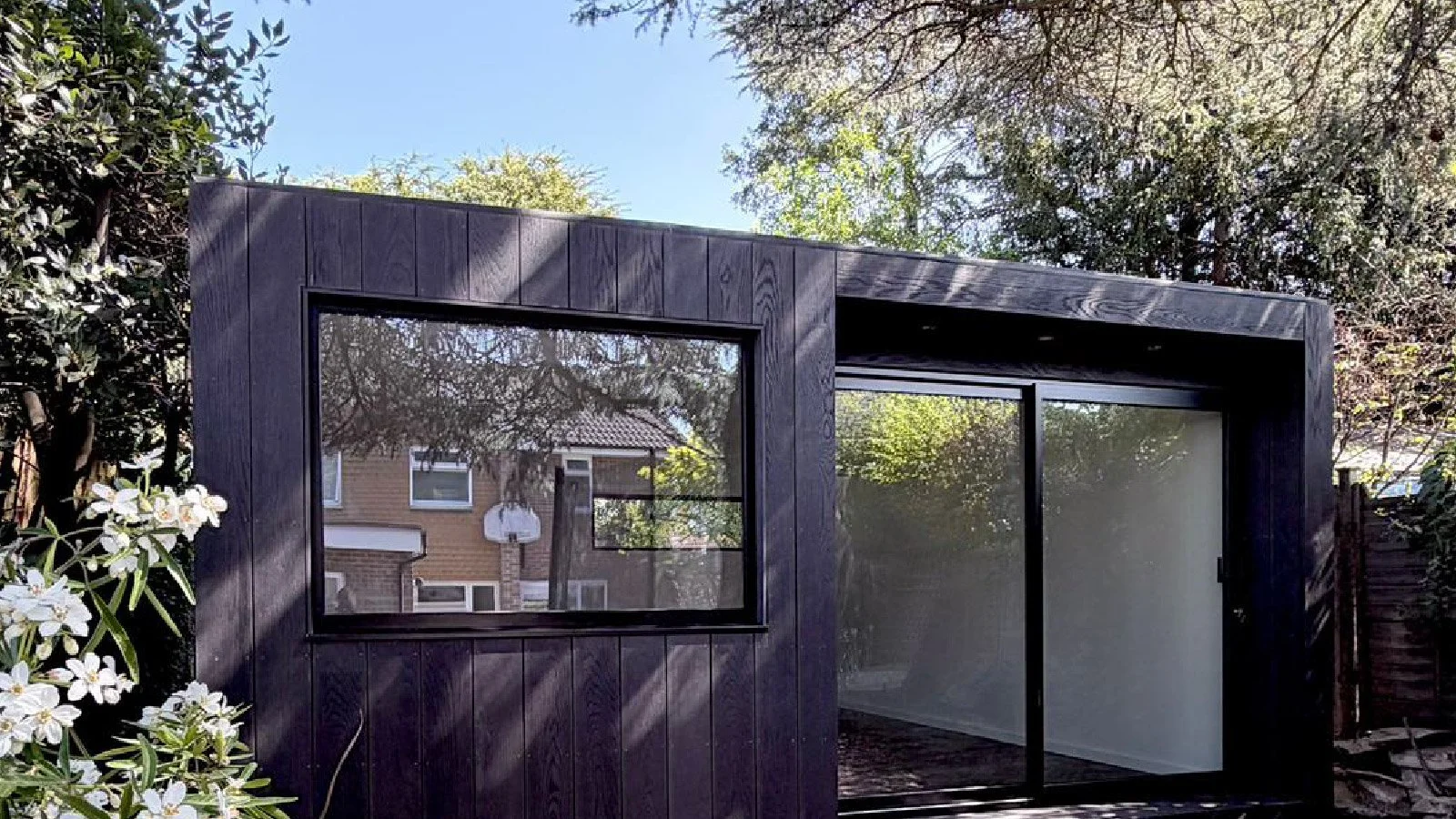
Project Spotlight: A Bespoke 28sqm Multi-Use Garden Room in Twyford, Berkshire (RG10)
A 28sqm bespoke garden room in Twyford, Berkshire (RG10). Explore design, materials, build time, and real project cost for a high-spec garden office.
What does a high-spec, fully bespoke garden room look like in 2026?
We recently completed a 28sqm bespoke garden room in Twyford, Berkshire (RG10), designed to function as a true multi-use space — combining the performance of a modern home extension with the speed and simplicity of a garden room build.
The brief was clear:
Create a large, modern, and thermally efficient space that could be used all year round, without compromise on design or finish.
This bespoke project was fully installed in just 13 working days from start to finish, demonstrating how even larger, high-spec builds can be delivered quickly with the right system and team.
The Specification: A Large-Scale, Bespoke Garden Room
At 4.8m x 6.0m (28sqm), this custom garden room provides a generous internal footprint, suitable for a wide range of uses:
Home office
Studio or creative space
Garden gym
Multi-purpose family room
Larger builds like this require careful planning and precision. For this project, we used SIPs (Structural Insulated Panels) throughout, ensuring both structural integrity and excellent thermal performance.
Who This Garden Room Is Ideal For
A garden room of this size and specification is typically suited to homeowners who need more than just a small office space.
This type of build works particularly well for:
Professionals working from home full-time
Clients needing a dedicated office separate from the house
Multi-use spaces combining work, fitness, and relaxation
Families needing additional flexible living space
Homeowners considering an extension but looking for a faster, simpler alternative
Exterior Design: Clean Lines, Premium Materials
The design focused on a modern, minimalist aesthetic, with a flat roof profile and contrasting materials.
Front Elevation
Premium Millboard Burnt Cedar cladding
Maintenance-free timber effect
Strong architectural presence
Side and Rear Elevations
Black steel sheet cladding
Durable and low maintenance
Clean, contemporary contrast
The result is a garden room that feels like a purpose-built architectural space, not a standard outbuilding.
Glazing & Natural Light: Creating a Bright, Open Space
Natural light was a key part of the design.
We installed:
A large black aluminium sliding door (approx. 2500mm wide)
A fixed front-facing double-glazed window (1700mm x 1200mm)
A bespoke high-level rear window for privacy without losing light
This combination creates a bright, open interior while maintaining privacy — ideal for residential settings like Twyford.
Foundations & Build System: Fast, Clean, and Efficient
For this Berkshire project, we used our ground screw foundation system instead of traditional concrete.
Why ground screws?
No excavation or heavy groundwork
Minimal disruption to the garden
Faster installation
Adaptable to different site conditions
Combined with SIPs construction, this allows for a high-performance build delivered in a fraction of the time of a traditional extension.
Interior Finish: A Fully Turnkey Space
This garden room was completed to a ready-to-use standard, with no further work required.
Interior Specification
Walls: Fully plastered and painted white
Flooring: Karndean LVT flooring
Electrics: Integrated sockets, lighting, and consumer unit
Heating: Smart wall-mounted heater with app control
The result is a space that feels like a natural extension of the home, suitable for daily use all year round.
Why This Garden Room Works So Well
This project highlights what makes a garden room truly successful.
Key factors included:
Size: Large enough to be genuinely multi-functional
Layout: Balanced use of glazing and privacy
Materials: Durable, low-maintenance finishes
Build System: SIPs construction for year-round comfort
Installation: Completed in just 13 working days
Cost & Value: What Did This Project Cost?
For this specific 28sqm bespoke garden room in Twyford, the total build cost was:
£34,000 including VAT
This reflects the size, materials, and high-spec internal finish, including:
SIPs construction for full insulation
Premium external cladding
Aluminium sliding doors and glazing
Fully plastered interior
Karndean LVT flooring
Integrated electrics and heating
For many homeowners, projects like this offer a practical alternative to extensions or loft conversions — delivering a large, usable space with significantly less disruption and a much faster installation time.
Every project we complete is tailored to the client, so costs will vary depending on design, layout, and specification. However, this example gives a clear indication of what a high-quality, fully bespoke garden room of this scale looks like in real terms.
Why Berkshire Homeowners Are Choosing Garden Rooms
In areas like Twyford, Berkshire, garden rooms have become a popular way to create additional space without major building work.
Common reasons include:
Faster installation compared to extensions
Less disruption to the home
Flexible, multi-use space
High-quality finishes suitable for daily use
A Structured, Professional Build Process
Every Backyard Cabins project follows a clear and transparent process:
Initial design and quotation
Technical drawings and planning
Deposit to secure the build slot
Professional installation on-site
Final handover upon completion
Our goal is to deliver a high-spec garden room with a predictable timeline and minimal disruption.
Frequently Asked Questions
How long does it take to build a bespoke garden room?
This project was completed in 13 working days, although timelines vary depending on size and complexity. Most garden rooms are installed within 2–3 weeks.
How much does a garden room like this cost?
This particular 28m² bespoke garden room cost £34,800 including VAT. The cost of a comparable cabin will depend on its dimensions, layout, materials, glazing, foundations and internal specification.
Can a garden room be used all year round?
Yes, when built with proper insulation and glazing, a garden room can be used comfortably throughout the year.
What was included in the £34,800 garden room price?
The £34,800 including VAT project price covered the insulated SIPs structure, ground screw foundations, Millboard and steel exterior cladding, aluminium doors and windows, a plastered and painted interior, Karndean flooring, integrated electrics and heating. Prices for future projects will depend on the dimensions, materials, glazing, foundations and individual specification.
Does a 28m² garden room require planning permission?
Not necessarily. Many garden rooms can be built under permitted development rights, but the position, height, total area, intended use and individual property must all be considered. Listed buildings, conservation areas and properties with restricted permitted development rights may require additional approval. Always check the circumstances applying to your property before proceeding.
Thinking About Your Own Garden Room Project?
If you’re considering a garden room in Berkshire or the surrounding areas, the best place to start is by exploring what’s possible in terms of size, layout, and pricing.
View Garden Room Models & Prices
Explore Our Cabin Range
Request a Personalised Quote
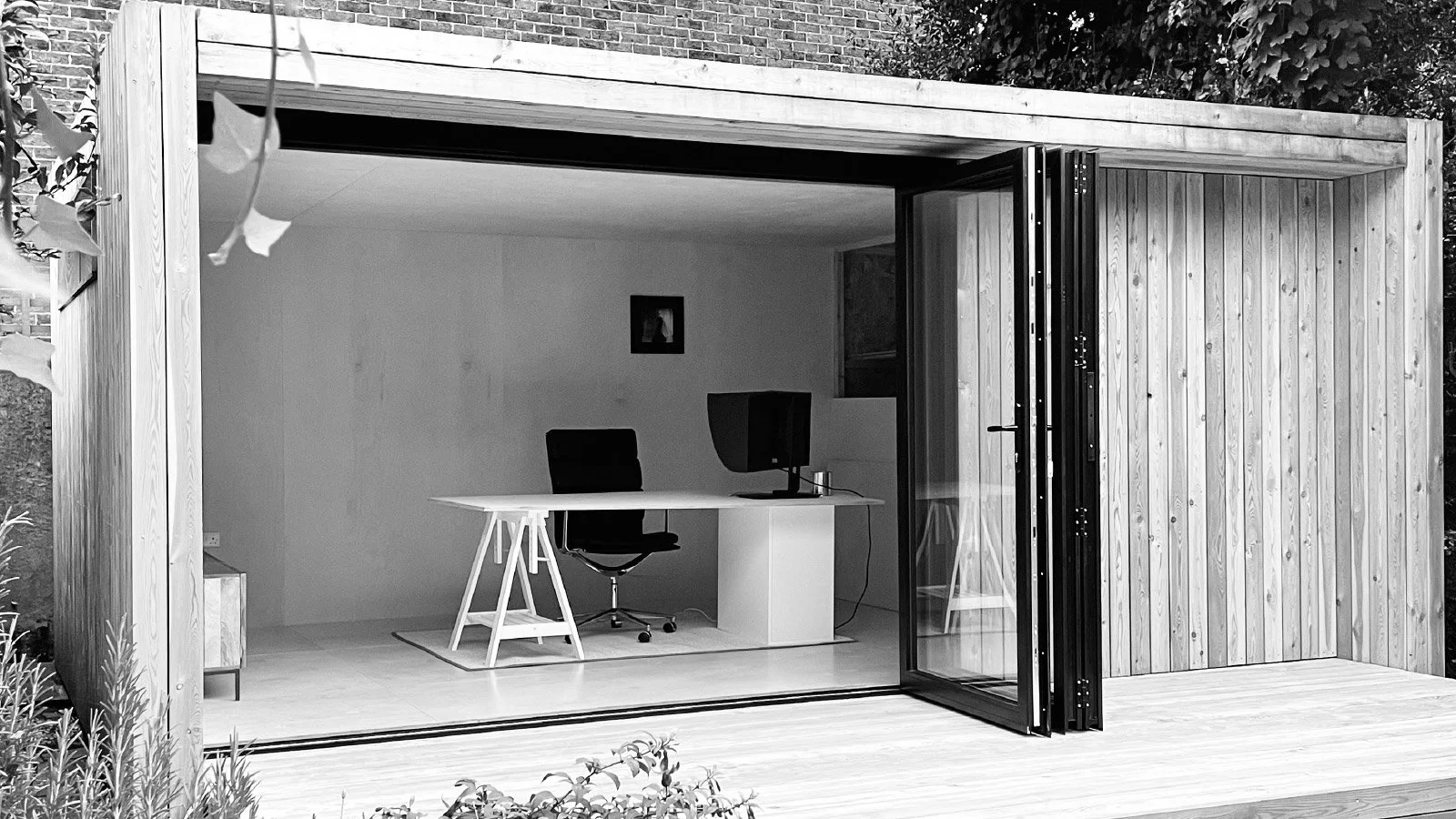
The Business Owner’s Guide to Garden Offices in 2026: Tax, VAT & ROI Explained
A clear guide for UK business owners on garden office tax, VAT, and business use in 2026. Understand key considerations before speaking to your accountant.
If you run a UK business, a garden office isn’t just extra space — it can be a practical, long-term investment in how you work.
But once you start looking into it, the questions quickly go beyond design and cost:
Can my company pay for a garden office?
Can I reclaim VAT on a garden room?
Is it tax deductible?
Will it affect my home’s value in the future?
The honest answer is that there’s no one-size-fits-all approach. The way a garden office is treated for tax and accounting purposes depends heavily on your personal circumstances, how the space is used, and how the purchase is structured.
This guide is designed to help you understand the key considerations, so you can have a more informed conversation with your accountant.
Important Disclaimer
Backyard Cabins are specialists in the design and construction of garden rooms. We are not tax advisors or accountants.
The information below is based on general industry understanding and common approaches used by UK business owners. It is provided for guidance only and does not constitute financial or tax advice.
Tax treatment depends on individual circumstances, and you should always consult a qualified accountant before making any decisions.
Company Purchase vs Personal Purchase: Where Most Decisions Start
One of the first questions business owners ask is:
“Should my company buy the garden office, or should I buy it personally?”
There are generally two common approaches.
Option 1: The Company Purchases the Garden Office
Some business owners choose to have the limited company pay for the garden office directly.
This may allow the business to fund the project without needing to extract personal income first, but it can also introduce additional considerations.
For example:
The building is located on personal land
The space may have mixed use (business and personal)
There could be implications around benefits-in-kind (BIK) depending on usage
This approach can work well in certain scenarios, but it is highly dependent on how the space is used and structured.
Option 2: Personal Purchase with Business Use
Another common approach is to purchase the garden room personally and allow the business to use it.
In this case, some business owners:
Retain full personal ownership
Maintain flexibility over how the space is used
Charge the business a reasonable amount for its use
This route is often considered simpler from a long-term ownership perspective, but again, it depends on your specific setup.
👉 This is one of the most important areas to discuss with your accountant early on.
Capital Allowances & Business Expenses: What You Should Know
When it comes to tax efficiency, many business owners look into whether parts of a garden office may be treated differently for accounting purposes.
In general terms:
The main structure of a building is often treated differently from internal elements
Certain components (such as electrics, fittings, or equipment) may sometimes be considered separately
The treatment can vary depending on how the space is used and how the costs are broken down
Because of this, having a clear, itemised quote can be helpful when discussing things with your accountant.
At Backyard Cabins, we can provide detailed breakdowns so your accountant can assess what may or may not be relevant in your specific case.
Can You Reclaim VAT on a Garden Office?
This is one of the most common questions we hear.
If your business is VAT-registered, it may be possible to reclaim VAT on certain costs, but this depends on how the garden office is used.
Things that can influence this include:
Whether the space is used exclusively for business
Whether there is any personal use
How the purchase is structured (company vs personal)
In situations where a space is used partly for business and partly for personal use, some businesses may take a proportionate approach — but this is something your accountant will need to guide you on.
The key takeaway: VAT recovery is possible in some scenarios, but it is not automatic.
Capital Gains Tax (CGT): A Consideration for the Future
Another area often discussed is how a garden office might affect your home when you eventually sell it.
In simple terms:
Homes in the UK typically benefit from Private Residence Relief (PPR)
However, how a garden office is used can influence how that applies
For example:
Exclusive business use may be treated differently from mixed use
Some homeowners choose to maintain a secondary use (e.g. occasional personal use)
This is a long-term consideration, but one that is worth being aware of early on.
ROI: Is a Garden Office a Good Investment?
Beyond tax and accounting, there’s a more practical question:
Is it worth it?
For many business owners, the answer comes down to how the space improves daily life and productivity.
A well-designed, fully insulated garden office can:
Create a dedicated workspace away from the house
Improve focus and separation between work and home life
Add functional, usable space to your property
Make your home more attractive to future buyers
In areas like Wiltshire, Berkshire, and Surrey, buyers increasingly expect homes to have flexible, work-ready spaces.
While every property is different, a high-quality garden room can often enhance both appeal and usability, which can be just as important as pure financial return.
What Makes a Garden Office “Business-Ready”?
If you are considering using your garden room for business purposes, the specification matters.
A proper year-round garden office should include:
Full insulation (walls, floor, and roof)
Double-glazed doors and windows
A clean, plastered internal finish
Proper electrics and lighting
A layout suited to daily use
This is what separates a temporary structure from a long-term working environment.
A Practical Checklist Before You Buy
Before committing to a garden office, it’s worth running through a few key points:
Have you spoken to your accountant about purchase structure?
Do you understand how the space will be used (business vs personal)?
Have you considered VAT implications?
Do you have a clear, itemised quote?
Are you choosing a specification that supports year-round use?
Getting these right early makes everything smoother later.
Ready to Take the Next Step?
If you’re considering a garden office for your business, the best place to start is by understanding what’s available in terms of size, layout, and pricing.
From there, you can have a much more informed conversation with your accountant.
View Garden Room Models & Prices
Request an Itemised Quote for Your Accountant
Frequently Asked Questions
Can my limited company pay for a garden office?
In some cases, yes — but this depends on how the space is used and structured. It’s best to confirm with your accountant.
Can I reclaim VAT on a garden room?
If your business is VAT-registered, this may be possible, depending on usage and setup.
Is a garden office tax deductible in the UK?
Some elements may be treated differently for accounting purposes, but this varies widely. Always check with a qualified accountant.
Is it better to buy personally or through a company?
There is no single “best” option — it depends on your circumstances, usage, and long-term plans.
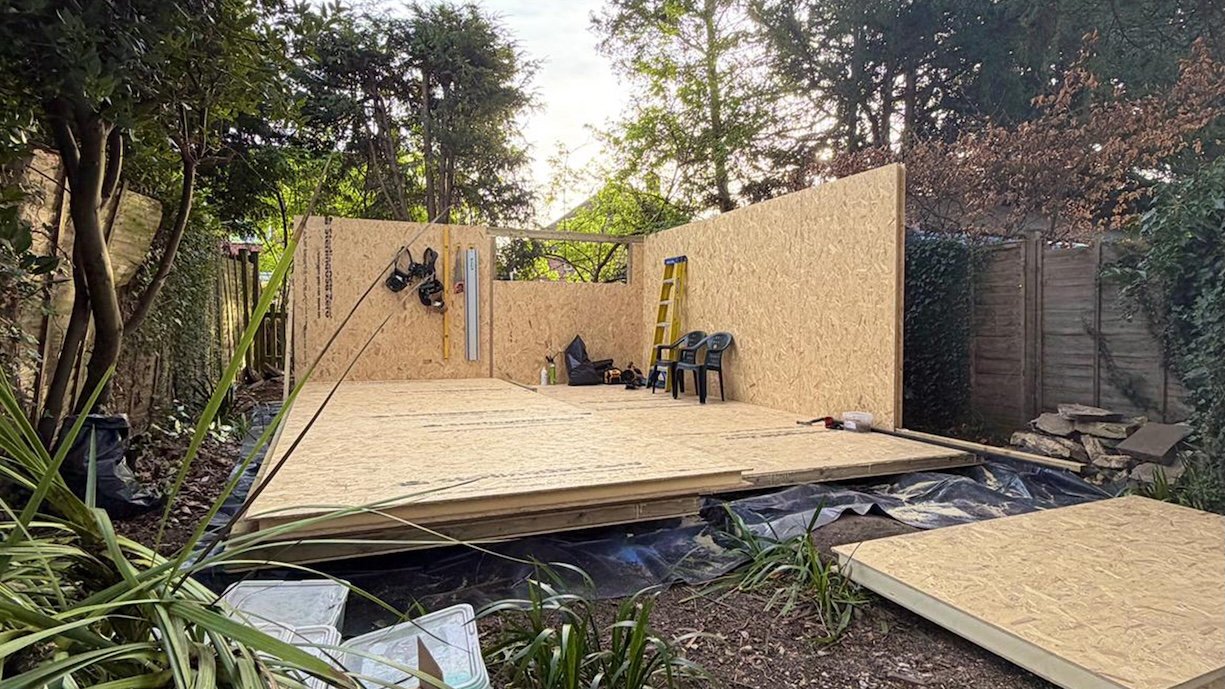
From Foundations to Finish: How We Build a Garden Room in Just 10–15 Days
A step-by-step guide to how long it takes to build a garden room in the UK. Discover our 10–15 day installation process, from ground screws to a fully finished, insulated space.
A high-quality, fully insulated garden room can be installed in as little as 10 working days for standard models like the NEO and FORZA. Larger or bespoke designs typically take up to 15 working days, all delivered with minimal disruption using modern SIPs construction.
One of the biggest concerns for homeowners in 2026 isn’t just the cost of a garden office — it’s the disruption.
Traditional home extensions can leave your property a building site for months, with noise, mess, and constant delays.
At Backyard Cabins, we’ve refined a process that delivers a fully insulated, plastered, and ready-to-use garden room in as little as 10 working days for standard models, and up to 15 days for larger or bespoke designs — all with minimal disruption to your home and garden.
For many of our clients choosing popular models like the NEO or FORZA, the full build is completed in just 10 working days from start to finish.
Here’s exactly how it works.
Week 1: Speed, Precision, and a Watertight Shell
Day 1: The Modern Foundation (No Concrete Required)
Unlike traditional builders, we avoid messy concrete bases wherever possible.
Instead, we use ground screws — a modern, eco-friendly foundation system.
Why this matters:
Installed in hours, not days
No digging or heavy machinery
No waiting for concrete to cure
Minimal disruption to your garden
The result:
We can begin constructing your garden room the very same day.
Day 2–5: The SIPs Build (Fast, Strong, and Insulated)
This is where the transformation happens.
We use SIPs (Structural Insulated Panels) — a high-performance building system where structure and insulation are combined into one.
What this means for you:
Faster build time
Superior insulation performance
Airtight, energy-efficient structure
Timeline:
Day 2–3: Walls installed
Day 4: Roof structure completed
Day 5: Windows and doors fitted
End of Week 1 Milestone:
✔ Fully watertight structure
✔ EPDM rubber roof installed (long-life, low maintenance)
✔ High-performance glazing fitted
At this stage, your garden room is already protected from the elements.
Week 2: Turning a Structure into a Real Room
Once the shell is complete, the focus shifts from construction to comfort.
This is where your garden room becomes a true extension of your home — not just a garden building.
Interior Fit-Out
While the external cladding is installed, our internal team completes the full interior.
Electrics
Consumer unit installed
LED downlights
Double sockets positioned to suit your layout
Walls & Finish
Fully plastered (not timber panelled)
Smooth, modern internal finish
Painted and ready for immediate use
This is a key difference from lower-cost alternatives, which often feel like sheds rather than real rooms.
External Cladding
We install premium cladding options such as:
Thermowood
Larch-style timber
These provide:
Long-term durability
Low maintenance
A clean, modern aesthetic that improves over time
Week 3: Finishing Touches & Handover
The Final Details
The final stage is all about precision and quality.
We complete:
Skirting boards
Flooring (including optional LVT finishes)
External lighting
Final snagging and quality checks
Day 10–15: Clean Finish & Handover
Depending on the size and specification of your build:
Standard models (NEO / FORZA): ~10 working days
Larger or bespoke builds: up to 15 working days
One of our core principles is simple:
We leave your garden exactly as we found it.
That means:
Full waste removal
No leftover materials
No mess or disruption
The only final step:
Your electrician connects power via armoured cable to the pre-installed consumer unit
Garden Room vs Traditional Build: Why This Process Wins
Compared to extensions or loft conversions:
Traditional build:
8–12+ weeks
Heavy disruption
Multiple trades involved
Higher risk of delays
Backyard Cabin:
10–15 working days
Clean, controlled process
Predictable timeline
Minimal disruption
Why a 10–15 Day Build Matters in 2026
In today’s world, speed isn’t just convenient — it’s a major lifestyle advantage.
Key benefits:
No long-term disruption to your home
No building site in your garden
Faster return on investment
Immediate usable space
You go from “no space” to “fully functional room” in under three weeks.
Frequently Asked Questions
How long does it take to build a garden room in the UK?
Most garden rooms take 2–4 weeks, but with our SIPs construction system:
10 working days for standard models (NEO & FORZA)
Up to 15 working days for larger or bespoke builds
Do you need planning permission?
Most garden rooms fall under Permitted Development, meaning planning permission is usually not required.
Is a garden room usable all year round?
Yes — our cabins use SIPs construction, meaning they perform like a fully insulated room, not a seasonal structure.
Do you need a concrete base?
No — we use ground screws, which are faster, cleaner, and more efficient than traditional concrete foundations.
Ready to Transform Your Garden?
If you’re based in Wiltshire, Berkshire, Surrey, or surrounding areas, we can deliver a fully installed garden room in as little as 10 working days.
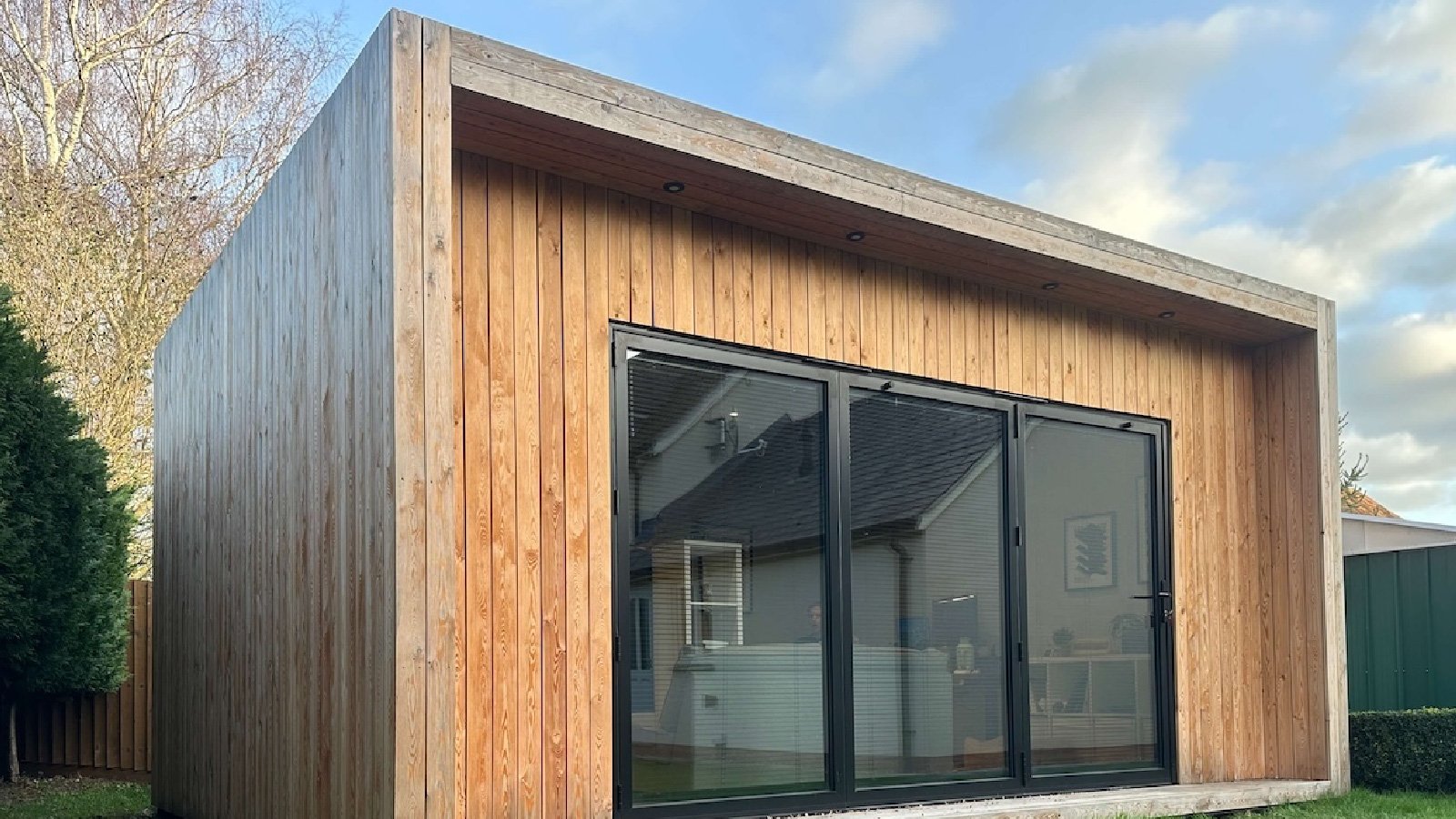
How Much Does a Garden Office Cost in 2026? A Clear UK Budgeting Guide
How much should you budget for a garden office in 2026? Compare complete, fully insulated models from £18,540 including VAT, see what is included, and discover when a custom design may be right for your garden.
If you are researching the cost of a garden office in the UK, you probably want a straightforward answer.
How much should a well-built garden office cost? What is included in the price? What makes one garden room more expensive than another? Most importantly, how can you tell whether you are comparing similar products?
Our complete, fully insulated garden rooms start from £18,540 including VAT. This includes professional installation, flooring, a plastered and painted interior, skirting boards, electrics and a radiator.
We also design and build custom garden rooms. In fact, a large proportion of the cabins we build are adapted or designed around the customer’s garden, preferred layout and intended use.
Garden office prices at a glance
Our current garden room models provide a useful starting point when planning your budget.
The NEO is a compact 3m × 3m garden room priced at £18,540 including VAT.
The FORZA measures 4m × 3m and is priced at £22,740 including VAT.
The LUNA measures 5m × 4m and is priced at £27,540 including VAT.
The META, our largest standard model, measures 6m × 4m and is priced at £33,420 including VAT.
Each model is fully insulated and professionally installed. Flooring, a plastered and white-painted interior, skirting boards, electrics and a radiator are included, giving you a complete garden room that is ready to furnish and use.
These models provide helpful starting points, but many of the cabins we build are customised around the customer’s garden and requirements. We can adjust dimensions, change the position of doors and windows, add internal partitions or create a completely custom design.
View our garden room models, prices and specifications
If you are unsure which size would work best, tell us about your garden and how you plan to use the space. We will help you understand the available options and provide a personalised quotation.
What is included in the price of a Backyard Cabin?
A Backyard Cabin is supplied as a complete garden room. It is not simply an external shell that leaves you to organise several other trades before you can use it.
Our garden rooms include:
A fully insulated SIPs structure, including the walls, floor and roof
Premium external cladding
A durable EPDM roofing system
Aluminium double-glazed doors
Flooring
A plastered interior
Walls painted white
Skirting boards
Internal lighting
External lighting
Electrical sockets and a dedicated consumer unit
A radiator for colder weather
Professional installation by our team
Removal of building waste
A clean finish at the end of the installation
A 10-year structural warranty
Once the agreed electrical supply is connected and the installation is complete, you have a properly finished room that is ready to furnish and use.
Site conditions can vary, so any groundwork, access requirements or electrical connection work that falls outside the standard installation will be discussed clearly before the project begins.
How much should you budget for a garden office in 2026?
For a professionally installed, fully insulated garden office, a realistic starting budget is approximately £18,540 including VAT.
The final cost will depend on the size, design, site conditions and level of customisation. A compact office for one person will normally cost less than a large garden room designed to serve as an office, gym and family space.
The important point is that not every price you see online represents the same type of building.
A low-cost garden building may be supplied as a basic shell. It may not include insulation, foundations, electrics, flooring, plastering, painting, heating or installation. A complete garden office costs more because it is intended to function as a comfortable room throughout the year.
What affects the cost of a garden office?
Several factors determine the final price of a garden office.
1. The size of the garden room
Size has a direct effect on the amount of material, glazing, flooring and labour required.
A 3m × 3m garden office can provide a comfortable workspace for one person without taking over a smaller garden. A 4m × 3m room provides more flexibility for storage, meetings, creative work or exercise.
Larger rooms, such as our 5m × 4m LUNA and 6m × 4m META, can accommodate several uses. They may serve as an office during the working day and become a gym, studio or family room at other times.
Choosing the right size is not simply about buying the largest room your garden can accommodate. It is about creating enough usable space while keeping the building in proportion with the garden.
2. Insulation and all-year comfort
A garden office should be comfortable in January as well as July.
Insulation in the walls, roof and floor helps the room maintain a more stable temperature. Good glazing, proper construction and appropriate heating are equally important.
Our cabins use structural insulated panels, commonly known as SIPs. This construction method creates a precise, robust and well-insulated structure suitable for regular use throughout the year.
Every Backyard Cabin also includes a radiator, helping you remain comfortable during colder weather.
When comparing prices, ask whether the quoted building includes full insulation, heating and a finished interior. Two rooms can look similar in a photograph while offering very different levels of comfort and long-term performance.
3. Standard model or custom design
Our standard models provide clear sizes and prices, but they are not the only options available.
Many of our customers choose a custom garden room. This may involve adjusting the dimensions of an existing model or creating a more individual design.
A custom garden office can be particularly useful when you have:
An unusually shaped garden
Limited access
A narrow or awkward plot
A preferred position for doors and windows
A need for internal partitions
A requirement for integrated storage
A particular architectural style
Several intended uses for the room
Space for a bathroom or other specialist feature
A custom build will normally require an individual quotation because the specification is designed around your requirements. We will explain the cost before work begins, so you can make an informed decision.
Discuss a custom garden room with our team
4. Doors, windows and glazing
Glazing has a significant effect on the appearance and atmosphere of a garden room.
Large doors and windows can create a bright, open interior and provide a stronger connection with the garden. Additional glazing may increase the cost, but it can transform how the room feels and functions.
The right arrangement depends on the room’s orientation, the position of neighbouring properties and how you plan to use the space. A computer-based office may need a different glazing layout from an art studio, gym or treatment room.
5. Ground conditions and access
Every garden is different.
A level site with straightforward access is generally easier to work with than a steep garden, a restricted side passage or a site with difficult ground conditions.
We consider access, levels and the proposed position of the building before confirming the project. If additional preparation is required, we will explain this clearly rather than allowing unexpected costs to appear later.
6. Internal layout and additional features
The way you intend to use the room will influence its design.
A simple home office may need a desk, storage and comfortable lighting. A garden gym may need more open floor space and ventilation. A business, treatment or creative space may require privacy, additional sockets or a separate internal area.
Custom partitions, extra glazing, specialist finishes and other design changes can affect the final price. The advantage of discussing these requirements early is that the room can be designed properly from the beginning.
Complete garden office or basic garden building?
One of the most difficult parts of comparing garden office prices is understanding what each supplier includes.
A low advertised price may cover only the building kit or external structure. Once foundations, installation, insulation, doors, electrics, flooring, heating and decoration are added, the final cost may be very different.
A complete Backyard Cabin includes the features required to turn the building into a comfortable, practical room. Flooring, plastering, painting, skirting boards, electrics and a radiator are all included.
This means you can compare the finished result, rather than comparing our complete price with the initial price of an unfinished structure.
Before accepting any quotation, ask:
Does the price include VAT?
Is professional installation included?
Are the walls, floor and roof insulated?
Are flooring and skirting boards included?
Will the interior be plastered and painted?
Are lighting, sockets and a consumer unit included?
Is heating included?
Are the doors double glazed?
Is waste removal included?
What warranty is provided?
Which site-specific costs could be additional?
Clear answers make it much easier to compare value accurately.
Compare our complete garden room models and prices
Is a garden office cheaper than a loft conversion or extension?
In many cases, a garden office costs considerably less than a loft conversion or traditional extension.
A loft conversion or extension can provide valuable additional space, but it often involves work inside the home, a longer construction period and a larger budget.
A garden office provides a different benefit. It creates a room that is physically separate from the house.
For people working from home, this separation can make it easier to concentrate during the day and switch off when work finishes. It also means that the room does not take over a bedroom, dining room or other part of the house.
A garden office installation will usually cause less disruption than major building work inside the property. Depending on the model and site, our standard garden rooms can be professionally installed in approximately two to three weeks.
The best option depends on how you want to use the space, your available budget and whether separation from the main house is important to you.
Are there any additional costs to consider?
Our model prices include a complete, professionally installed cabin, but some project costs depend on the individual property.
Items that may need to be considered include:
Site-specific groundwork or base preparation
The electrical connection between the house and garden room
Restricted or unusual access
Custom dimensions or layouts
Additional doors or windows
Internal partitions
Specialist heating, cooling or ventilation
Bespoke finishes or fittings
These do not apply to every project. We will assess your requirements and explain what is included before providing a final quotation.
Does a garden office need planning permission?
Many garden offices can be built under permitted development rights, provided the building meets the relevant requirements.
However, planning rules depend on the property, the position and size of the building, and the way it will be used. Additional restrictions may apply to listed buildings, conservation areas and properties where permitted development rights have been removed.
The height of the building and its distance from boundaries are also important considerations.
We design our standard cabins with permitted development guidelines in mind, but every property should be considered individually. If there is any uncertainty, it is sensible to check with the local planning authority before work begins.
Planning permission and Building Regulations are separate matters. Requirements can also change if the building will contain sleeping accommodation or be used in a way that goes beyond a normal home office, studio or leisure room.
Is a garden office worth the investment?
A good garden office can provide much more than somewhere to place a desk.
It can create a quiet place to work, free up space inside the house and provide a flexible room that adapts as your needs change. The same room might later become a studio, gym, hobby room, treatment space or place for older children to study.
The value comes from using the room regularly and choosing a building that remains comfortable and attractive over time.
A cheap structure that is too cold in winter, too hot in summer or difficult to maintain may offer poor value, even if the initial price appears attractive.
A well-designed garden room costs more at the beginning, but it provides a complete and durable space that can become part of everyday life.
Garden offices in Berkshire and surrounding areas
Backyard Cabins is based in Wokingham and builds garden rooms throughout Berkshire and surrounding areas.
We work with homeowners in Reading, Bracknell, Wokingham, Maidenhead, Windsor, Newbury, Slough, Ascot and nearby towns. We also serve customers across Surrey, Oxfordshire, London, Wiltshire and other parts of southern England.
Local gardens vary enormously, from compact town gardens to large rural plots. This is one reason custom design plays such an important role in our work.
Rather than trying to force every customer into the same standard building, we consider the garden, access, surrounding property and intended use. We can then recommend a standard model, adapt one of our existing designs or create a custom cabin.
Which garden office should you choose?
The right garden office depends on the available space and what you want the room to do.
NEO, 3m × 3m, £18,540 including VAT
NEO is a compact garden room designed for smaller gardens and focused workspaces. It is particularly well suited to a comfortable home office for one person.
FORZA, 4m × 3m, £22,740 including VAT
FORZA provides more flexibility while remaining suitable for many residential gardens. It can work as an office, studio, gym or adaptable everyday room.
LUNA, 5m × 4m, £27,540 including VAT
LUNA offers substantially more floor space and is ideal for larger offices, shared working, creative studios and rooms with several purposes.
META, 6m × 4m, £33,420 including VAT
META is our largest standard model. It provides the scale required for larger offices, gyms, studios and premium multipurpose spaces.
View all garden room models and prices
If none of these sizes is quite right, we can adapt a model or create a custom garden room around your available space.
Ready to find the right garden office?
The best way to establish an accurate garden office cost is to begin with the size of your garden, how you want to use the room and the features that matter to you.
You can view our standard models, dimensions and VAT-inclusive prices online. If you require something different, contact us to discuss a custom design.
There is no need to know every detail before getting in touch. We can help you understand which size and layout would work best and explain the likely cost clearly.
View garden room models and prices
Request a personalised quotation
Frequently asked questions
What is the average cost of a garden office in the UK in 2026?
A professionally installed and fully insulated garden office will usually cost considerably more than a basic garden building. Backyard Cabins’ complete garden rooms start from £18,540 including VAT.
What is included in a Backyard Cabins garden office?
Our garden rooms include a fully insulated structure, premium cladding, double-glazed doors, flooring, a plastered and white-painted interior, skirting boards, lighting, electrical sockets, a consumer unit, a radiator, professional installation, waste removal and a 10-year structural warranty.
Site-specific groundwork and the electrical connection from the house will be confirmed as part of the quotation.
Can you build a custom garden office?
Yes. Custom builds make up a large part of our work. We can change the dimensions, door and window positions, internal layout and other features to suit your garden and intended use.
Is VAT included in your garden office prices?
Yes. The prices shown in this guide and on our cabin range page include VAT.
How long does it take to install a garden office?
Our standard garden rooms can usually be installed in approximately two to three weeks, depending on the model, site and agreed specification. A custom project may have a different schedule.
Is a garden office suitable for use during winter?
Yes. Our cabins use fully insulated SIPs construction and include a radiator, making them suitable for comfortable use throughout the year.
Is a garden office cheaper than a loft conversion?
In many cases, a garden office is less expensive and causes less disruption than a loft conversion. It also creates useful separation between work and home life.
Does a garden office need planning permission?
Many garden offices fall within permitted development rights, but this depends on the property, building dimensions, position and intended use. Listed buildings, conservation areas and other restrictions may require additional consideration.
Do your prices include installation?
Yes. Professional installation is included in the prices shown for our standard garden room models.
What size garden office do I need?
A 3m × 3m room can provide a comfortable individual office. Larger sizes provide more space for storage, meetings, exercise, creative work or several uses. We can help you choose a suitable size after discussing your garden and requirements.
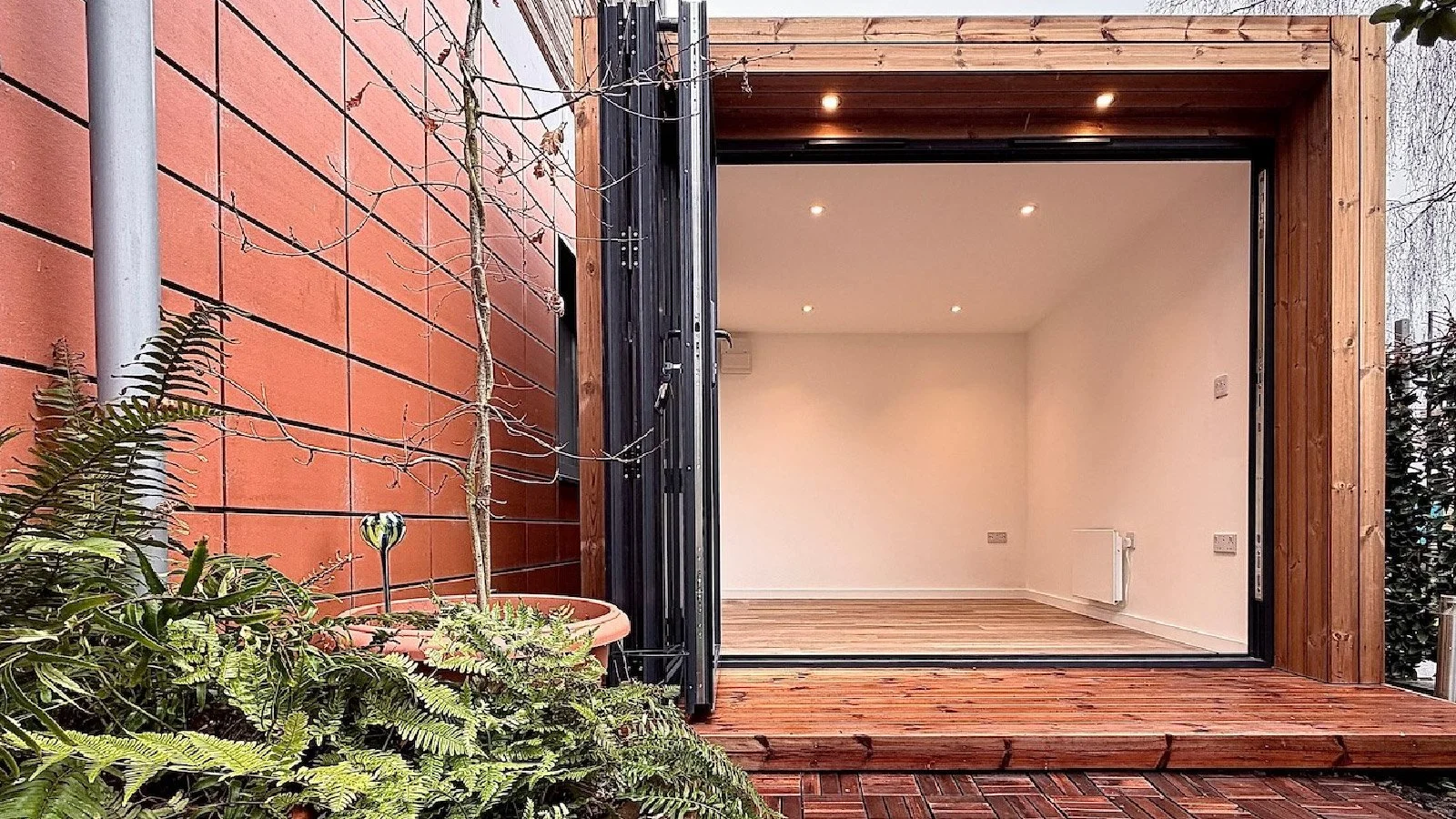
Garden Room vs Loft Conversion: Which Is Better in 2026?
Garden room or loft conversion? Compare costs, build time, planning rules, and lifestyle benefits to find the best option for your home in 2026.
When homeowners start to outgrow their space, two options usually come up:
a garden room
a loft conversion
Both can add value, both can transform how you live, and both require a significant investment.
But they are fundamentally different in cost, disruption, and long-term flexibility.
In this guide, we break down the real differences so you can make a confident, informed decision.
Garden Room vs Loft Conversion: Key Differences
When comparing a garden room and a loft conversion, the differences become clear quite quickly.
A garden room is typically far more cost-effective, with prices starting from around £15,000–£30,000+, depending on size and specification. In contrast, a loft conversion will often start from £40,000 and can exceed £70,000 once structural work, insulation upgrades, stairs, and finishing are included.
Build time is another major factor. A garden room is usually installed within 2–3 weeks once the base is prepared, whereas a loft conversion can take anywhere from 6–12 weeks, often with ongoing disruption inside the home.
That disruption is one of the biggest deciding factors for many homeowners. A loft conversion involves builders working inside your property for weeks, affecting daily life. A garden room, on the other hand, is built externally, keeping your home clean, calm, and usable throughout the process.
Planning permission is also simpler with garden rooms. When designed under 2.5 metres in height, most fall within permitted development and do not require planning permission. Loft conversions are more likely to involve approvals, regulations, and additional complexity.
Finally, flexibility is where garden rooms really stand out. A loft conversion usually has a fixed purpose, such as a bedroom or office. A garden room can evolve over time, changing from a workspace to a gym, studio, or relaxation space as your needs shift.
Cost Comparison: What Do You Actually Pay?
A loft conversion is often seen as the traditional solution, but it comes at a significantly higher cost.
Typical loft conversion costs include structural reinforcements, steel beams, insulation upgrades, staircase installation, electrics, plastering, and decorating. These elements quickly add up, often pushing total costs well beyond initial expectations.
In comparison, a garden room offers a more controlled and transparent investment.
Our garden rooms start from:
NEO (3m x 3m): from £15,450 + VAT
Ideal for smaller gardens or dedicated home offices.
FORZA (4m x 3m): from £18,950 + VAT
A versatile mid-size space suited to offices, studios, or multi-purpose use.
LUNA (5m x 4m): from £22,950 + VAT
A spacious garden room designed for shared use, studios, or flexible family spaces.
META (6m x 4m): from £27,850 + VAT
Our largest model, ideal for home gyms, entertaining, or multi-functional living.
Even when factoring in groundwork and electrical connection, a garden room is typically far more cost-effective overall.
For many homeowners, the decision becomes less about adding space, and more about creating better space.
Build Time and Disruption
The difference in build experience is significant.
A loft conversion can take between 6 and 12 weeks, with ongoing noise, dust, and disruption inside your home. Rooms may become temporarily unusable, and daily routines are often affected.
A garden room is far simpler. Once the base is ready, installation is typically completed within 2–3 weeks, depending on the size of the cabin and site conditions.
Because the build takes place entirely in your garden, your home remains clean, functional, and undisturbed throughout.
Planning Permission and Complexity
Planning is often one of the biggest concerns when starting a project.
Loft conversions can require planning permission, building regulations approval, and structural calculations, depending on the design and property type.
Garden rooms are much more straightforward. When designed under 2.5m in height and within permitted development guidelines, planning permission is usually not required.
This reduces delays, removes uncertainty, and allows the project to move forward much more efficiently.
Lifestyle Difference: The Biggest Factor
While cost and build time are important, lifestyle is often the deciding factor.
A loft conversion adds space within your home, but it doesn’t change how the space feels.
A garden room offers something completely different: separation.
It creates a clear boundary between home and work, giving you a dedicated environment for focus, creativity, or relaxation, just a few steps from your house.
This is why many homeowners choose garden rooms for:
home offices
creative studios
gyms or wellness spaces
quiet retreats away from the main house
Flexibility Over Time
A loft conversion is typically designed for a specific purpose and remains fixed.
A garden room is far more adaptable.
What starts as a home office can later become a gym, a studio, or a multi-purpose space used by the whole family.
This flexibility is one of the key reasons garden rooms have become increasingly popular in recent years.
Which Option Is Right for You?
A garden room is usually the better choice if you want:
a faster, simpler installation
minimal disruption to your home
a separate, focused space
greater flexibility over time
better overall value
A loft conversion may be more suitable if:
you specifically need an additional bedroom
you are focused on increasing internal square footage
you are prepared for a longer, more complex build
Why More Homeowners Are Choosing Garden Rooms in 2026
With remote working, flexible living, and wellness becoming more important, garden rooms are no longer seen as a luxury.
They are now a practical, long-term solution for creating space without extending the main house.
They offer:
independence from the home
year-round usability
a better balance between work and personal life
Explore Your Options
If you’re considering a garden room, you can explore our range:
Compact spaces: NEO 3x3
Versatile rooms: FORZA 4x3
Larger multi-use spaces: LUNA and META
Or get in touch to discuss your project and find the most suitable option for your garden and lifestyle.
Key Takeaways
Garden rooms are typically more affordable than loft conversions
Installation is faster and far less disruptive
Planning permission is usually not required
Garden rooms offer greater flexibility over time
A separate space can significantly improve how you live and work
Written by Backyard Cabins
This guide was written by the team at Backyard Cabins, specialists in designing and building high-quality, fully insulated garden rooms across the South of England.
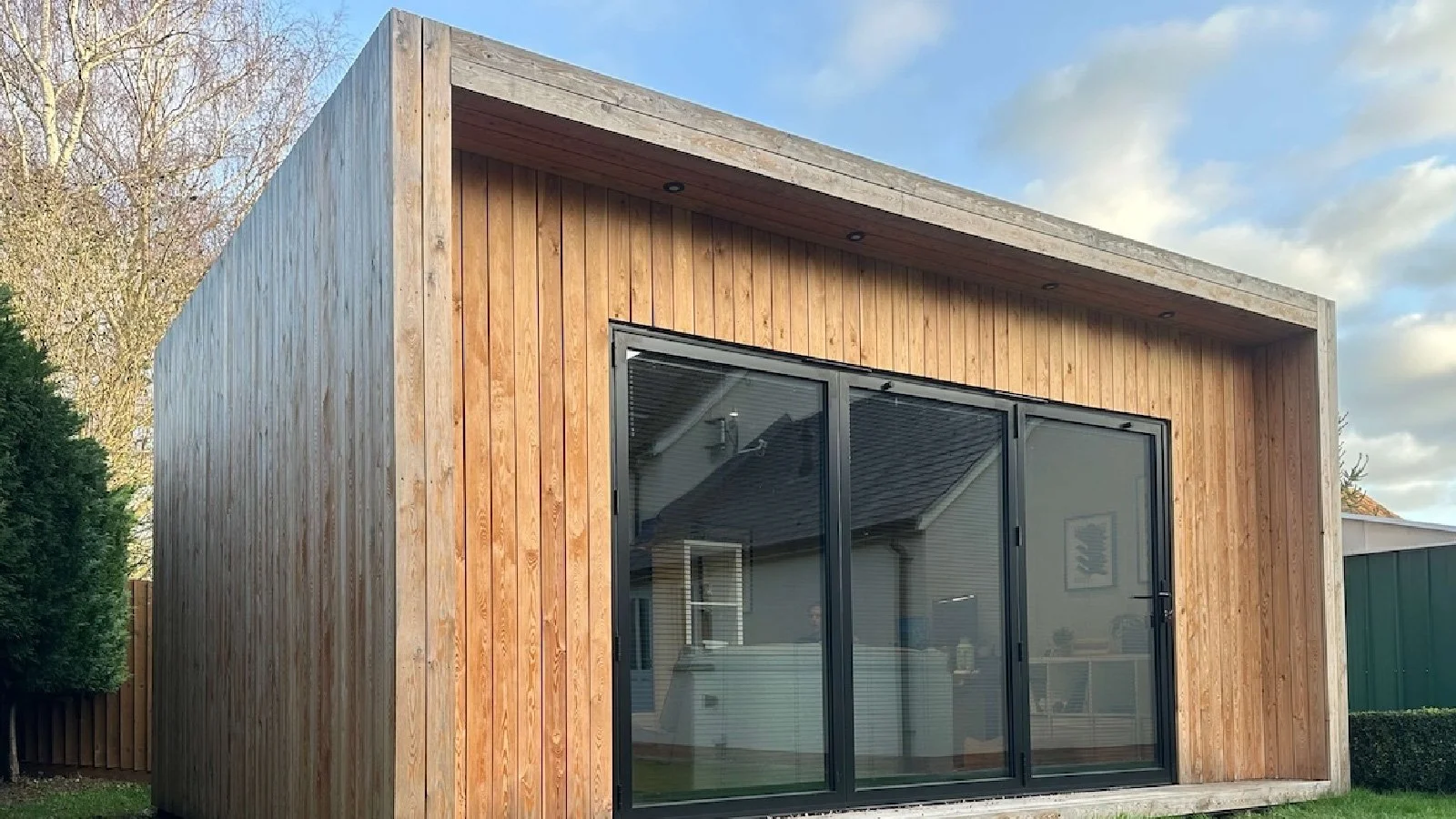
Garden Rooms in London: A Practical Guide to Creating Extra Space Without Extending Your Home
Garden rooms are becoming increasingly popular across London as homeowners look for practical ways to add extra space without extending the main house. Whether used as a garden office, studio, or flexible living area, a well-designed garden room can transform how your home works day-to-day. This guide explains what to consider when planning a garden room in London and how to design a space that works year-round.
Garden Rooms in London: Why More Homeowners Are Choosing Them
Across London, homeowners are increasingly turning to garden rooms as a practical way to create extra space without extending the main house.
Whether the goal is a garden office, studio, gym, or flexible family space, a well-designed garden room can completely transform how a property functions.
Unlike a traditional extension, garden rooms are typically quicker to install, less disruptive, and often fall within permitted development rules.
For many homeowners, they offer the ideal balance between additional living space and maintaining the character of the main house.
If you are considering garden rooms in London, there are several important factors worth understanding before moving forward.
Why Garden Rooms Work Particularly Well in London
London homes often have valuable garden space that is underused.
Instead of extending the house or converting interior rooms, a garden room allows you to create a separate environment within the garden itself.
This separation is particularly valuable in the city where homes are often busy, multi-purpose spaces.
A thoughtfully designed garden room can provide:
a calm workspace away from the house
a studio or creative space
a garden office for remote work
a flexible multi-purpose room
Because the structure sits within the garden, it can provide a sense of separation that is difficult to achieve within the main house.
Garden Offices in London: A Better Way to Work From Home
One of the most common reasons London homeowners install garden rooms is to create a dedicated garden office.
Working from home has become increasingly common, but many properties were not designed with home offices in mind.
Kitchen tables, spare bedrooms, and living rooms often become temporary workspaces, which can make it difficult to maintain a clear boundary between work and home life.
A garden office solves this problem by providing a quiet, dedicated workspace just outside the house.
Many homeowners choose garden offices because they offer:
a calm, focused working environment
natural light and garden views
separation from household activity
flexibility to adapt the space in the future
A garden office can also evolve over time, becoming a studio, consulting room, or creative space depending on how needs change.
Are Garden Rooms Suitable for Year-Round Use?
A common question people ask when researching garden rooms is whether they can be used comfortably throughout the year.
The answer depends entirely on how the building is designed and constructed.
A high-quality garden room should include:
full insulation in the walls, floor, and roof
durable roofing systems
high-performance glazing
proper structural construction
When built properly, a garden room becomes a genuine extension of living space rather than a seasonal feature used only in summer.
Many modern garden rooms are used every day of the year as offices, studios, or relaxation spaces.
Designing a Garden Room for a London Garden
Designing garden rooms in London requires careful consideration.
Gardens are often more compact, neighbouring properties are closer, and privacy becomes more important.
For this reason, good garden room design focuses on:
balanced proportions that suit the garden
glazing that maximises light without sacrificing privacy
positioning that feels natural within the garden
materials that complement the surrounding architecture
A well-designed garden room should feel like a natural part of the landscape rather than simply a structure placed at the end of the garden.
Pre-Designed Garden Rooms vs Bespoke Designs
When planning a garden room, homeowners generally have two options.
Pre-designed garden rooms
Pre-designed cabins offer carefully balanced layouts that work well for common uses such as garden offices, studios, and multi-purpose spaces.
These designs are typically refined over time to maximise usable space, natural light, and practicality.
Bespoke garden rooms
Bespoke designs allow the building to be tailored specifically to the garden.
This can be particularly useful for:
narrow plots
unusual garden shapes
privacy-sensitive spaces
multi-use layouts
Choosing between these options usually depends on the shape of the garden and how the space will be used.
Do Garden Rooms Require Planning Permission in London?
In many cases, garden rooms fall under permitted development, meaning planning permission is not required.
However, there are several conditions that must be met.
Typical considerations include:
height restrictions when close to a boundary
the overall height of the structure
the intended use of the building
Because London gardens can vary significantly, it is always sensible to understand these rules before committing to a design.
Choosing the Right Garden Room Builder
Not all garden rooms are built to the same standard.
When comparing options, it is important to look beyond appearance and consider the quality of construction.
Things to look for include:
insulation and structural design
materials and durability
attention to detail
warranty and long-term reliability
A garden room should be a long-term investment that enhances the property rather than a temporary solution.
Exploring Garden Rooms in London
If you are considering installing a garden room or garden office in London, the best place to start is by exploring different designs and thinking about how the space will be used.
You can learn more about garden rooms and garden offices in London here:
Garden Rooms & Garden Offices in London
Or explore our range of pre-designed garden rooms to see what might suit your garden.
Or if you are considering a fully tailored design, we are always happy to discuss ideas and possibilities.
Speak to us about a bespoke garden room
Final Thoughts
Garden rooms offer one of the most effective ways to create additional space in a London home without extending the main building.
Whether used as a garden office, studio, or flexible multi-purpose space, a well-designed garden room can transform how a property functions day to day.
The key is thoughtful design, quality construction, and ensuring the structure works naturally within the garden.
When those elements come together, a garden room becomes far more than an outbuilding — it becomes a valuable and enjoyable part of the home.
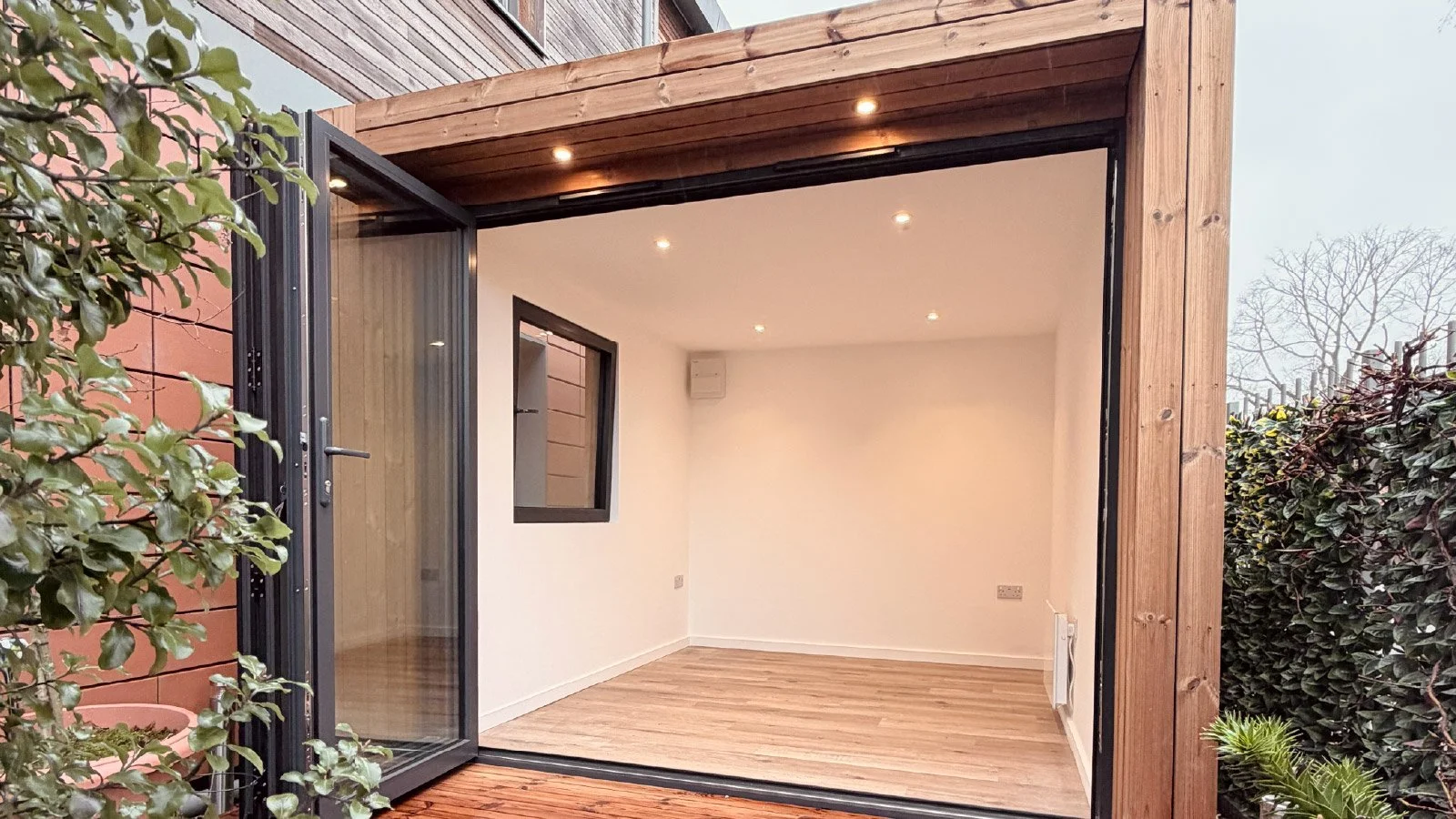
Garden Rooms Surrey – How to Choose the Right Garden Office or Outdoor Space
A practical guide to garden rooms in Surrey. Discover how to choose the right garden office, understand year-round performance, and decide between pre-designed and bespoke options.
Across Surrey, more homeowners are choosing garden rooms as a practical alternative to extensions. Whether the goal is a dedicated garden office, a creative studio, or a flexible multi-purpose space, a well-designed garden room can transform how your home functions, without the disruption of major building work.
If you’re considering a garden room in Surrey, here’s what you should think about before making a decision.
Why Garden Rooms Are Growing in Popularity in Surrey
Surrey homes often benefit from generous gardens, making them ideal for adding usable space without altering the main house.
A garden room offers something unique:
Physical separation from the home
A calm, distraction-free environment
A flexible space that can evolve over time
An alternative to extending or converting interior rooms
For many homeowners, a garden office in Surrey provides the ideal balance between working from home and maintaining boundaries between work and personal life.
Can You Use a Garden Room All Year Round?
One of the most common questions is whether garden rooms are suitable for winter use.
The answer depends entirely on how they’re built.
A high-quality garden room should include:
Full insulation in walls, floor and roof
A strong structural system
Proper waterproofing and breathable membrane protection
Quality glazing to maximise natural light while maintaining comfort
When built correctly, a garden room becomes a true year-round space — not a seasonal summer feature.
Garden Office or Multi-Use Space?
Before choosing a design, it’s important to consider how you’ll use the space day to day.
A garden office typically requires:
Adequate desk and storage space
Strong natural light
A quiet, private setting
But many Surrey homeowners choose to future-proof their investment. What begins as a home office may later become:
A yoga or wellness studio
A garden gym
A consulting or therapy room
A guest or hobby space
Flexibility is key.
Pre-Designed vs Bespoke Garden Rooms in Surrey
When exploring options, you’ll generally have two routes.
Our pre-designed garden rooms offer proven layouts and carefully balanced proportions. They’re ideal if your garden has a straightforward footprint and you want a well-considered, efficient design that works beautifully in everyday use.
You can explore our full range of pre-designed garden cabins to see which size and layout may suit your space.
Bespoke garden rooms, on the other hand, are better suited for:
Narrow or corner plots
Specific layout requirements
Integrated storage solutions
Partitioned or multi-use spaces
The right choice depends on your garden, your lifestyle, and how you want the space to feel long term.
Do Garden Rooms Need Planning Permission in Surrey?
In many cases, garden rooms fall under permitted development. However, this depends on factors such as height, placement and intended use.
For example, there are commonly referenced rules around maximum height when positioned close to a boundary, and different overall limits depending on roof style.
It’s always sensible to understand the basics before committing, particularly if your property has specific planning restrictions.
Choosing the Right Garden Room Builder in Surrey
Not all garden rooms are built to the same standard.
When comparing providers, look beyond appearance and consider:
Construction method and insulation quality
Waterproofing systems
Warranty and longevity
Reviews and completed projects
Whether designs are created in-house
A garden room should be a long-term investment, not a temporary solution.
Explore Garden Rooms in Surrey
If you’re considering a garden room or garden office in Surrey, it’s worth taking the time to explore different layouts, finishes and options before deciding.
You can explore our full guide to garden rooms in Surrey here:
Explore our Garden Rooms in Surrey
Or browse our range of pre-designed cabins and bespoke options to see what might suit your garden best.
Thinking About a Garden Room?
A well-designed garden room can change how you live and work — providing space, separation and flexibility without altering your main home.
If you’re based in Surrey and exploring options, start by understanding how the structure is built, how it performs year-round, and which layout best suits your space.
The right design makes all the difference.
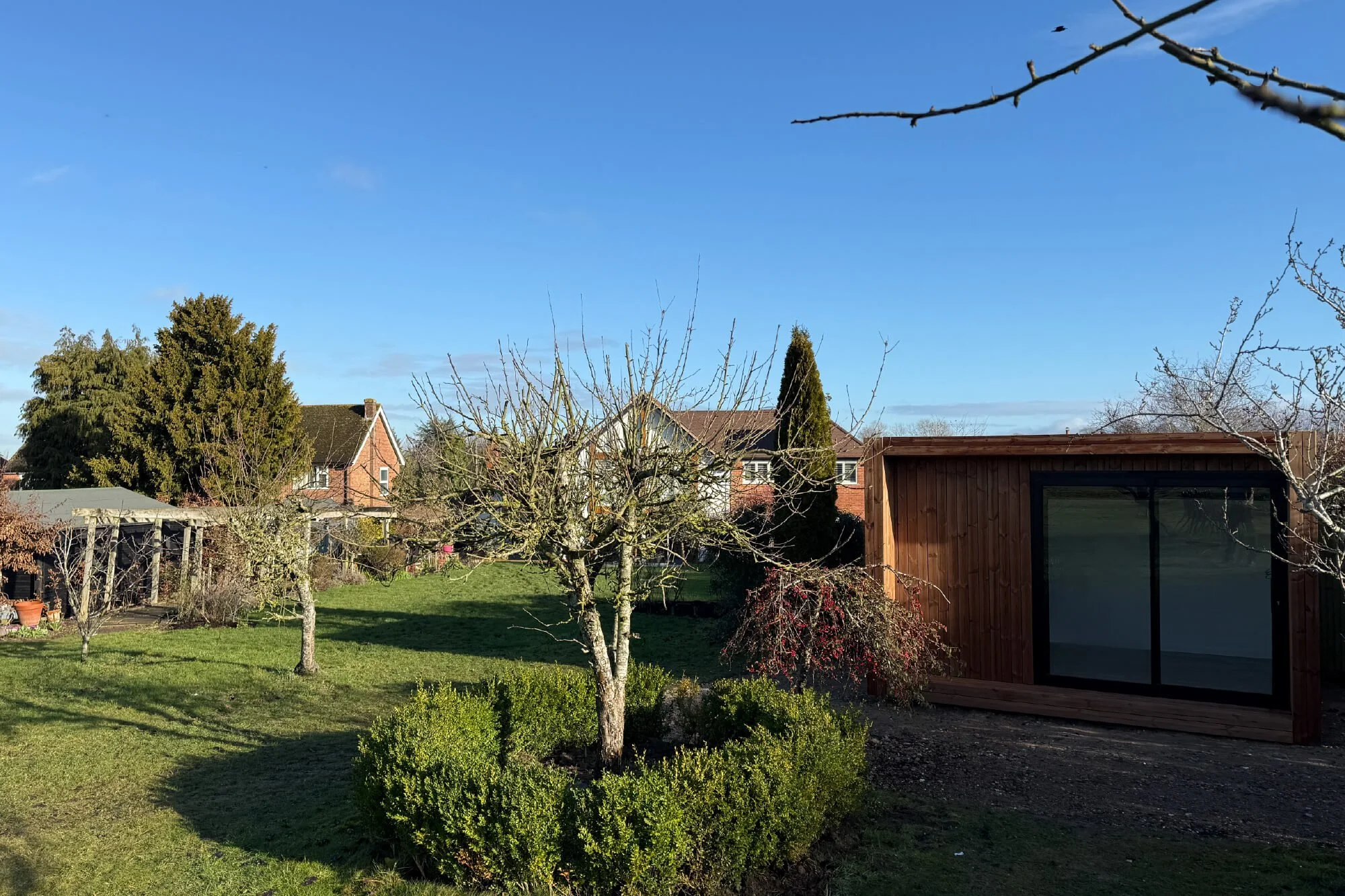
Garden Rooms in Oxfordshire: A Smarter Way to Add Space Without Extending
Garden rooms are becoming a popular alternative to home extensions across Oxfordshire. This guide explains why — from garden offices to year-round use and bespoke design options.
Homeowners across Oxfordshire are increasingly choosing garden rooms as a practical, stylish alternative to traditional home extensions. Whether it’s driven by working from home, growing families, or simply the desire for more usable space, garden rooms offer flexibility without the disruption, cost, or planning complexity of building work.
From Oxford and Abingdon to Henley, Wantage, and surrounding villages, garden rooms are becoming a natural extension of modern living — providing calm, dedicated space just steps from the house.
Why Garden Rooms Are So Popular in Oxfordshire
Oxfordshire homes are incredibly varied — from period properties and cottages to newer developments and rural homes. What many of them have in common is outdoor space that can be used more effectively.
Garden rooms work particularly well in Oxfordshire because they:
Add valuable, usable space without altering the main house
Sit comfortably within both urban and rural gardens
Avoid the disruption and uncertainty of extensions
Can be designed to suit planning-friendly requirements
Offer year-round usability when properly built
For many homeowners, a garden room provides the extra space they need without compromising the character of their home or garden.
Are Garden Rooms Suitable for Year-Round Use?
This is one of the most common questions homeowners ask — and the answer is yes, provided the garden room is designed and built correctly.
High-quality garden rooms use:
Full insulation in walls, floor, and roof
Modern construction methods such as SIPs panels
Durable, weatherproof roofing systems
Double-glazed doors and windows
When these elements are combined, a garden room performs more like a permanent room than a seasonal structure. It stays warm in winter, cool in summer, and comfortable enough for everyday use throughout the year.
This makes garden rooms a long-term investment rather than a short-term solution.
Garden Offices in Oxfordshire – A Better Way to Work From Home
Garden offices are one of the most popular uses for garden rooms across Oxfordshire.
They provide a dedicated workspace that helps separate work from home life while keeping you close enough to step back into the house when needed. Unlike spare rooms or kitchen tables, a garden office offers focus, privacy, and a professional environment.
A garden office can offer:
A quiet, distraction-free workspace
Natural light and views of the garden
Space for desks, storage, and video calls
Flexibility to evolve into a different use over time
Many garden offices later become studios, hobby rooms, or guest spaces — making them one of the most versatile additions to a home.
Pre-Designed vs Bespoke Garden Rooms
When exploring garden rooms in Oxfordshire, homeowners often wonder whether to choose a pre-designed model or go fully bespoke.
Pre-Designed Garden Rooms
Pre-designed garden rooms are ideal for many gardens. They offer proven layouts, balanced proportions, and a faster route from idea to installation. These designs can still be configured with different finishes, glazing options, and layouts.
Bespoke Garden Rooms
Bespoke garden rooms are best suited to:
Awkward or restricted plots
Narrow or corner gardens
Period properties requiring sensitive design
Specific internal requirements such as storage, partitions, or multi-use layouts
The right choice depends on your garden, how you plan to use the space, and how you want it to feel day to day.
Choosing the Right Garden Room Builder in Oxfordshire
Not all garden rooms are created equal. When choosing a garden room company in Oxfordshire, it’s important to look beyond appearance and understand how the room is designed, built, and installed.
Key things to consider include:
Construction method and insulation
Build quality and materials
Longevity and maintenance requirements
Warranty and aftercare
Real customer reviews and completed projects
A garden room should be designed to last, perform well year-round, and age gracefully over time.
Designed for Real Oxfordshire Gardens
Successful garden rooms are those that feel natural within their surroundings. Whether installed in a compact town garden or a larger rural plot, thoughtful design ensures the room complements both the garden and the home.
Well-designed garden rooms balance:
Internal space and light
External proportions and materials
Practical access and positioning
Long-term performance
If you’re researching garden rooms or garden offices in Oxfordshire, taking the time to understand these details makes all the difference.
Explore Garden Rooms in Oxfordshire
A garden room can completely change how you use your home — adding valuable space without the upheaval of a traditional extension.
If you’re based in Oxfordshire and considering a garden room or garden office, it’s worth exploring your options carefully and choosing a design that suits your garden, lifestyle, and long-term plans.
Explore our garden rooms in Oxfordshire
View our range of garden rooms
Learn how our garden rooms are designed and built
Thinking About a Garden Room?
Whether you’re planning a garden office, creative studio, or flexible family space, the right design makes all the difference.
If you’re based in Oxfordshire and would like to discuss ideas, layouts, or possibilities for your garden, we’re always happy to help.
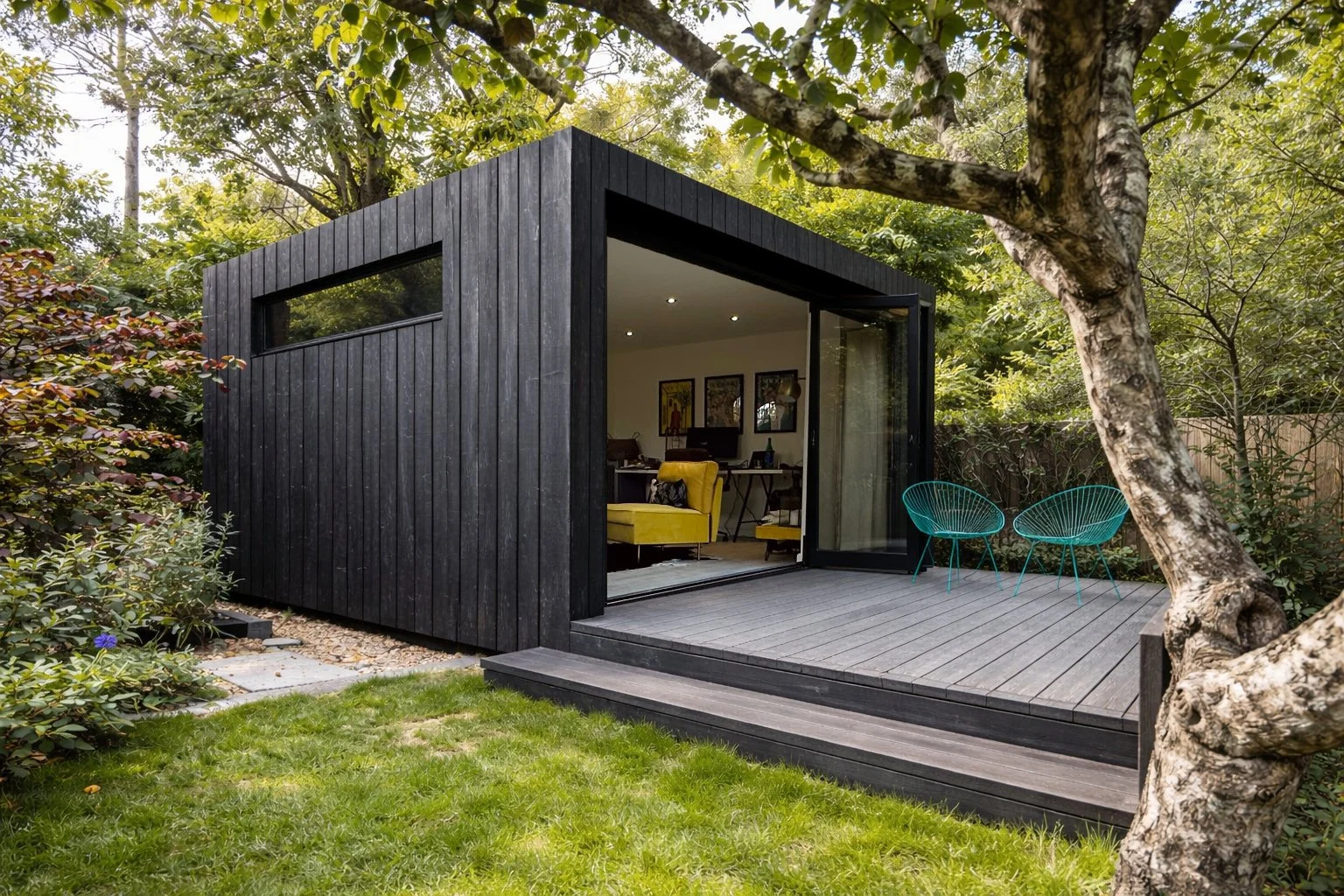
Garden Rooms in Berkshire: A Practical Alternative to Home Extensions
Garden rooms are becoming a popular alternative to home extensions in Berkshire. Explore why more homeowners are choosing garden rooms and garden offices for modern living.
Why More Homeowners in Berkshire Are Choosing Garden Rooms
Across Berkshire, more homeowners are rethinking how they use their space. With working from home becoming the norm for many, and families looking for flexible ways to add usable room without the disruption of building work, garden rooms have become an increasingly popular solution.
A well-designed garden room offers something a traditional extension often can’t: a calm, separate space that feels connected to the home but distinct from it. Whether used as a garden office, studio, gym, or multi-purpose room, garden rooms allow you to adapt your home to modern living without major structural changes.
Are Garden Rooms Suitable for Year-Round Use?
This is one of the most common questions we hear, and the answer is yes, provided they’re built properly.
High-quality garden rooms use full insulation in the walls, floor, and roof, along with modern construction methods that ensure thermal efficiency and comfort in all seasons. When designed correctly, a garden room can be used every day of the year, not just during warmer months.
For homeowners in Berkshire, this makes garden rooms a practical, long-term investment rather than a seasonal feature.
Garden Offices in Berkshire: Creating Space to Work From Home
Garden offices are one of the most popular uses for garden rooms across Berkshire. They provide a quiet, dedicated workspace just steps from the house, helping to separate work from home life while avoiding the commute altogether.
A garden office offers:
A calm, distraction-free environment
Natural light and views of the garden
A professional space for calls and focused work
A flexible room that can evolve over time
Many garden offices later become studios, guest rooms, or hobby spaces, making them a versatile addition to the home.
Pre-Designed vs Bespoke Garden Rooms
When considering a garden room, homeowners often ask whether to choose a pre-designed model or go fully bespoke.
Pre-designed garden rooms work well for many gardens, offering proven layouts and proportions that suit common uses such as home offices or studios. They’re a great starting point and can often be customised with finishes, glazing, and layout options.
Bespoke garden rooms, on the other hand, are ideal for:
Awkward or restricted garden spaces
Corner plots or narrow gardens
Specific requirements such as storage, partitioned layouts, or multi-use spaces
The right choice depends on your garden, how you plan to use the space, and how you want it to feel day to day.
Choosing a Garden Room Builder in Berkshire
Not all garden rooms are created equal. When choosing a garden room builder in Berkshire, it’s important to look beyond appearances and understand how the structure is designed and built.
Key things to consider include:
Construction method and insulation
Build quality and materials
Warranty and longevity
Experience and customer reviews
A garden room should be a long-term addition to your home, designed to perform well and age gracefully over time.
Garden Rooms Designed for Berkshire Homes
Every garden is different, and successful garden rooms are those that sit naturally within their surroundings. From compact town gardens to larger suburban plots, thoughtful design ensures the room complements both the garden and the home.
If you’re exploring options for a garden room or garden office in Berkshire, it’s worth taking the time to understand what’s possible and how different designs perform in real gardens.
Explore our garden rooms in Berkshire
Thinking About a Garden Room?
A garden room can transform how you use your home — providing valuable space without the upheaval of a traditional extension. Whether you’re planning a garden office, a creative studio, or a flexible family space, the right design makes all the difference.
If you’re based in Berkshire and considering a garden room, we’re always happy to talk through ideas, layouts, and options to help you decide what’s right for your space.