
The Business Owner’s Guide to Garden Offices in 2026: Tax, VAT & ROI Explained
A clear guide for UK business owners on garden office tax, VAT, and business use in 2026. Understand key considerations before speaking to your accountant.
If you run a UK business, a garden office isn’t just extra space — it can be a practical, long-term investment in how you work.
But once you start looking into it, the questions quickly go beyond design and cost:
Can my company pay for a garden office?
Can I reclaim VAT on a garden room?
Is it tax deductible?
Will it affect my home’s value in the future?
The honest answer is that there’s no one-size-fits-all approach. The way a garden office is treated for tax and accounting purposes depends heavily on your personal circumstances, how the space is used, and how the purchase is structured.
This guide is designed to help you understand the key considerations, so you can have a more informed conversation with your accountant.
Important Disclaimer
Backyard Cabins are specialists in the design and construction of garden rooms. We are not tax advisors or accountants.
The information below is based on general industry understanding and common approaches used by UK business owners. It is provided for guidance only and does not constitute financial or tax advice.
Tax treatment depends on individual circumstances, and you should always consult a qualified accountant before making any decisions.
Company Purchase vs Personal Purchase: Where Most Decisions Start
One of the first questions business owners ask is:
“Should my company buy the garden office, or should I buy it personally?”
There are generally two common approaches.
Option 1: The Company Purchases the Garden Office
Some business owners choose to have the limited company pay for the garden office directly.
This may allow the business to fund the project without needing to extract personal income first, but it can also introduce additional considerations.
For example:
The building is located on personal land
The space may have mixed use (business and personal)
There could be implications around benefits-in-kind (BIK) depending on usage
This approach can work well in certain scenarios, but it is highly dependent on how the space is used and structured.
Option 2: Personal Purchase with Business Use
Another common approach is to purchase the garden room personally and allow the business to use it.
In this case, some business owners:
Retain full personal ownership
Maintain flexibility over how the space is used
Charge the business a reasonable amount for its use
This route is often considered simpler from a long-term ownership perspective, but again, it depends on your specific setup.
👉 This is one of the most important areas to discuss with your accountant early on.
Capital Allowances & Business Expenses: What You Should Know
When it comes to tax efficiency, many business owners look into whether parts of a garden office may be treated differently for accounting purposes.
In general terms:
The main structure of a building is often treated differently from internal elements
Certain components (such as electrics, fittings, or equipment) may sometimes be considered separately
The treatment can vary depending on how the space is used and how the costs are broken down
Because of this, having a clear, itemised quote can be helpful when discussing things with your accountant.
At Backyard Cabins, we can provide detailed breakdowns so your accountant can assess what may or may not be relevant in your specific case.
Can You Reclaim VAT on a Garden Office?
This is one of the most common questions we hear.
If your business is VAT-registered, it may be possible to reclaim VAT on certain costs, but this depends on how the garden office is used.
Things that can influence this include:
Whether the space is used exclusively for business
Whether there is any personal use
How the purchase is structured (company vs personal)
In situations where a space is used partly for business and partly for personal use, some businesses may take a proportionate approach — but this is something your accountant will need to guide you on.
The key takeaway: VAT recovery is possible in some scenarios, but it is not automatic.
Capital Gains Tax (CGT): A Consideration for the Future
Another area often discussed is how a garden office might affect your home when you eventually sell it.
In simple terms:
Homes in the UK typically benefit from Private Residence Relief (PPR)
However, how a garden office is used can influence how that applies
For example:
Exclusive business use may be treated differently from mixed use
Some homeowners choose to maintain a secondary use (e.g. occasional personal use)
This is a long-term consideration, but one that is worth being aware of early on.
ROI: Is a Garden Office a Good Investment?
Beyond tax and accounting, there’s a more practical question:
Is it worth it?
For many business owners, the answer comes down to how the space improves daily life and productivity.
A well-designed, fully insulated garden office can:
Create a dedicated workspace away from the house
Improve focus and separation between work and home life
Add functional, usable space to your property
Make your home more attractive to future buyers
In areas like Wiltshire, Berkshire, and Surrey, buyers increasingly expect homes to have flexible, work-ready spaces.
While every property is different, a high-quality garden room can often enhance both appeal and usability, which can be just as important as pure financial return.
What Makes a Garden Office “Business-Ready”?
If you are considering using your garden room for business purposes, the specification matters.
A proper year-round garden office should include:
Full insulation (walls, floor, and roof)
Double-glazed doors and windows
A clean, plastered internal finish
Proper electrics and lighting
A layout suited to daily use
This is what separates a temporary structure from a long-term working environment.
A Practical Checklist Before You Buy
Before committing to a garden office, it’s worth running through a few key points:
Have you spoken to your accountant about purchase structure?
Do you understand how the space will be used (business vs personal)?
Have you considered VAT implications?
Do you have a clear, itemised quote?
Are you choosing a specification that supports year-round use?
Getting these right early makes everything smoother later.
Ready to Take the Next Step?
If you’re considering a garden office for your business, the best place to start is by understanding what’s available in terms of size, layout, and pricing.
From there, you can have a much more informed conversation with your accountant.
View Garden Room Models & Prices
Request an Itemised Quote for Your Accountant
Frequently Asked Questions
Can my limited company pay for a garden office?
In some cases, yes — but this depends on how the space is used and structured. It’s best to confirm with your accountant.
Can I reclaim VAT on a garden room?
If your business is VAT-registered, this may be possible, depending on usage and setup.
Is a garden office tax deductible in the UK?
Some elements may be treated differently for accounting purposes, but this varies widely. Always check with a qualified accountant.
Is it better to buy personally or through a company?
There is no single “best” option — it depends on your circumstances, usage, and long-term plans.
From Foundations to Finish: How We Build a Garden Room in Just 10–15 Days
A step-by-step guide to how long it takes to build a garden room in the UK. Discover our 10–15 day installation process, from ground screws to a fully finished, insulated space.
A high-quality, fully insulated garden room can be installed in as little as 10 working days for standard models like the NEO and FORZA. Larger or bespoke designs typically take up to 15 working days, all delivered with minimal disruption using modern SIPs construction.
One of the biggest concerns for homeowners in 2026 isn’t just the cost of a garden office — it’s the disruption.
Traditional home extensions can leave your property a building site for months, with noise, mess, and constant delays.
At Backyard Cabins, we’ve refined a process that delivers a fully insulated, plastered, and ready-to-use garden room in as little as 10 working days for standard models, and up to 15 days for larger or bespoke designs — all with minimal disruption to your home and garden.
For many of our clients choosing popular models like the NEO or FORZA, the full build is completed in just 10 working days from start to finish.
Here’s exactly how it works.
Week 1: Speed, Precision, and a Watertight Shell
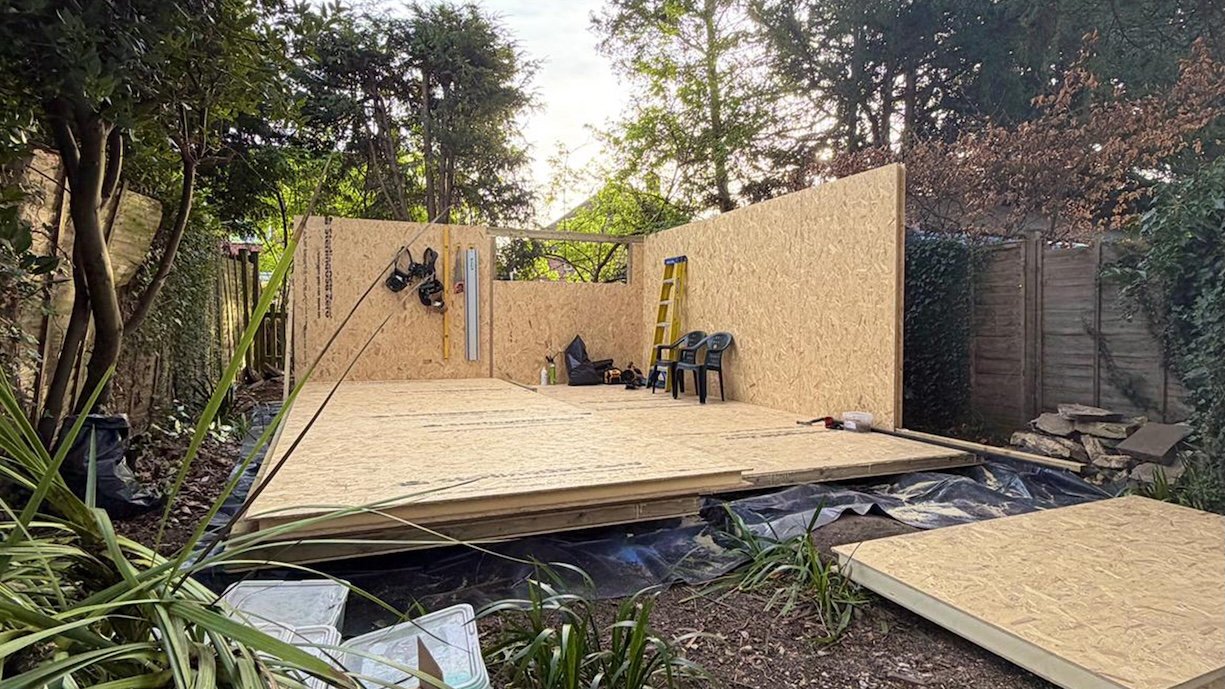
Day 1: The Modern Foundation (No Concrete Required)
Unlike traditional builders, we avoid messy concrete bases wherever possible.
Instead, we use ground screws — a modern, eco-friendly foundation system.
Why this matters:
Installed in hours, not days
No digging or heavy machinery
No waiting for concrete to cure
Minimal disruption to your garden
The result:
We can begin constructing your garden room the very same day.
Day 2–5: The SIPs Build (Fast, Strong, and Insulated)
This is where the transformation happens.
We use SIPs (Structural Insulated Panels) — a high-performance building system where structure and insulation are combined into one.
What this means for you:
Faster build time
Superior insulation performance
Airtight, energy-efficient structure
Timeline:
Day 2–3: Walls installed
Day 4: Roof structure completed
Day 5: Windows and doors fitted
End of Week 1 Milestone:
✔ Fully watertight structure
✔ EPDM rubber roof installed (long-life, low maintenance)
✔ High-performance glazing fitted
At this stage, your garden room is already protected from the elements.
Week 2: Turning a Structure into a Real Room
Once the shell is complete, the focus shifts from construction to comfort.
This is where your garden room becomes a true extension of your home — not just a garden building.
Interior Fit-Out
While the external cladding is installed, our internal team completes the full interior.
Electrics
Consumer unit installed
LED downlights
Double sockets positioned to suit your layout
Walls & Finish
Fully plastered (not timber panelled)
Smooth, modern internal finish
Painted and ready for immediate use
This is a key difference from lower-cost alternatives, which often feel like sheds rather than real rooms.
External Cladding
We install premium cladding options such as:
Thermowood
Larch-style timber
These provide:
Long-term durability
Low maintenance
A clean, modern aesthetic that improves over time
Week 3: Finishing Touches & Handover
The Final Details
The final stage is all about precision and quality.
We complete:
Skirting boards
Flooring (including optional LVT finishes)
External lighting
Final snagging and quality checks
Day 10–15: Clean Finish & Handover
Depending on the size and specification of your build:
Standard models (NEO / FORZA): ~10 working days
Larger or bespoke builds: up to 15 working days
One of our core principles is simple:
We leave your garden exactly as we found it.
That means:
Full waste removal
No leftover materials
No mess or disruption
The only final step:
Your electrician connects power via armoured cable to the pre-installed consumer unit
Garden Room vs Traditional Build: Why This Process Wins
Compared to extensions or loft conversions:
Traditional build:
8–12+ weeks
Heavy disruption
Multiple trades involved
Higher risk of delays
Backyard Cabin:
10–15 working days
Clean, controlled process
Predictable timeline
Minimal disruption
Why a 10–15 Day Build Matters in 2026
In today’s world, speed isn’t just convenient — it’s a major lifestyle advantage.
Key benefits:
No long-term disruption to your home
No building site in your garden
Faster return on investment
Immediate usable space
You go from “no space” to “fully functional room” in under three weeks.
Frequently Asked Questions
How long does it take to build a garden room in the UK?
Most garden rooms take 2–4 weeks, but with our SIPs construction system:
10 working days for standard models (NEO & FORZA)
Up to 15 working days for larger or bespoke builds
Do you need planning permission?
Most garden rooms fall under Permitted Development, meaning planning permission is usually not required.
Is a garden room usable all year round?
Yes — our cabins use SIPs construction, meaning they perform like a fully insulated room, not a seasonal structure.
Do you need a concrete base?
No — we use ground screws, which are faster, cleaner, and more efficient than traditional concrete foundations.
Ready to Transform Your Garden?
If you’re based in Wiltshire, Berkshire, Surrey, or surrounding areas, we can deliver a fully installed garden room in as little as 10 working days.
How Much Does a Garden Office Cost in 2026? A Clear UK Budgeting Guide
How much should you budget for a garden office in 2026? Compare complete, fully insulated models from £18,540 including VAT, see what is included, and discover when a custom design may be right for your garden.
If you are researching the cost of a garden office in the UK, you probably want a straightforward answer.
How much should a well-built garden office cost? What is included in the price? What makes one garden room more expensive than another? Most importantly, how can you tell whether you are comparing similar products?
Our complete, fully insulated garden rooms start from £18,540 including VAT. This includes professional installation, flooring, a plastered and painted interior, skirting boards, electrics and a radiator.
We also design and build custom garden rooms. In fact, a large proportion of the cabins we build are adapted or designed around the customer’s garden, preferred layout and intended use.
Garden office prices at a glance
Our current garden room models provide a useful starting point when planning your budget.
The NEO is a compact 3m × 3m garden room priced at £18,540 including VAT.
The FORZA measures 4m × 3m and is priced at £22,740 including VAT.
The LUNA measures 5m × 4m and is priced at £27,540 including VAT.
The META, our largest standard model, measures 6m × 4m and is priced at £33,420 including VAT.
Each model is fully insulated and professionally installed. Flooring, a plastered and white-painted interior, skirting boards, electrics and a radiator are included, giving you a complete garden room that is ready to furnish and use.
These models provide helpful starting points, but many of the cabins we build are customised around the customer’s garden and requirements. We can adjust dimensions, change the position of doors and windows, add internal partitions or create a completely custom design.
View our garden room models, prices and specifications
If you are unsure which size would work best, tell us about your garden and how you plan to use the space. We will help you understand the available options and provide a personalised quotation.
What is included in the price of a Backyard Cabin?
A Backyard Cabin is supplied as a complete garden room. It is not simply an external shell that leaves you to organise several other trades before you can use it.
Our garden rooms include:
A fully insulated SIPs structure, including the walls, floor and roof
Premium external cladding
A durable EPDM roofing system
Aluminium double-glazed doors
Flooring
A plastered interior
Walls painted white
Skirting boards
Internal lighting
External lighting
Electrical sockets and a dedicated consumer unit
A radiator for colder weather
Professional installation by our team
Removal of building waste
A clean finish at the end of the installation
A 10-year structural warranty
Once the agreed electrical supply is connected and the installation is complete, you have a properly finished room that is ready to furnish and use.
Site conditions can vary, so any groundwork, access requirements or electrical connection work that falls outside the standard installation will be discussed clearly before the project begins.
How much should you budget for a garden office in 2026?
For a professionally installed, fully insulated garden office, a realistic starting budget is approximately £18,540 including VAT.
The final cost will depend on the size, design, site conditions and level of customisation. A compact office for one person will normally cost less than a large garden room designed to serve as an office, gym and family space.
The important point is that not every price you see online represents the same type of building.
A low-cost garden building may be supplied as a basic shell. It may not include insulation, foundations, electrics, flooring, plastering, painting, heating or installation. A complete garden office costs more because it is intended to function as a comfortable room throughout the year.
What affects the cost of a garden office?
Several factors determine the final price of a garden office.
1. The size of the garden room
Size has a direct effect on the amount of material, glazing, flooring and labour required.
A 3m × 3m garden office can provide a comfortable workspace for one person without taking over a smaller garden. A 4m × 3m room provides more flexibility for storage, meetings, creative work or exercise.
Larger rooms, such as our 5m × 4m LUNA and 6m × 4m META, can accommodate several uses. They may serve as an office during the working day and become a gym, studio or family room at other times.
Choosing the right size is not simply about buying the largest room your garden can accommodate. It is about creating enough usable space while keeping the building in proportion with the garden.
2. Insulation and all-year comfort
A garden office should be comfortable in January as well as July.
Insulation in the walls, roof and floor helps the room maintain a more stable temperature. Good glazing, proper construction and appropriate heating are equally important.
Our cabins use structural insulated panels, commonly known as SIPs. This construction method creates a precise, robust and well-insulated structure suitable for regular use throughout the year.
Every Backyard Cabin also includes a radiator, helping you remain comfortable during colder weather.
When comparing prices, ask whether the quoted building includes full insulation, heating and a finished interior. Two rooms can look similar in a photograph while offering very different levels of comfort and long-term performance.
3. Standard model or custom design
Our standard models provide clear sizes and prices, but they are not the only options available.
Many of our customers choose a custom garden room. This may involve adjusting the dimensions of an existing model or creating a more individual design.
A custom garden office can be particularly useful when you have:
An unusually shaped garden
Limited access
A narrow or awkward plot
A preferred position for doors and windows
A need for internal partitions
A requirement for integrated storage
A particular architectural style
Several intended uses for the room
Space for a bathroom or other specialist feature
A custom build will normally require an individual quotation because the specification is designed around your requirements. We will explain the cost before work begins, so you can make an informed decision.
Discuss a custom garden room with our team
4. Doors, windows and glazing
Glazing has a significant effect on the appearance and atmosphere of a garden room.
Large doors and windows can create a bright, open interior and provide a stronger connection with the garden. Additional glazing may increase the cost, but it can transform how the room feels and functions.
The right arrangement depends on the room’s orientation, the position of neighbouring properties and how you plan to use the space. A computer-based office may need a different glazing layout from an art studio, gym or treatment room.
5. Ground conditions and access
Every garden is different.
A level site with straightforward access is generally easier to work with than a steep garden, a restricted side passage or a site with difficult ground conditions.
We consider access, levels and the proposed position of the building before confirming the project. If additional preparation is required, we will explain this clearly rather than allowing unexpected costs to appear later.
6. Internal layout and additional features
The way you intend to use the room will influence its design.
A simple home office may need a desk, storage and comfortable lighting. A garden gym may need more open floor space and ventilation. A business, treatment or creative space may require privacy, additional sockets or a separate internal area.
Custom partitions, extra glazing, specialist finishes and other design changes can affect the final price. The advantage of discussing these requirements early is that the room can be designed properly from the beginning.
Complete garden office or basic garden building?
One of the most difficult parts of comparing garden office prices is understanding what each supplier includes.
A low advertised price may cover only the building kit or external structure. Once foundations, installation, insulation, doors, electrics, flooring, heating and decoration are added, the final cost may be very different.
A complete Backyard Cabin includes the features required to turn the building into a comfortable, practical room. Flooring, plastering, painting, skirting boards, electrics and a radiator are all included.
This means you can compare the finished result, rather than comparing our complete price with the initial price of an unfinished structure.
Before accepting any quotation, ask:
Does the price include VAT?
Is professional installation included?
Are the walls, floor and roof insulated?
Are flooring and skirting boards included?
Will the interior be plastered and painted?
Are lighting, sockets and a consumer unit included?
Is heating included?
Are the doors double glazed?
Is waste removal included?
What warranty is provided?
Which site-specific costs could be additional?
Clear answers make it much easier to compare value accurately.
Compare our complete garden room models and prices
Is a garden office cheaper than a loft conversion or extension?
In many cases, a garden office costs considerably less than a loft conversion or traditional extension.
A loft conversion or extension can provide valuable additional space, but it often involves work inside the home, a longer construction period and a larger budget.
A garden office provides a different benefit. It creates a room that is physically separate from the house.
For people working from home, this separation can make it easier to concentrate during the day and switch off when work finishes. It also means that the room does not take over a bedroom, dining room or other part of the house.
A garden office installation will usually cause less disruption than major building work inside the property. Depending on the model and site, our standard garden rooms can be professionally installed in approximately two to three weeks.
The best option depends on how you want to use the space, your available budget and whether separation from the main house is important to you.
Are there any additional costs to consider?
Our model prices include a complete, professionally installed cabin, but some project costs depend on the individual property.
Items that may need to be considered include:
Site-specific groundwork or base preparation
The electrical connection between the house and garden room
Restricted or unusual access
Custom dimensions or layouts
Additional doors or windows
Internal partitions
Specialist heating, cooling or ventilation
Bespoke finishes or fittings
These do not apply to every project. We will assess your requirements and explain what is included before providing a final quotation.
Does a garden office need planning permission?
Many garden offices can be built under permitted development rights, provided the building meets the relevant requirements.
However, planning rules depend on the property, the position and size of the building, and the way it will be used. Additional restrictions may apply to listed buildings, conservation areas and properties where permitted development rights have been removed.
The height of the building and its distance from boundaries are also important considerations.
We design our standard cabins with permitted development guidelines in mind, but every property should be considered individually. If there is any uncertainty, it is sensible to check with the local planning authority before work begins.
Planning permission and Building Regulations are separate matters. Requirements can also change if the building will contain sleeping accommodation or be used in a way that goes beyond a normal home office, studio or leisure room.
Is a garden office worth the investment?
A good garden office can provide much more than somewhere to place a desk.
It can create a quiet place to work, free up space inside the house and provide a flexible room that adapts as your needs change. The same room might later become a studio, gym, hobby room, treatment space or place for older children to study.
The value comes from using the room regularly and choosing a building that remains comfortable and attractive over time.
A cheap structure that is too cold in winter, too hot in summer or difficult to maintain may offer poor value, even if the initial price appears attractive.
A well-designed garden room costs more at the beginning, but it provides a complete and durable space that can become part of everyday life.
Garden offices in Berkshire and surrounding areas
Backyard Cabins is based in Wokingham and builds garden rooms throughout Berkshire and surrounding areas.
We work with homeowners in Reading, Bracknell, Wokingham, Maidenhead, Windsor, Newbury, Slough, Ascot and nearby towns. We also serve customers across Surrey, Oxfordshire, London, Wiltshire and other parts of southern England.
Local gardens vary enormously, from compact town gardens to large rural plots. This is one reason custom design plays such an important role in our work.
Rather than trying to force every customer into the same standard building, we consider the garden, access, surrounding property and intended use. We can then recommend a standard model, adapt one of our existing designs or create a custom cabin.
Which garden office should you choose?
The right garden office depends on the available space and what you want the room to do.
NEO, 3m × 3m, £18,540 including VAT
NEO is a compact garden room designed for smaller gardens and focused workspaces. It is particularly well suited to a comfortable home office for one person.
FORZA, 4m × 3m, £22,740 including VAT
FORZA provides more flexibility while remaining suitable for many residential gardens. It can work as an office, studio, gym or adaptable everyday room.
LUNA, 5m × 4m, £27,540 including VAT
LUNA offers substantially more floor space and is ideal for larger offices, shared working, creative studios and rooms with several purposes.
META, 6m × 4m, £33,420 including VAT
META is our largest standard model. It provides the scale required for larger offices, gyms, studios and premium multipurpose spaces.
View all garden room models and prices
If none of these sizes is quite right, we can adapt a model or create a custom garden room around your available space.
Ready to find the right garden office?
The best way to establish an accurate garden office cost is to begin with the size of your garden, how you want to use the room and the features that matter to you.
You can view our standard models, dimensions and VAT-inclusive prices online. If you require something different, contact us to discuss a custom design.
There is no need to know every detail before getting in touch. We can help you understand which size and layout would work best and explain the likely cost clearly.
View garden room models and prices
Request a personalised quotation
Frequently asked questions
What is the average cost of a garden office in the UK in 2026?
A professionally installed and fully insulated garden office will usually cost considerably more than a basic garden building. Backyard Cabins’ complete garden rooms start from £18,540 including VAT.
What is included in a Backyard Cabins garden office?
Our garden rooms include a fully insulated structure, premium cladding, double-glazed doors, flooring, a plastered and white-painted interior, skirting boards, lighting, electrical sockets, a consumer unit, a radiator, professional installation, waste removal and a 10-year structural warranty.
Site-specific groundwork and the electrical connection from the house will be confirmed as part of the quotation.
Can you build a custom garden office?
Yes. Custom builds make up a large part of our work. We can change the dimensions, door and window positions, internal layout and other features to suit your garden and intended use.
Is VAT included in your garden office prices?
Yes. The prices shown in this guide and on our cabin range page include VAT.
How long does it take to install a garden office?
Our standard garden rooms can usually be installed in approximately two to three weeks, depending on the model, site and agreed specification. A custom project may have a different schedule.
Is a garden office suitable for use during winter?
Yes. Our cabins use fully insulated SIPs construction and include a radiator, making them suitable for comfortable use throughout the year.
Is a garden office cheaper than a loft conversion?
In many cases, a garden office is less expensive and causes less disruption than a loft conversion. It also creates useful separation between work and home life.
Does a garden office need planning permission?
Many garden offices fall within permitted development rights, but this depends on the property, building dimensions, position and intended use. Listed buildings, conservation areas and other restrictions may require additional consideration.
Do your prices include installation?
Yes. Professional installation is included in the prices shown for our standard garden room models.
What size garden office do I need?
A 3m × 3m room can provide a comfortable individual office. Larger sizes provide more space for storage, meetings, exercise, creative work or several uses. We can help you choose a suitable size after discussing your garden and requirements.
Garden Room vs Loft Conversion: Which Is Better in 2026?
Garden room or loft conversion? Compare costs, build time, planning rules, and lifestyle benefits to find the best option for your home in 2026.
When homeowners start to outgrow their space, two options usually come up:
a garden room
a loft conversion
Both can add value, both can transform how you live, and both require a significant investment.
But they are fundamentally different in cost, disruption, and long-term flexibility.
In this guide, we break down the real differences so you can make a confident, informed decision.
Garden Room vs Loft Conversion: Key Differences
When comparing a garden room and a loft conversion, the differences become clear quite quickly.
A garden room is typically far more cost-effective, with prices starting from around £15,000–£30,000+, depending on size and specification. In contrast, a loft conversion will often start from £40,000 and can exceed £70,000 once structural work, insulation upgrades, stairs, and finishing are included.
Build time is another major factor. A garden room is usually installed within 2–3 weeks once the base is prepared, whereas a loft conversion can take anywhere from 6–12 weeks, often with ongoing disruption inside the home.
That disruption is one of the biggest deciding factors for many homeowners. A loft conversion involves builders working inside your property for weeks, affecting daily life. A garden room, on the other hand, is built externally, keeping your home clean, calm, and usable throughout the process.
Planning permission is also simpler with garden rooms. When designed under 2.5 metres in height, most fall within permitted development and do not require planning permission. Loft conversions are more likely to involve approvals, regulations, and additional complexity.
Finally, flexibility is where garden rooms really stand out. A loft conversion usually has a fixed purpose, such as a bedroom or office. A garden room can evolve over time, changing from a workspace to a gym, studio, or relaxation space as your needs shift.
Cost Comparison: What Do You Actually Pay?
A loft conversion is often seen as the traditional solution, but it comes at a significantly higher cost.
Typical loft conversion costs include structural reinforcements, steel beams, insulation upgrades, staircase installation, electrics, plastering, and decorating. These elements quickly add up, often pushing total costs well beyond initial expectations.
In comparison, a garden room offers a more controlled and transparent investment.
Our garden rooms start from:
NEO (3m x 3m): from £15,450 + VAT
Ideal for smaller gardens or dedicated home offices.
FORZA (4m x 3m): from £18,950 + VAT
A versatile mid-size space suited to offices, studios, or multi-purpose use.
LUNA (5m x 4m): from £22,950 + VAT
A spacious garden room designed for shared use, studios, or flexible family spaces.
META (6m x 4m): from £27,850 + VAT
Our largest model, ideal for home gyms, entertaining, or multi-functional living.
Even when factoring in groundwork and electrical connection, a garden room is typically far more cost-effective overall.
For many homeowners, the decision becomes less about adding space, and more about creating better space.
Build Time and Disruption
The difference in build experience is significant.
A loft conversion can take between 6 and 12 weeks, with ongoing noise, dust, and disruption inside your home. Rooms may become temporarily unusable, and daily routines are often affected.
A garden room is far simpler. Once the base is ready, installation is typically completed within 2–3 weeks, depending on the size of the cabin and site conditions.
Because the build takes place entirely in your garden, your home remains clean, functional, and undisturbed throughout.
Planning Permission and Complexity
Planning is often one of the biggest concerns when starting a project.
Loft conversions can require planning permission, building regulations approval, and structural calculations, depending on the design and property type.
Garden rooms are much more straightforward. When designed under 2.5m in height and within permitted development guidelines, planning permission is usually not required.
This reduces delays, removes uncertainty, and allows the project to move forward much more efficiently.
Lifestyle Difference: The Biggest Factor
While cost and build time are important, lifestyle is often the deciding factor.
A loft conversion adds space within your home, but it doesn’t change how the space feels.
A garden room offers something completely different: separation.
It creates a clear boundary between home and work, giving you a dedicated environment for focus, creativity, or relaxation, just a few steps from your house.
This is why many homeowners choose garden rooms for:
home offices
creative studios
gyms or wellness spaces
quiet retreats away from the main house
Flexibility Over Time
A loft conversion is typically designed for a specific purpose and remains fixed.
A garden room is far more adaptable.
What starts as a home office can later become a gym, a studio, or a multi-purpose space used by the whole family.
This flexibility is one of the key reasons garden rooms have become increasingly popular in recent years.
Which Option Is Right for You?
A garden room is usually the better choice if you want:
a faster, simpler installation
minimal disruption to your home
a separate, focused space
greater flexibility over time
better overall value
A loft conversion may be more suitable if:
you specifically need an additional bedroom
you are focused on increasing internal square footage
you are prepared for a longer, more complex build
Why More Homeowners Are Choosing Garden Rooms in 2026
With remote working, flexible living, and wellness becoming more important, garden rooms are no longer seen as a luxury.
They are now a practical, long-term solution for creating space without extending the main house.
They offer:
independence from the home
year-round usability
a better balance between work and personal life
Explore Your Options
If you’re considering a garden room, you can explore our range:
Compact spaces: NEO 3x3
Versatile rooms: FORZA 4x3
Larger multi-use spaces: LUNA and META
Or get in touch to discuss your project and find the most suitable option for your garden and lifestyle.
Key Takeaways
Garden rooms are typically more affordable than loft conversions
Installation is faster and far less disruptive
Planning permission is usually not required
Garden rooms offer greater flexibility over time
A separate space can significantly improve how you live and work
Written by Backyard Cabins
This guide was written by the team at Backyard Cabins, specialists in designing and building high-quality, fully insulated garden rooms across the South of England.